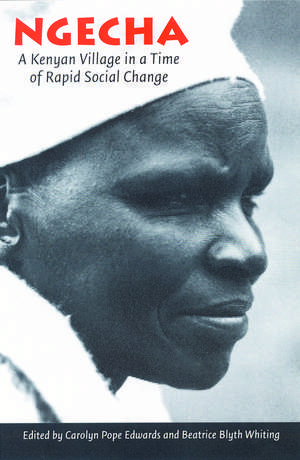
Ngecha: A Kenyan Village in a Time of Rapid Social Change
Editat de Carolyn Pope Edwards, Beatrice Blyth Whitingen Limba Engleză Hardback – iul 2004
Ngecha is the monumental and intimate study of modernization and nationalization in rural Africa in the early years following Kenyan independence in 1963, as experienced by the people of Ngecha, a village outside Nairobi. From 1968 to 1973 Ngecha was a research site of the Child Development Research Unit, a team that brought together Kenyan and non-Kenyan social scientists under the leadership of John Whiting and Beatrice Blyth Whiting.
The study documents how families adapted to changing opportunities and conditions as their former colony became a modern nation, and the key role that women played as agents of change as they became small-scale cash-crop farmers and entrepreneurs. Mothers modified the culture of their parents to meet the evolving national economy, and they participated in the shift from an agrarian to a wage economy in ways that transformed their workloads and perceptions of isolation and individualism within and between households, thereby challenging traditional family-based morals and obligations. Their children, in turn, experienced evolving educational practices and achievement expectations. The elders faced new situations as well as new modes of treatment. Completing this valuable record of a nation in transition are the long-term reassessments of the observations and conclusions of the research team, and a description of Ngecha today as viewed by Kenyans who participated in the original study.
Preț: 430.57 lei
Puncte Express: 646
Carte disponibilă
Livrare economică 28 octombrie-11 noiembrie
Livrare prin curier în România Termenul estimat este afișat lângă disponibilitate.
Transport gratuit pentru acest produs Plată online sau ramburs, în funcție de opțiunile comenzii.
Retur gratuit în 14 zile Comandă securizată și suport în română.
Specificații
ISBN-13: 9780803248090
ISBN-10: 0803248091
Pagini: 280
Ilustrații: Illus., Map
Dimensiuni: 162 x 234 x 28 mm
Greutate: 0.59 kg
Ediția:New.
Editura: Nebraska
Colecția University of Nebraska Press
Locul publicării:United States
ISBN-10: 0803248091
Pagini: 280
Ilustrații: Illus., Map
Dimensiuni: 162 x 234 x 28 mm
Greutate: 0.59 kg
Ediția:New.
Editura: Nebraska
Colecția University of Nebraska Press
Locul publicării:United States
V-ar putea interesa
-
 Wrapping in Images: Tattooing in PolynesiaAlfred Gell-34%Preț: 732.14 lei1103.07 lei
 -
 Personality: What makes you the way you areDaniel Nettle-19%Preț: 69.47 lei85.99 lei
 -
 Handbook of Theory and Research for the Sociology of EducationJohn G. Richardson-45%Preț: 348.18 lei630.10 lei
 -
 The Dance of LifeEdward T. HallPreț: 104.63 lei
 -
 Guns, Germs, and SteelJared DiamondPreț: 229.05 lei
 -
 Dictionary of SymbolsJ. C. CirlotPreț: 308.18 lei
 -
 -15%Preț: 484.96 lei570.54 lei
 -
 Beauty UpLaura MillerPreț: 276.72 lei
 -
 Communities of PracticeEtienne WengerPreț: 366.93 lei
 -
 The Botany of Desire: A Plant's-eye View of the WorldMichael Pollan-27%Preț: 77.52 lei106.85 lei
 -
 Intimate History of HumanityTheodore Zeldin-18%Preț: 75.56 lei92.66 lei
 -
 TotemismClaude Levi-StraussPreț: 120.56 lei
 -
 The Omnivore's DilemmaMichael PollanPreț: 171.25 lei
Notă biografică
Carolyn Pope Edwards is Willa Cather Professor and a professor of psychology and of family and consumer sciences at the University of Nebraska–Lincoln. Beatrice Blyth Whiting (1914–2003) was a professor of anthropology and education at Harvard University. Whiting and Edwards are co-authors of Children of Different Worlds: The Formation of Social Behavior.
Recenzii
“A tremendously exciting book. . . . offers many enticements to a Kenya scholar. Written in clear, lucid prose by a number of authors who have worked together intimately, the voices of the individual collaborators are molded into a smooth whole by the two editors, an anthropologist and psychologist, who also are the co-authors of all but three of the nine chapters. . . . This book is a must for any collection.”—Miroslava Prazak, African Studies Review
“Africanist scholars are known for applying multidisciplinary approaches to the research and teaching of Africa, and Ngecha: A Kenyan Village in a Tie of Rapid Social Change epitomizes the usefulness of such an approach. The authors of this study offer a blend of history, ethnography, anthropology, sociology, educational studies, and gender studies in a form accessible to scholars and students across a wide range of disciplines. . . . Ngecha is an incredibly rich contribution to African studies research, and scholars from all disciplines should find value in the text.” —Andrea L. Arrington, International Journal of African Historical Studies