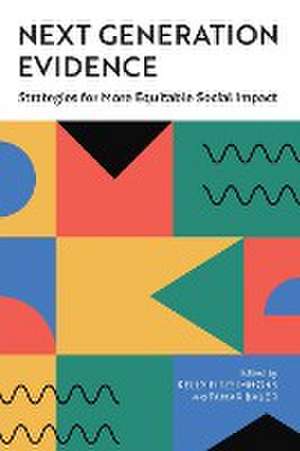
Next Generation Evidence: Strategies for More Equitable Social Impact
Editat de Kelly Fitzsimmons, Tamar Baueren Limba Engleză Paperback – 15 dec 2023
Evidence is remarkably powerful; it helps us understand the needs of communities, make decisions in times of change and scarcity, and build and do more of what works. However, practitioners face a number of structural and practical hurdles to building and using evidence. Traditional evaluation and research methods are often not timely, affordable, meaningful, or inclusive for helping practitioners make decisions to increase their impact for people and communities. Too often and for too long, evaluation was a thing done to practitioners and the communities they serve, relegating them to a passive role when they should be regarded as leaders of this work. Worse, their data and evidence has been used against them in disempowering thumbs-up, thumbs-down circumstances, rather than for learning and improvement that leads to impact.
Next Generation Evidence features innovative thinking from leaders across policy, philanthropy, research, and practice. Together, these leaders lay out a vision for a stronger, more equitable data and evidence ecosystem that centers on the voices of people and communities most directly impacted by the problems we seek to solve. Throughout the book, case studies featuring practitioners at various stages in their evidence-building journey highlight concrete illustrations of how continuous evidence building can benefit organizations and outcomes for communities.
The ebook editions of this book are available open access under a CC BY-NC-ND 4.0 licence on bloomsburycollections.com. Open access was funded by Brookings Institution.
Preț: 286.20 lei
Preț vechi: 367.01 lei
-22%
Puncte Express: 429
Carte tipărită la comandă
Livrare economică 05-19 decembrie
Livrare prin curier în România Termenul estimat este afișat lângă disponibilitate.
Transport gratuit de la 400.00 lei Plată online sau ramburs, în funcție de opțiunile comenzii.
Retur gratuit în 14 zile Comandă securizată și suport în română.
Specificații
ISBN-13: 9780815740537
ISBN-10: 0815740530
Pagini: 500
Ilustrații: 14 b/w illustrations;4 tables; 3 textboxes
Dimensiuni: 151 x 229 x 32 mm
Greutate: 0.73 kg
Editura: Bloomsbury Publishing
Colecția Brookings Institution Press
Locul publicării:New York, United States
ISBN-10: 0815740530
Pagini: 500
Ilustrații: 14 b/w illustrations;4 tables; 3 textboxes
Dimensiuni: 151 x 229 x 32 mm
Greutate: 0.73 kg
Editura: Bloomsbury Publishing
Colecția Brookings Institution Press
Locul publicării:New York, United States
V-ar putea interesa
-
 Burdens by WaterAlan RifkinPreț: 108.00 lei
 -
 Connaissez-vous les véritables motifs du projet de loi sur la police de la presse ?Benjamin-Louis BelletPreț: 79.18 lei
 -
 Nouveau Système TypographiqueFrançois-Paul Barletti de Saint-PaulPreț: 93.68 lei
 -
 Preț: 97.14 lei
 -
 Auguste Poulet-MalassisMaurice TourneuxPreț: 79.38 lei
 -
 Preț: 198.63 lei
 -
 Preț: 82.58 lei
 -
 Preț: 82.11 lei
 -
 Preț: 97.14 lei
 -
 Histoire critique des journaux. T01Denis-François CamusatPreț: 177.63 lei
 -
 Preț: 93.64 lei
 -
 Digitale AugenzeugenHolger IsermannPreț: 445.93 lei
 -
 Game Studies im Paradigma Virtueller RealitätFelix HanserPreț: 281.16 lei
 -
 Preț: 80.64 lei
 -
 Preț: 275.41 lei
 -
 Watzlawicks Axiome im Spannungsfeld interkultureller KommunikationAnn-Kristin MehnertPreț: 80.64 lei
 -
 Gatekeeper trifft auf modernen JournalismusLukas SorgePreț: 81.11 lei
 -
 Preț: 87.04 lei
Recenzii
Next Generation Evidence tackles an increasingly important set of questions for any of us, and our organizations, on our way to seeking improvements for all members of society. Their five key insights should be driving us as we do this work: we have to center practitioners and those they serve; embed equitable processes and outcomes; work directly with the communities we seek to serve to identify the right kinds of evidence for action; think of the work more like an "engineering" process, not "one and done"-continuous, evidence-grounded iteration in consultation with users and communities; and be prepared to think innovatively about what kinds of new evidence will help us take actions to improve outcomes for each member of the community. A wealth of examples from different arenas make these points and show how this work can be done better, and that it makes a measurable difference when done this way. For anyone intending to craft increasingly effective solutions to complex social problems, this is a terrific and insightful resource.
A powerful volume that is long overdue! Those of us who work with distressed communities welcome the book's practical insights about how to make evidence building and use more equitable and effective. The book is a must read for community-based organizations, philanthropy, and all working to drive better outcomes for our communities.
We have crossed the threshold into the "Data Age" and this book is a must-read to bring social impact evidence practices into the 21st century, where data is power. The book provides a comprehensive roadmap for practitioners, philanthropists, governments, and academia to make the changes necessary for this moment in time.
Next Generation Evidence is a powerful and much needed addition to the continuing national discussion about the importance of using evidence in improving our education system. Among other things it suggests ways that schools and districts can conduct research around their own activities along much shorter time horizons to test what is working and what needs to be refined, and how to take real-time action relative to implementation. The ideas presented are elegant and can make a tremendous difference for those who may think evidence gathering and synthesis are cumbersome and not useful, but who just want ways to know if a particular new approach is making the expected difference.
A reflective and revealing roadmap! Next Generation Evidence highlights the central-yet often overlooked-role practitioners play in building and using evidence for greater equity and impact, and illustrates how policymakers and philanthropy can provide practitioner leaders with the resources they need to drive outcomes. Featuring an impressive array of viewpoints, the book shows that regardless of issue area or approach, data and evidence capacities are critical for organizations that care about equity and evidence (and deserving of support from equity and evidence-minded funders).
This timely book offers an essential antidote to the too-often narrow discussions about evidence production and use in public policy and in practice. It reminds us that the processes involved in producing and making sense of evidence have social, economic, and political dimensions, and the essays eloquently establish how evidence can be used for social good, and how we might correct for how evidence use can sometimes cause further harm in this prolonged era of deep and racialized inequality by engaging more deeply with practitioners, communities, and policy makers.
Simply stated: this book is a must-read. The insight contained within these essays - presenting diverse reflections into the power and complexity of research, evidence, and practice - is more than just enlightening; it's a beacon for those of us committed to forging real and meaningful impacts on future social outcomes.
Next Generation Evidence puts compelling practitioner voices front and center to demonstrate how evidence and the practice of evidence building can be reimagined. It shows how embedding equity and elevating community voice can build trust, increase the practical use of evidence to drive better outcomes, and right-size the level of rigor. It is an accessible and expansive overview of the state of the field - both what it is today and the hope for what it might become.
Next Generation Evidence is a timely and essential compilation of ideas about innovation, equity, family engagement and cross-systems collaboration as drivers of transformation in the field of research and evidence building. Diverse voices illuminate facets of a powerful call to action: To build a brighter future for the nation's children and families, we must expand the approaches used to document the effectiveness of community-based wellness, health, justice and child welfare interventions, practices and services.
A powerful volume that is long overdue! Those of us who work with distressed communities welcome the book's practical insights about how to make evidence building and use more equitable and effective. The book is a must read for community-based organizations, philanthropy, and all working to drive better outcomes for our communities.
We have crossed the threshold into the "Data Age" and this book is a must-read to bring social impact evidence practices into the 21st century, where data is power. The book provides a comprehensive roadmap for practitioners, philanthropists, governments, and academia to make the changes necessary for this moment in time.
Next Generation Evidence is a powerful and much needed addition to the continuing national discussion about the importance of using evidence in improving our education system. Among other things it suggests ways that schools and districts can conduct research around their own activities along much shorter time horizons to test what is working and what needs to be refined, and how to take real-time action relative to implementation. The ideas presented are elegant and can make a tremendous difference for those who may think evidence gathering and synthesis are cumbersome and not useful, but who just want ways to know if a particular new approach is making the expected difference.
A reflective and revealing roadmap! Next Generation Evidence highlights the central-yet often overlooked-role practitioners play in building and using evidence for greater equity and impact, and illustrates how policymakers and philanthropy can provide practitioner leaders with the resources they need to drive outcomes. Featuring an impressive array of viewpoints, the book shows that regardless of issue area or approach, data and evidence capacities are critical for organizations that care about equity and evidence (and deserving of support from equity and evidence-minded funders).
This timely book offers an essential antidote to the too-often narrow discussions about evidence production and use in public policy and in practice. It reminds us that the processes involved in producing and making sense of evidence have social, economic, and political dimensions, and the essays eloquently establish how evidence can be used for social good, and how we might correct for how evidence use can sometimes cause further harm in this prolonged era of deep and racialized inequality by engaging more deeply with practitioners, communities, and policy makers.
Simply stated: this book is a must-read. The insight contained within these essays - presenting diverse reflections into the power and complexity of research, evidence, and practice - is more than just enlightening; it's a beacon for those of us committed to forging real and meaningful impacts on future social outcomes.
Next Generation Evidence puts compelling practitioner voices front and center to demonstrate how evidence and the practice of evidence building can be reimagined. It shows how embedding equity and elevating community voice can build trust, increase the practical use of evidence to drive better outcomes, and right-size the level of rigor. It is an accessible and expansive overview of the state of the field - both what it is today and the hope for what it might become.
Next Generation Evidence is a timely and essential compilation of ideas about innovation, equity, family engagement and cross-systems collaboration as drivers of transformation in the field of research and evidence building. Diverse voices illuminate facets of a powerful call to action: To build a brighter future for the nation's children and families, we must expand the approaches used to document the effectiveness of community-based wellness, health, justice and child welfare interventions, practices and services.