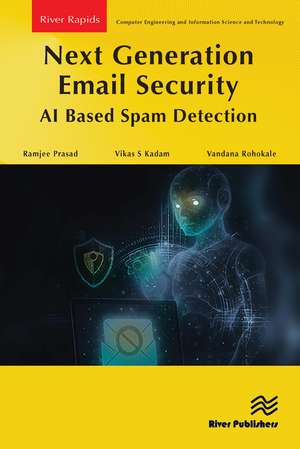
Next Generation Email Security: AI Based Spam Detection: River Publishers Rapids Series in Computer Engineering and Information Science and Technology
Editat de Ramjee Prasad, Vikas S Kadam, Vandana Rohokaleen Limba Engleză Paperback – 25 iun 2026
Key Features:
- Concise review of classical and AI-based spam detection.
- Innovative frameworks: FLIDA and G-SFO–ACapsNet.
- Insights into quantum paradigms for cybersecurity.
- Empirical evaluations and comparative performance analyses.
- Open research issues and future perspectives.


Preț: 573.27 lei
Preț vechi: 716.58 lei
-20%
Puncte Express: 860
Carte tipărită la comandă
Livrare economică 25 noiembrie-09 decembrie
Livrare prin curier în România Termenul estimat este afișat lângă disponibilitate.
Transport gratuit pentru acest produs Plată online sau ramburs, în funcție de opțiunile comenzii.
Retur gratuit în 14 zile Comandă securizată și suport în română.
Specificații
ISBN-13: 9788743810377
ISBN-10: 8743810373
Pagini: 164
Ilustrații: 26
Dimensiuni: 156 x 234 mm
Greutate: 0.24 kg
Ediția:1
Editura: River Publishers
Colecția River Publishers
Seria River Publishers Rapids Series in Computer Engineering and Information Science and Technology
ISBN-10: 8743810373
Pagini: 164
Ilustrații: 26
Dimensiuni: 156 x 234 mm
Greutate: 0.24 kg
Ediția:1
Editura: River Publishers
Colecția River Publishers
Seria River Publishers Rapids Series in Computer Engineering and Information Science and Technology
Public țintă
Academic, Postgraduate, and Professional Practice & DevelopmentNotă biografică
Dr. Ramjee Prasad’s accolades include authored books, chapters, 200+ peer-reviewed publications, and leadership roles in EU and US research initiatives. His career is defined by a relentless focus on secure, sustainable, and socially responsible solutions, principles he continues to advance through his entrepreneurial ventures and global partnerships. Ramjee Prasad, Fellow IEEE, IET, IETE, and WWRF, is a former Professor Emeritus of Future Technologies for Business Ecosystem Innovation (FT4BI) in the Department of Business Development and Technology, Aarhus University, Herning, Denmark. He is the Founder President of the CTIF Global Capsule (CGC) and the Founder Chairman of the Global ICT Standardization Forum for India, established in 2009. He was honored by the University of Rome “Tor Vergata,” Italy as a Distinguished Professor of the Department of Clinical Sciences and Translational Medicine in 2016. He is an Honorary Professor at the University of Cape Town, South Africa and the University of KwaZulu-Natal, South Africa, and also an Adjunct Professor at Birsa Institute of Technology, Sindri, Jharkhand, India. He received Pravasi Bhartiya Samman Puraskaar (Emigrant Indian Honor Award by the Indian President) in 2023 and the Ridderkorset of Dannebrogordenen (Knight of the Dannebrog) in 2010 from the Danish Queen for the internationalization of top-class telecommunication research and education. He has received several international awards such as the IEEE Communications Society Wireless Communications Technical Committee Recognition Award in 2003 for making a contribution in the field of “Personal, Wireless and Mobile Systems and Networks,” Telenor’s Research Award in 2005 for impressive merits, both academic and organizational within the field of wireless and personal communication, and 2014 IEEE AESS Outstanding Organizational Leadership Award for “Organizational Leadership in developing and globalizing the CTIF (Center for TeleInFrastruktur) Research Network”. He has been the Project Coordinator of several EC projects, namely, MAGNET, MAGNET Beyond, and eWALL. He has published more than 50 books, 1000 plus journal and conference publications, more than 15 patents, over 150 Ph.D. Graduates and a larger number of masters (over 250). Several of his students are today’s worldwide telecommunication leaders themselves
Dr. Vikas Kadam is an accomplished researcher and Associate Professor in the Information Technology Department at Marathwada Mitra Mandal’s College of Engineering, Pune. His research primarily focuses on cybersecurity, machine learning, and deep learning algorithms, with a special emphasis on spam detection using advanced machine learning techniques. He has contributed significantly to the field through several high-impact publications, including “Enhancement of Email Spam Detection Using Improved Deep Learning Algorithms for Cyber Security” published in the Journal of Computer Security (2022) and “A Hybrid Meta-Heuristic-Based Multi-Objective Feature Selection with Adaptive Capsule Network for Automated Email Spam Detection” in the International Journal of Intelligent Robotics and Applications (2022). His latest work, “Designing a Novel Framework of Email Spam Detection Using an Improved Heuristic Algorithm and Dual-Scale Feature Fusion-Based Adaptive Convolution Neural Network”, was published in Information Security Journal: A Global Perspective (2025). Dr. Kadam holds a Ph.D. in Spam Detection Using Machine Learning Algorithms and was recognized for his excellence with the EMC² Star Performer Award in 2015. His research continues to contribute toward enhancing cybersecurity frameworks and intelligent systems, helping address critical challenges in digital communication security.
Vandana Rohokale received her B.Eng. degree in Electronics Engineering in 1997 from Pune University, Maharashtra, India. She received her master’s degree in Electronics in 2007 from Shivaji University, Kolhapur, Maharashtra, India. She received her Ph.D. degree in Wireless Communication in 2013 from CTIF, Aalborg University, Denmark. She completed her post doctorate from ARHUS University under the guidance of Prof. Ramjee Prasad in 2023. She is presently working as Professor and Vice Principal in Sinhgad Institute of Technology and Science, Pune, Maharashtra, India. Her teaching experience is around 28 years. She has published four books with international publishers. She has published around 60 plus papers in various international journals and conferences. Her research interests include cooperative wireless communications, adhoc and cognitive networks, physical layer security, digital signal processing, information theoretic security and its applications, cyber security, artificial intelligence and machine learning, quantum computing, etc
Dr. Vikas Kadam is an accomplished researcher and Associate Professor in the Information Technology Department at Marathwada Mitra Mandal’s College of Engineering, Pune. His research primarily focuses on cybersecurity, machine learning, and deep learning algorithms, with a special emphasis on spam detection using advanced machine learning techniques. He has contributed significantly to the field through several high-impact publications, including “Enhancement of Email Spam Detection Using Improved Deep Learning Algorithms for Cyber Security” published in the Journal of Computer Security (2022) and “A Hybrid Meta-Heuristic-Based Multi-Objective Feature Selection with Adaptive Capsule Network for Automated Email Spam Detection” in the International Journal of Intelligent Robotics and Applications (2022). His latest work, “Designing a Novel Framework of Email Spam Detection Using an Improved Heuristic Algorithm and Dual-Scale Feature Fusion-Based Adaptive Convolution Neural Network”, was published in Information Security Journal: A Global Perspective (2025). Dr. Kadam holds a Ph.D. in Spam Detection Using Machine Learning Algorithms and was recognized for his excellence with the EMC² Star Performer Award in 2015. His research continues to contribute toward enhancing cybersecurity frameworks and intelligent systems, helping address critical challenges in digital communication security.
Vandana Rohokale received her B.Eng. degree in Electronics Engineering in 1997 from Pune University, Maharashtra, India. She received her master’s degree in Electronics in 2007 from Shivaji University, Kolhapur, Maharashtra, India. She received her Ph.D. degree in Wireless Communication in 2013 from CTIF, Aalborg University, Denmark. She completed her post doctorate from ARHUS University under the guidance of Prof. Ramjee Prasad in 2023. She is presently working as Professor and Vice Principal in Sinhgad Institute of Technology and Science, Pune, Maharashtra, India. Her teaching experience is around 28 years. She has published four books with international publishers. She has published around 60 plus papers in various international journals and conferences. Her research interests include cooperative wireless communications, adhoc and cognitive networks, physical layer security, digital signal processing, information theoretic security and its applications, cyber security, artificial intelligence and machine learning, quantum computing, etc
Cuprins
1. Introduction 2. Email Spam Detection Models Overview 3. Email Spam Detection Approach I 4. Performance Analysis of FLIDA 5. Email Spam Detection Approach II: Adaptive Capsule Network based - An Automated Email Spam Detection Approach 6. Performance Analysis of G-SFO with Acaps Network 7. Comparative Analysis 8. Quantum Machine Learning for Email Spam Detection 9. Conclusion and Future Scope
Descriere
The book presents AI-driven solutions for securing email systems against spam, phishing and malware. It introduces FLIDA and G-SFO with adaptive capsule networks while offering insights into quantum machine learning for scalable cybersecurity.