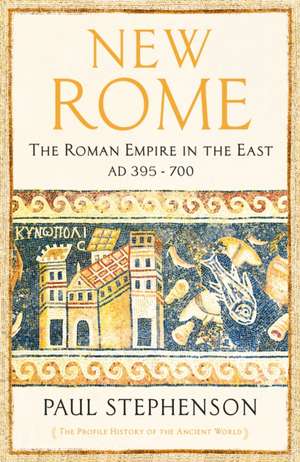
New Rome: The Roman Empire in the East, AD 395 - 700 - Longlisted for the Anglo-Hellenic Runciman Award: The Profile History of the Ancient World Series
Autor Paul Stephensonen Limba Engleză Hardback – 6 ian 2022
Preț: 177.19 lei
Preț vechi: 221.17 lei
-20% Precomandă
Puncte Express: 266
Carte nepublicată încă
Livrare prin curier în România Precomanda se expediază când titlul devine disponibil.
Transport gratuit de la 400.00 lei Plată online sau ramburs, în funcție de opțiunile comenzii.
Retur gratuit în 14 zile Comandă securizată și suport în română.
Doresc să fiu notificat când acest titlu va fi disponibil:
Se trimite...
Specificații
ISBN-13: 9781781250075
ISBN-10: 1781250073
Pagini: 464
Ilustrații: 16pp colour plate section, B&W integrated images and maps
Dimensiuni: 160 x 238 x 44 mm
Greutate: 0.74 kg
Ediția:Main
Editura: Profile
Colecția Profile Books
Seria The Profile History of the Ancient World Series
Locul publicării:London, United Kingdom
ISBN-10: 1781250073
Pagini: 464
Ilustrații: 16pp colour plate section, B&W integrated images and maps
Dimensiuni: 160 x 238 x 44 mm
Greutate: 0.74 kg
Ediția:Main
Editura: Profile
Colecția Profile Books
Seria The Profile History of the Ancient World Series
Locul publicării:London, United Kingdom
V-ar putea interesa
-
 -26%Preț: 84.52 lei114.36 lei
 -
 Preț: 156.14 lei
 -
 Skin in the GameNassim Nicholas TalebPreț: 84.94 lei
Notă biografică
Paul Stephenson has held teaching and research posts at universities, museums and institutes around the world, including at the Metropolitan Museum of Art, New York, and Princeton University. He has held chairs at the Universities of Wisconsin, Nijmegen and Durham. He is author or editor of ten books, including Constantine: Unconquered Emperor, Christian Victor.
Recenzii
Conventional histories of the last days of the Roman Empire will no longer suffice after you read this book.
Wonderful ... Total history at its very best.
The most compelling fusion yet of narrative history with the recent findings of environmental research and scientific data.
Stephenson's gift for narrative is matched by an eye for arresting images and quirky anecdotes that will surprise and delight even jaded readers.
Casts brilliant shafts of light on the material conditions and spiritual quests of the ruling and the ruled ... masterly
A new book from the historian Paul Stephenson centers on the Byzantine world in the period 395-700 A.D., combining modern scientific methods with traditional history to explain which parts of Rome migrated east and what became of them.
A wonderfully sharp eye for data and detail. ... A sobering but fascinating history. Not for a long time has a book surprised me as much as this one did. ... I have been quoting passages and surprising facts to everyone around me ever since putting it down.
Stephenson explores evidence of climate change caused by volcanic eruption and earthquakes not so much as an engine for political change as a permanent threat to the human environment ... [he] draws with great skill and an eye for detail on the stories embedded in surviving papyri, on laws, and on saints' lives.
Wonderful ... Total history at its very best.
The most compelling fusion yet of narrative history with the recent findings of environmental research and scientific data.
Stephenson's gift for narrative is matched by an eye for arresting images and quirky anecdotes that will surprise and delight even jaded readers.
Casts brilliant shafts of light on the material conditions and spiritual quests of the ruling and the ruled ... masterly
A new book from the historian Paul Stephenson centers on the Byzantine world in the period 395-700 A.D., combining modern scientific methods with traditional history to explain which parts of Rome migrated east and what became of them.
A wonderfully sharp eye for data and detail. ... A sobering but fascinating history. Not for a long time has a book surprised me as much as this one did. ... I have been quoting passages and surprising facts to everyone around me ever since putting it down.
Stephenson explores evidence of climate change caused by volcanic eruption and earthquakes not so much as an engine for political change as a permanent threat to the human environment ... [he] draws with great skill and an eye for detail on the stories embedded in surviving papyri, on laws, and on saints' lives.