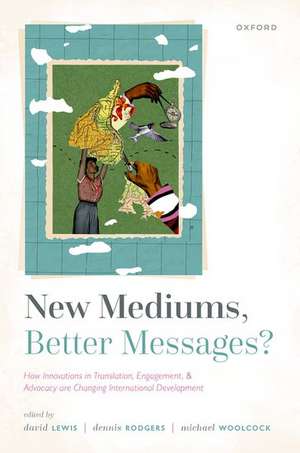
New Mediums, Better Messages?: How Innovations in Translation, Engagement, and Advocacy are Changing International Development
Editat de David Lewis, Dennis Rodgers, Michael Woolcocken Limba Engleză Hardback – 15 iun 2022
Preț: 546.76 lei
Preț vechi: 719.61 lei
-24%
Puncte Express: 820
Carte disponibilă
Livrare economică 13-18 noiembrie
Livrare prin curier în România Termenul estimat este afișat lângă disponibilitate.
Transport gratuit pentru acest produs Plată online sau ramburs, în funcție de opțiunile comenzii.
Retur gratuit în 14 zile Comandă securizată și suport în română.
Specificații
ISBN-13: 9780198858751
ISBN-10: 0198858752
Pagini: 276
Dimensiuni: 163 x 240 x 20 mm
Greutate: 0.59 kg
Editura: OUP OXFORD
Colecția OUP Oxford
Locul publicării:Oxford, United Kingdom
ISBN-10: 0198858752
Pagini: 276
Dimensiuni: 163 x 240 x 20 mm
Greutate: 0.59 kg
Editura: OUP OXFORD
Colecția OUP Oxford
Locul publicării:Oxford, United Kingdom
Notă biografică
David Lewis teaches at the London School of Economics and Political Science, where he has specialized in development issues in South Asia, with a particular focus on Bangladesh. An anthropologist by background, he is author of Bangladesh: Politics, Economy and Civil Society (Cambridge University Press, 2011), Non-Governmental Organizations, Management and Development (Routledge, 2014) and co-author with Katy Gardner of Anthropology and Development: Challenges for the Twenty First Century (Pluto, 2015).Dennis Rodgers is Research Professor in Anthropology and Sociology at the Graduate Institute of International and Development Studies, Geneva, Switzerland. His research focuses principally on issues relating to the dynamics of conflict and violence in cities, with tangents on the historiography of urban theory and popular representations of development. In 2018, he was awarded an ERC Advanced Grant for a project on "Gangs, Gangsters, and Ganglands: Towards a Comparative Global Ethnography" (GANGS), which aims to systematically compare gang dynamics in Nicaragua, South Africa, and France. He previously held appointments at the Universities of Amsterdam, Glasgow, Manchester, and the London School of Economics.Michael Woolcock is Lead Social Scientist in the World Bank's Development Research Group, and an Adjunct Lecturer in Public Policy at Harvard Kennedy School. He has published numerous articles and books across several sub-fields of international development, including conflict dynamics, social theory, legal reform, research methods, state capability, and popular culture. An Australian national, he has a PhD in comparative historical sociology from Brown University.
Cuprins
- Introduction: Innovations in translation, advocacy, and engagement in global development
- Part I: Translation
- 1: David Lewis, Dennis Rodgers, and Michael Woolcock: The sounds of development: Musical representations as (an)other source of development knowledge
- 2: Danny Hoffman: The pedagogy of trash: Photography, environmental activism, and African dumpsites
- 3: Mark Ralph-Bowman: Writing a development play: 'The Soft Bulldozer', or the subtle smashing of self-empowerment
- 4: Hilary Standing: Entering the fictional world of development: Writers, readers, and representations
- Part II: Advocacy
- 5: Duncan Green and Maria Faciolince: From poverty to power: A blogger's story
- 6: Jolene Fisher: Playing for change: Global development and digital games
- 7: Emily Le Roux-Rutledge: Women saving the world: Narratives of gender and development on global radio
- 8: Ben Jones: 'Being in the spotlight is not something that we are used to': Awkward encounters in The Guardian's Katine initiative
- Part III: Engagement
- 9: Shahpar Selim: Allah megh de: Culture and climate struggles in Bangladesh
- 10: Caroline Sage: Contemporary arts festivals in Nigeria and Nepal: Reclaiming and reimagining development discourse
- 11: Sophie Harman: Who consumes? How the represented respond to popular representations of development
- 12: Patrick Kabanda: The arts in the economy and the economy in the arts