Cantitate/Preț
Produs

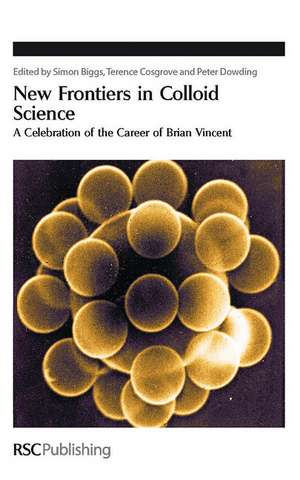
New Frontiers in Colloid Science

Editat de Simon Biggs, Terence Cosgrove, Peter Dowding
en Limba Engleză Hardback – 24 iul 2008

Considerăm acest volum, New Frontiers in Colloid Science, o lucrare de tip simpozion esențială pentru înțelegerea evoluției chimiei fizice moderne. Structura cărții este concepută ca un omagiu adus carierei prodigioase a profesorului Brian Vincent, îmbinând armonios rigoarea academică a fundamentelor cu aplicațiile industriale practice. Volumul se deschide cu o retrospectivă detaliată a contribuțiilor lui Vincent, de la sinteza particulelor la interacțiunile electrostatice, urmată de o serie de contribuții științifice de vârf care explorează noi frontiere în domeniu. Subliniem faptul că această lucrare nu este doar o privire spre trecut, ci un instrument de referință activ. Capitolele acoperă subiecte diverse, de la utilizarea polimerilor în misiunea spațială CASSINI, până la dezvoltarea emulsiilor pentru livrarea medicamentelor. Abordarea este una multidisciplinară, reflectând colaborările extinse ale profesorului Vincent cu industrii variate, precum cea farmaceutică, petrochimică și a vopselelor. New Frontiers in Colloid Science acoperă aceeași arie tematică precum Surface and Colloid Science de Fernando Galembeck, însă se diferențiază printr-o perspectivă mai personală și o focalizare specifică pe moștenirea științifică a grupului de la Bristol, oferind detalii despre evoluția conceptelor de-a lungul a patru decenii. Credem că progresia capitolelor, de la sinteza microgelurilor la modificarea suprafețelor, indică o acoperire exhaustivă a fenomenelor de interfață. Ritmul textului este unul dens, specific literaturii de specialitate, fiind susținut de date experimentale solide și referințe bibliografice bogate. Este o resursă care documentează tranziția de la cercetarea fundamentală la soluții tehnologice complexe, fiind indispensabilă oricărui laborator de chimie coloidală.

Citește tot Restrânge

Preț: 77946 lei

Preț vechi: 90635 lei
-14%

Puncte Express: 1169

Carte disponibilă

Livrare economică 31 august-14 septembrie

Livrare prin curier în România Termenul estimat este afișat lângă disponibilitate.
Transport gratuit pentru acest produs Plată online sau ramburs, în funcție de opțiunile comenzii.
Retur gratuit în 14 zile Comandă securizată și suport în română.

Specificații

ISBN-13: 9780854041138
ISBN-10: 0854041133
Pagini: 212
Dimensiuni: 162 x 242 x 24 mm
Greutate: 0.48 kg
Editura: Royal Society Of Chemistry

De ce să citești această carte

Recomandăm această carte cercetătorilor și studenților care doresc să înțeleagă profunzimea științei coloizilor prin prisma unuia dintre pionierii săi, Brian Vincent. Cititorul câștigă acces la o colecție unică de studii ce variază de la nanotehnologie la aplicații aerospațiale, oferind un model de succes despre cum teoria fundamentală poate rezolva probleme industriale reale. Este, în esență, o hartă a inovației în chimia interfețelor.


Despre autor

Editorul principal, Simon Biggs, deși cunoscut în prezent pentru activitatea sa în gerontologie socială la Keele University, are o experiență vastă în lucrul cu comunitățile academice și profesionale. În acest volum, el colaborează cu specialiști precum Terence Cosgrove și Peter Dowding pentru a onora activitatea lui Brian Vincent. Deși alte lucrări ale sale, precum Generational Intelligence sau Ageing and Diversity, explorează dinamica socială și diversitatea îmbătrânirii, prezența sa ca editor în acest volum de chimie subliniază capacitatea de a coordona contribuții interdisciplinare complexe și de a structura cunoașterea academică la cel mai înalt nivel.


Descriere scurtă

Professor Brian Vincent is a leading light in colloid science both in the UK and internationally. The science Brian has been involved in has influenced many areas of colloids both academically and industrially. He has collaborated with many sectors of industry (including pharmaceuticals, petrochemicals, agrochemicals, personal products, laundry products, paints and coatings). Brian has also been an active member of both the RSC and the SCI and has collaborated with many universities in the UK and overseas. Brian Vincent retired from the position of Leverhulme Professor of Physical Chemistry at the University of Bristol at the end of 2007 after a long and distinguished career which started as a chemistry undergraduate in Bristol in 1961. After obtaining a 1st class honours degree in Chemistry and an MSc in Surface Chemistry and Colloids and a PhD, Brian then moved to Wageningen to work in Hans Lyklema's laboratory on a Royal Society Fellowship. This was to be the start of a lifelong friendship and scientific collaboration with the Colloid and Physical Chemistry Group there. After returning to the UK in 1969, Brian had a succession of top posts and appointments culminating in 1993 when he became the 5th Leverhulme Professor in Physical Chemistry. In 1994, together with Dr Jim Goodwin, Brian founded the very successful Bristol Colloid Centre, an organisation which carries out short-term research and consultancy work for industry. Brian has received many honours including the SCI Founder's Lecture and Award, the SCI Distinguished Service Award, the RSC award in Surface and Colloid Chemistry and the Rehbinder Lecture and Medal (Moscow). He has had numerous invitations to give lectures throughout the world and has published over 250 papers, articles, books and patents during his career. He has also been very active at the academic /industry interface and has been a consultant for many of the leading companies that use colloid technology worldwide. This unique book is effectively a compendium of Brian's research, complemented by contributions on current topics in colloids by some of the leading scientists in the field. It provides an overview of the broad spectrum of colloid and interface science in which Brian has been a research pioneer for many years. The contributors to this symposium volume comprise a selection of Brian's past students and postdocs who have themselves pursued academic careers and other colleagues with whom he has worked extensively, all of whom are of international standing in colloid science and as such make this book an invaluable reference tool. The book backs up a meeting organised jointly by the RSC Colloid and Interface Science Group and the SCI Colloid & Surface Science Group and covers topics such as: " The Adsorption of Small, Negative Particles onto Large Positive Particles " Polymer Chemistry, Hypervelocity Physics and the CASSINI Space Mission " The BV Droplets Downunder: From Model Emulsions to Drug Delivery " Polymers and Surfactants at Interfaces " Controlled Release as Desorption from Porous Polymeric Systems " Characterisation and Application of Colloidal Micorogels " Surface Modification The range of the subject material highlights Brian's own very broad interests in colloid science; it also reflects his long-standing interest in both the academic fundamentals as well as practical applications of the subject. The volume is dedicated to Brian in recognition of his considerable contribution to the world of colloid science and to the guidance and inspiration he has given to many future generations of colloid scientists. However, the book is not just reflective, but provides insight into new areas in which colloid science is being applied. It has specific appeal to both colloid scientists in academia and industry who will find this book fascinating as well as an indispensable reference tool.

Cuprins

Foreword; 1- A Journey through Colloid Science; Early Days; Novel Colloidal Systems; Particle Synthesis; Particles with terminally-grafted polymer chains; Electrically -conducting particles; Microemulsions based on block or graft copolymers; Monodisperse Liquid Droplets; Liquid core / solid shell particles; Microgel Particles; Particle Interactions; Electrostatic interactions; Polymers at interfaces and steric interactions; Depletion interactions; Interactions in mixed particle systems; Deposition of particles on flat surfaces; Final Remarks; References; 2- Synthesis of Poly-N-Isopropylacrylamide microgel particles containing gold nanoshell cores with potential for triggered de-swelling; Abstract; Introduction; Materials and Methods; Preparation of silica particles; Preparation of positively charged silica particles; Preparation of Gold nanoparticles; Attachment of gold nanoparticles to silica cores; Growth of gold nanoshells; Synthesis of hydrogel-coated gold or gold nanoshells; Results and Discussion; Adsorption of Gold nanoparticles onto positively charged silica particles; Concluding Remarks; References; 3- Polymer Chemistry, Hypervelocity Physics and the CASSINI Space Mission; Introduction; Organic conducting polymers; Synthesis and properties of polypyrrole; Hypervelocity acceleration experiments; Do plasma mass spectra originate from the latex core or shell? Kinetic energy of a hypervelocity impact; The CASSINI space mission and the CDA adaptor; Four classes of micrometeorites; What is the nature of the volcanic activity on Io? Latex mimics for sulphur-rich micrometeorites; Conclusions; 4- From Novel Monodisperse "Silicone Oil"/Water Emulsions to Drug Deliver; Abstract; Background; Introduction; Interaction Forces and Deformation of PDMS Droplets; Rheological Behavior of concentrated emulsions of PDMS Droplets; Polymers at Silicone Droplets Interfaces; Nanoparticles at PDMS Droplets; Towards a drug delivery system; Conclusions; Acknowledgements; References; 5- Polymers and surfactants at interfaces: colloidal lego for nanotechnology; Introduction; Self-assembly of block copolymers and the formation of "smart colloids"; Adsorption of block copolymer micelles at the aqueous/ solid interface; Responsive and functional surfaces; Multilayer coatings, particles and capsules; Conclusions; Acknowledgements; References; 6- Polymer depletion: recent progress for polymer/colloid phase diagrams; Abstract; Introduction; Theory; System and system parameters; Thermodynamics; Some illustrations; Results; Concluding remarks; References; 7- NanoBubbles, dissolved gas, boundary layers and related mysterious effects in colloidal stability; Abstract; Introduction; Results and Discussion; Stability ratio as a function of dissolved gas and hydrophobicity; Colloid Stability Analysis; TMAFM Imaging; Images of Bubble Coalescence; Nature of Domains; Bubble Formation on Solid-Water Interfaces; Contact angles and line tension; Kinetics of CO2 gas adsorption using the QCM; Conclusions; Acknowledgement; References; 8- Heteroflocculation studies of colloidal poly(N-isopropylacrylamide) microgels with polystyrene latex particles: effect of particle size, temperature and surface charge; Abstract; Introduction and background; Heterflocculation studies; Experimental; Microgel synthesis; Dry weight analysis; Preparation of anionic polystyrene latex and cationic microgel mixed dispersions; Dynamic light scattering (DLS); Electrophoretic mobility and zeta potential measurements; Turbidimetric analysis; Scanning electron microscopy (SEM); Results and Discussion; Scanning electron microscopy (SEM); Characterisation of anionic PS latex particles; Heteroflocculation of microgel-latex mixtures; Concluding remarks; 9- Surface Modification, Encapsulation and Coating- A Career built on Graft; Abstract; The early years: Colloid science, zeta potential and polymers; The dark side: Black boxes, sunscreens and hope-in-a-bottle; Back to the future: Colloid science, vaccines, microbicides and HIV/ AIDS; Conclusions; Acknowledgements; References

Notă biografică

Peter J Dowding, a Fellow of the Royal Society of Chemistry, is Principal Scientist at Infineum UK Limited an Exxon & Shell joint venture. He is leader for all background and fundamental studies of colloidal additives for future generations of additives used in lubricants and his research interests include: Surfactant Stabilised Nanoparticles, Steric Stabilisation, Surfactancy, Controlled Release, Supercritical Fluids and Properties of Asphaltenes. Terence Cosgrove is Professor at the School of Chemistry, University of Bristol. Simon Biggs is Professor of Particle Science and Engineering, Institute for Particle Science and Engineering, The University of Leeds and is a Fellow of the Royal Society of Chemistry, a member of the American Chemical Society, the International Association of Colloid and Interface Scientists, and the Royal Australian Chemical Society. His main research interests are in the field of colloid and interface science and he is recognised as a pioneer in the application of atomic force microscopy to the study of colloid and particle science. A significant number of his published papers were the first of their kind in the open literature - especially the work on the influence of polymers and surfactants on inter-particle forces.

Descriere

A summary of the career of Brian Vincent, a recognised expert in the field of colloid science, as well as an autobiographical summary of his impact on the field.