
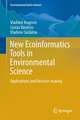
New Ecoinformatics Tools in Environmental Science: Applications and Decision-making: Environmental Earth Sciences
Autor Vladimir F. Krapivin, Costas A. Varotsos, Vladimir Yu. Soldatoven Limba Engleză Paperback – 6 oct 2016
| Toate formatele și edițiile | Preț | Express |
|---|---|---|
| Paperback (1) | 936.96 lei 6-8 săpt. | |
| Springer International Publishing – 6 oct 2016 | 936.96 lei 6-8 săpt. | |
| Hardback (1) | 943.34 lei 6-8 săpt. | |
| Springer International Publishing – 3 feb 2015 | 943.34 lei 6-8 săpt. |
Din seria Environmental Earth Sciences
- 18%
 Preț: 1823.47 lei
 - 18%
 Preț: 1180.81 lei
 - 18%
 Preț: 911.78 lei
 - 15%
 Preț: 613.80 lei
 - 18%
 Preț: 1187.36 lei
 - 15%
 Preț: 615.35 lei
 - 18%
 Preț: 943.34 lei
 - 15%
 Preț: 616.15 lei
 - 18%
 Preț: 972.17 lei
 - 18%
 Preț: 705.86 lei
 - 15%
 Preț: 663.14 lei
 - 15%
 Preț: 674.37 lei
 - 15%
 Preț: 689.13 lei
 - 18%
 Preț: 2383.38 lei
 -
 Preț: 401.33 lei
Preț: 936.96 lei
Preț vechi: 1142.63 lei
-18%
Puncte Express: 1405
Preț estimativ în valută:
165.68€ • 190.03$ • 143.24£
165.68€ • 190.03$ • 143.24£
Carte tipărită la comandă
Livrare economică 29 aprilie-13 mai
Specificații
ISBN-13: 9783319362151
ISBN-10: 3319362151
Pagini: 936
Ilustrații: XXXIII, 903 p. 289 illus., 120 illus. in color.
Dimensiuni: 155 x 235 x 47 mm
Greutate: 1.29 kg
Ediția:Softcover reprint of the original 1st ed. 2015
Editura: Springer International Publishing
Colecția Springer
Seria Environmental Earth Sciences
Locul publicării:Cham, Switzerland
ISBN-10: 3319362151
Pagini: 936
Ilustrații: XXXIII, 903 p. 289 illus., 120 illus. in color.
Dimensiuni: 155 x 235 x 47 mm
Greutate: 1.29 kg
Ediția:Softcover reprint of the original 1st ed. 2015
Editura: Springer International Publishing
Colecția Springer
Seria Environmental Earth Sciences
Locul publicării:Cham, Switzerland
V-ar putea interesa
-
 Preț: 333.64 lei
 -
 Asian Mobilities Consumption in a Changing ArcticYoung-Sook Lee-18%Preț: 1067.29 lei1301.56 lei
 -
 Preț: 334.93 lei
 -
 -15%Preț: 415.25 lei488.53 lei
 -
 Conservation of Medicinal PlantsOlayiwola AkerelePreț: 432.19 lei
 -
 The Arctic and Antarctic: Their Division into Geobotanical AreasVera D. AleksandrovaPreț: 320.70 lei
 -
 Preț: 154.81 lei
 -
 -15%Preț: 411.40 lei484.00 lei
 -
 Ecomobilities: Driving the Anthropocene in Popular CinemaMichael W. Pesses-34%Preț: 491.93 lei744.23 lei
 -
 Microwave Remote Sensing Tools in Environmental ScienceCostas A. Varotsos-18%Preț: 1016.26 lei1239.34 lei
 -
 -18%Preț: 1081.77 lei1319.24 lei
 -
 -15%Preț: 567.09 lei667.17 lei
 -
 Design di involucri ad alta efficienza energeticaNazzareno VivianiPreț: 393.78 lei
 -
 Preț: 318.56 lei
 -
 Progettazione digestione anaerobica ad umido e a secco della FORSUMaria Beatrice Ostuni-8%Preț: 381.53 lei414.71 lei
 -
 Aprovechamiento de residuos mediante compostaje en una instituciónXimena Maria Vargas RamirezPreț: 318.96 lei
 -
 Vigas de Madera de Sección Compuesta Reforzadas con GuaduaGeovanny Rayo MoralesPreț: 318.96 lei
 -
 -8%Preț: 413.26 lei449.21 lei
 -
 Global Carbon Cycle and Climate ChangeKirill Y. Kondratyev-18%Preț: 912.25 lei1112.50 lei
 -
 Atmospheric Aerosol Properties: Formation, Processes and ImpactsKirill Ya. Kondratyev-18%Preț: 1187.36 lei1448.00 lei
 -
 Natural Disasters as Interactive Components of Global-EcodynamicsKirill Ya. Kondratyev-18%Preț: 1187.79 lei1448.52 lei
 -
 Global Environmental Change: Modelling and MonitoringKirill Y. Kondratyev-18%Preț: 1165.92 lei1421.85 lei
 -
 Biogeochemical Cycles in Globalization and Sustainable DevelopmentVladimir F. Krapivin-18%Preț: 1181.84 lei1441.27 lei
 -
 Global Climatology and Ecodynamics: Anthropogenic Changes to Planet EarthArthur Philip Cracknell-18%Preț: 1754.77 lei2139.96 lei
 -
 Global EcodynamicsKirill Y. Kondratyev-18%Preț: 935.11 lei1140.38 lei
 -
 Fitorremediación de Aguas Residuales con Canna ÍndicaAuxilia Dolores Mallia-MinioPreț: 251.48 lei
 -
 Construcción de Tablestacados Metálicos en Ingeniería PortuariaManuel Dekar Vidal CruzPreț: 314.44 lei
Cuprins
Information-modeling technology for the environmental monitoring.- Remote-sensing technologies and data processing algorithms.- Environmental decision-making.- Ecoinformatics problems of the world ocean.- Ecoinformatics problems of global climate change.- The Arctic environmental problems.- Tropical cyclogenesis and ecoinformatics methods.- Ecoinformatics and soil-plant formations.- Operational diagnostics, estimation of the scale of damage and aftermath reduction of stressful natural processes.- Ecoinformatics problems in the future world.
Textul de pe ultima copertă
This book provides new insights on the study of global environmental changes using the ecoinformatics tools and the adaptive-evolutionary technology of geoinformation monitoring. The main advantage of this book is that it gathers and presents extensive interdisciplinary expertise in the parameterization of global biogeochemical cycles and other environmental processes in the context of globalization and sustainable development. In this regard, the crucial global problems concerning the dynamics of the nature-society system are considered and the key problems of ensuring the system’s sustainable development are studied. A new approach to the numerical modeling of the nature-society system is proposed and results are provided on modeling the dynamics of the system’s characteristics with regard to scenarios of anthropogenic impacts on biogeochemical cycles, land ecosystems and oceans. The main purpose of this book is to develop a universal guide to information-modeling technologies for assessing the function of environmental subsystems under various climatic and anthropogenic conditions.
Caracteristici
Presents an algorithm for detecting tropical cyclones Discusses information-modeling technologies for reconstructing environmental subsystems Demonstrates methods of detecting heat sources in forest areas Includes supplementary material: sn.pub/extras