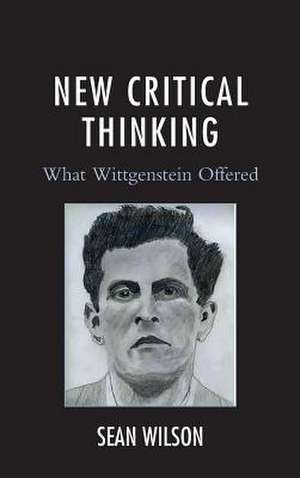
New Critical Thinking
Autor Sean Wilsonen Limba Engleză Hardback – 22 oct 2018
Wittgenstein didn't leave us "philosophy"; he left a pathway for a more perspicuous intellect. This was caused by a psychological condition that made him meticulous and hypersensitive. He could abnormally perceive three natural phenomena: (a) the social traits implicated in word use; (b) the task-functions signified in communication; and (c) the pictures that flash before the mind's eye. With this unique acuity, he showed us how post-analytic thinking was to occur.
And this discovery changes everything. It revolutionizes how we must argue with one another and what we believe is "true." Instead of focusing primarily upon premises or facts, we must point people to how their intellect behaves during a speech act-something called "therapy." And this has radical implications for analysis, conceptual investigation, value judgments, political ideology, ethics and even religion.
This book is both an explanation of, and a blueprint for, the new critical thinking. Written for both a lay and special audience, and for all fields of study, it shows what Wittgenstein invented and how it affects us all.
Preț: 683.19 lei
Preț vechi: 803.75 lei
-15%
Puncte Express: 1025
Carte tipărită la comandă
Livrare economică 05-19 decembrie
Livrare prin curier în România Termenul estimat este afișat lângă disponibilitate.
Transport gratuit pentru acest produs Plată online sau ramburs, în funcție de opțiunile comenzii.
Retur gratuit în 14 zile Comandă securizată și suport în română.
Specificații
ISBN-13: 9781498583596
ISBN-10: 1498583598
Pagini: 198
Dimensiuni: 157 x 235 x 15 mm
Greutate: 0.45 kg
Editura: Bloomsbury Publishing
ISBN-10: 1498583598
Pagini: 198
Dimensiuni: 157 x 235 x 15 mm
Greutate: 0.45 kg
Editura: Bloomsbury Publishing
Cuprins
Part I: Wittgenstein Chapter 1: Was Wittgenstein a Charlatan? Chapter 2: What Made Wittgenstein Special Chapter 3: Why Does It Matter Part II: New Foundations Chapter 4: Word Sense Chapter 5: Meaning is Use Chapter 6: Task-Functions Chapter 7: Picturing Chapter 8: Therapy Part III: Post-Analytic Thought Chapter 9: Meaning and Intent Chapter 10: Definition and False Dispute Chapter 11: Designation and Specimen Chapter 12: Conceptual Investigation Chapter 13: Aspect and Framing Chapter 14: Connoisseurship and Ethics Chapter 15: Religion
Notă biografică
Sean Wilson is associate professor at Wright State University and is the author of The Flexible Constitution.
Descriere
This book is the first clear and unproblematic account of Ludwig Wittgenstein's method and its consequences for good thinking. It has radical implications for conceptual investigation, analysis, value judgment, political ideology, ethics, and even religion.
Recenzii
For years Wittgensteinian philosophers have wanted to see a movement away from exegesis toward the application of Wittgenstein's way of dealing with problems to new areas. Wilson's book promises to make a contribution to this effort. The book is blazing a trail of its own, which is its great strength. To the extent that Wilson has not only been a pioneer but also got Wittgenstein right, this is an excellent achievement.
Sean Wilson's new book offers some of the clearest insights into Wittgenstein's later thoughts that I have come across. By clearly explaining three facets of Wittgenstein's problem-solving "therapy," Wilson is able to neatly put important-but often confusing-ideas into a coherent and helpful form. I highly recommend this book to any reader, not just the career philosopher. It may just change the way you view the world.
In his book Sean Wilson has devoted himself to an important task rarely undertaken by Wittgenstein scholars: rather than limiting himself to interpreting Wittgenstein's thought or bringing it to bear on philosophical problems, he has explored ways in which Wittgenstein's insights can be employed in the clarification of many kinds of intellectual entanglements, within various academic disciplines, in legal argument, political and cultural debate and everyday interchange.
Sean Wilson's new book offers some of the clearest insights into Wittgenstein's later thoughts that I have come across. By clearly explaining three facets of Wittgenstein's problem-solving "therapy," Wilson is able to neatly put important-but often confusing-ideas into a coherent and helpful form. I highly recommend this book to any reader, not just the career philosopher. It may just change the way you view the world.
In his book Sean Wilson has devoted himself to an important task rarely undertaken by Wittgenstein scholars: rather than limiting himself to interpreting Wittgenstein's thought or bringing it to bear on philosophical problems, he has explored ways in which Wittgenstein's insights can be employed in the clarification of many kinds of intellectual entanglements, within various academic disciplines, in legal argument, political and cultural debate and everyday interchange.