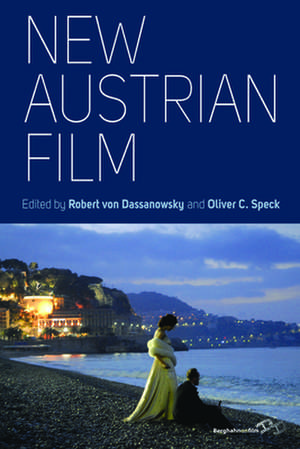
New Austrian Film
Editat de Robert Von Dassanowsky, Oliver C. Specken Limba Engleză Paperback – 3 mar 2014
Prezentându-se ca un ghid portabil dar dens, cu peste 400 de pagini dedicate analizei vizuale și teoretice, New Austrian Film este o resursă esențială pentru înțelegerea fenomenului cinematografic din Europa Centrală. Considerăm că forța acestui volum rezidă în modul în care reușește să cartografieze succesul recent al unor regizori precum Michael Haneke sau Ulrich Seidl, pornind de la o bază industrială care inițial s-a confruntat cu lipsuri financiare severe. Pe raftul de artă, alături de Austrian Cinema, acest album se distinge prin focalizarea pe perioada contemporană și pe diversitatea critică a contributorilor săi, oferind o perspectivă mai fragmentată și mai analitică asupra „noului val” austriac. Experimentăm, parcurgând eseurile incluse, o incursiune în estetica provocatoare și adesea incomodă a spațiului germanofon. Credem că structura sa antologică permite o navigare fluidă între studii de caz individuale și analize de context politic. În cadrul operei editorului Oliver C. Speck, acest volum continuă preocupările sale pentru rigoarea formală și politicul în cinema, teme explorate anterior și în Funny Frames, unde analiza se concentra pe inovațiile cinematografice ale lui Haneke. Dacă în lucrările anterioare accentul cădea pe un singur autor sau pe un film controversat, precum studiul despre Quentin Tarantino's Django Unchained, aici perspectiva se lărgește pentru a cuprinde o întreagă cultură națională în plină ascensiune internațională. Tonul este unul academic, însă accesibil, punând accent pe modul în care imaginea devine un instrument de reflecție socială.
Preț: 308.21 lei
Carte tipărită la comandă
Livrare economică 04-18 decembrie
Specificații
ISBN-10: 178238510X
Pagini: 410
Dimensiuni: 152 x 229 x 23 mm
Greutate: 0.59 kg
Editura: BERGHAHN BOOKS
V-ar putea interesa
-
 -19%Preț: 350.94 lei435.43 lei
 -
 East, West and CentreMichael Gott-25%Preț: 600.73 lei796.34 lei
 -
 Improving PassionsCharles Burnetts-23%Preț: 722.31 lei938.07 lei
 -
 Austrian Cinema: A HistoryRobert von Dassanowsky-23%Preț: 432.20 lei561.29 lei
 -
 Unsung Hollywood Musicals of the Golden EraEdwin M. BradleyPreț: 297.08 lei
 -
 Cinema and SpectatorshipJudith Mayne-18%Preț: 1248.18 lei1522.18 lei
 -
 Reframing the Past: History, Film and TelevisionMia Treacey-18%Preț: 1148.05 lei1400.07 lei
 -
 -18%Preț: 1246.62 lei1520.27 lei
 -
 Quentin Tarantino's Inglourious Basterds: A Manipulation of MetacinemaProfessor or Dr. Robert von Dassanowsky-24%Preț: 616.15 lei812.21 lei
 -
 Quentin Tarantino's Inglourious Basterds: A Manipulation of MetacinemaProfessor or Dr. Robert von Dassanowsky-16%Preț: 181.35 lei216.37 lei
 -
 Funny Frames: The Filmic Concepts of Michael HanekeOliver C. Speck-14%Preț: 236.32 lei275.04 lei
 -
 One World, Big ScreenM. Todd BennettPreț: 303.60 lei
 -
 Film FablesJacques Rancière-20%Preț: 161.11 lei201.48 lei
 -
 Cinema of the Dark SideShohini Chaudhuri-17%Preț: 176.12 lei211.23 lei
 -
 Hong Kong Documentary FilmIan Aitken-15%Preț: 213.69 lei252.54 lei
 -
 Border CrossingAlexander Burry-24%Preț: 613.25 lei809.15 lei
 -
 The Fox Film Corporation, 1915-1935Aubrey SolomonPreț: 283.99 lei
 -
 -23%Preț: 524.35 lei684.25 lei
 -
 Preț: 213.83 lei
 -
 Beyond the Looking GlassAna Salzberg-23%Preț: 758.62 lei985.21 lei
 -
 SupercinemaWilliam BrownPreț: 190.12 lei
De ce să citești această carte
Recomandăm această carte studenților la regie, criticilor de film și cinefililor care doresc să descopere mecanismele din spatele succesului unor autori precum Michael Haneke. Cititorul câștigă o înțelegere profundă a modului în care cinematografia austriacă a evoluat de la marginalitate la recunoaștere în marile festivaluri, oferind instrumente critice pentru a descifra un stil vizual adesea auster, dar profund impactant.
Despre autor
Editorii acestui volum sunt figuri centrale în studiile cinematografice europene. Oliver C. Speck este cunoscut pentru cercetările sale asupra regizorului Michael Haneke, publicând Funny Frames, o analiză detaliată a modului în care gândirea politică se manifestă în cadrele cinematografice. De asemenea, a explorat recepția culturală și controversele rasiale în volume precum cel dedicat filmului lui Tarantino, Quentin Tarantino's Django Unchained. Alături de Robert von Dassanowsky, un expert în istoria culturală a Austriei, acesta oferă o viziune echilibrată între contextul istoric și analiza estetică modernă.
Notă biografică
Descriere scurtă
Cuprins
PART I: EARLY VISIONS/INFLUENTIAL SITES
Chapter 1. "The Experiment is Not Yet Finished": VALIE EXPORT's Avant Garde Film
Margarete Lamb-Faffelberger
Chapter 2. Franz Antel's Bockerer Series: Constructing the Historical Myth of the Austrian Second Republic
Joseph Moser
Chapter 3. Historical Drama of a Well-Intentioned Kind: Wolfgang Glück's: 38: Auch das war Wien
Felix Tweraser
Chapter 4. Cartographies of Identity: Memory and History in Ruth Beckermann's Documentary Films
Christina Guenther
PART II: BARBARA ALBERT AND THE FEMALE RE-FOCUS
Chapter 5. A New Community of Women: Barbara Albert's Nordrand/Northern Skirts
Dagmar Lorenz
Chapter 6. Metonymic Visions: Globalization, Consumer Culture, and Mediated Affect in Barbara Albert's Böse Zellen/Free Radicals
Imke Meyer
Chapter 7. Place and Space of Contemporary Austria in Barbara Albert's Feature Films
Mary Wauchope
Chapter 8. Connecting with Others; Mirroring Difference: Films by Kathrin Resetarits - Director, Actress, and Writer
Verena Mund
Chapter 9. Not Politics but People: The "Feminine Aesthetic" of Valeska Grisebach and Jessica Hausner
Catherine Wheatley
PART III: MICHAEL HANEKE AND ULRICH SEIDL: A QUESTION OF SPECTATORIAL DESTINATION
Chapter 10. Allegory in Michael Haneke's The Seventh Continent
Eva Kuttenberg
Chapter 11. "What-Goes-Without-Saying": Michael Haneke's Confrontation with Myths in Funny Games
Gabi Wurmitzer
Chapter 12. Unseen/Obscene: The (Non-) Framing of the Sexual Act in Michael Haneke's La Pianiste
Catherine Wheatley
Chapter 13. The Possibility of Desire in a Conformist World: The Cinema of Ulrich Seidl
Matthias Frey
Chapter 14. Dog Days: Ulrich Seidl's Fin-de-Siecle Vision
Justin Vicari
Chapter 15. Import and Export: Ulrich Seidl's Indiscreet Anthropology of Migration
Martin Brady and Helen Hughes
PART IV: RE-VISIONS, SHIFTING CENTERS, CROSSING BORDERS
Chapter 16. Crossing Borders in Austrian Cinema at the Turn of the Century: Flicker, Allahyari, Albert
Nikhil Sathe
Chapter 17. The Resentment of One's Fellow Citizens Intensified into a Strong Sense of Community: Psychology and Misanthropy in Total Therapy, The Hold-up, and Caché
Andreas Böhn
Chapter 18. Trapped Bodies, Roaming Fantasies: Mobilizing the Constructions of Place and Identity in Florian Flicker's Suzie Washington
Gundolf Graml
Chapter 19. A Cinephilic Avant-Garde: The Films of Peter Tscherkassky, Martin Arnold, and Gustav Deutsch
Erika Balsom
PART V: STEFAN RUZOWITZKY AND NEO-CLASSIC TRENDS
Chapter 20. Screening Nazisms and Reclaiming the Horror Genre: Stefan Ruzowitzky's Anatomy Films
Alexandra Ludewig
Chapter 21. Beyond Borders and Across Genre Boundaries: Critical Heimat in Stefan Ruzowitzky's The Inheritors
Rachel Palfreyman
Chapter 22. A Genuine Dilemma: Ruzowitzky's The Counterfeiters as Moral Experiment
Raymond Burt
Chapter 23. National Box Office Hits - International "Arthouse"? The New Austrokomödie
Regina Standún
PART VI: AUSTRIA AND BEYOND AS TERRA INCOGNITA: GLAWOGGER, SAUPER, SPIELMANN
Chapter 24. Austria Plays Itself and Sees Da Him: Notes on the Image of Austria in the Films of Michael Glawogger
Christoph Huber
Chapter 25. Configurations of the Authentic in Hubert Sauper'sDarwin's Nightmare
Arno Russegger
Chapter 26. The Lady in the Lake: Austria's Images in Götz Spielmann'sAntares
Sara Hall
Chapter 27. "Children of Optimism": An Interview with Götz Spielmann on Revanche and New Austrian Film
Catherine Wheatley
Selected Filmography
Contributors
Index