
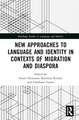
New Approaches to Language and Identity in Contexts of Migration and Diaspora: Routledge Studies in Language and Identity
Editat de Charlotte Taylor, Karolina Rosiak, Stuart Dunmoreen Limba Engleză Paperback – 28 noi 2025


Preț: 360.47 lei
Nou
Puncte Express: 541
Preț estimativ în valută:
63.78€ • 74.90$ • 55.99£
63.78€ • 74.90$ • 55.99£
Carte indisponibilă temporar
Doresc să fiu notificat când acest titlu va fi disponibil:
Se trimite...
Preluare comenzi: 021 569.72.76
Specificații
ISBN-13: 9781032447360
ISBN-10: 1032447362
Pagini: 188
Dimensiuni: 156 x 234 mm
Greutate: 0.37 kg
Editura: Taylor & Francis Ltd.
Seria Routledge Studies in Language and Identity
ISBN-10: 1032447362
Pagini: 188
Dimensiuni: 156 x 234 mm
Greutate: 0.37 kg
Editura: Taylor & Francis Ltd.
Seria Routledge Studies in Language and Identity
Cuprins
Acknowledgements
List of contributors
1. Language and identity in Contexts of Migration and Diaspora – Introductory Remarks
2. “And suddenly the foreign, the Other, is no longer so foreign”: Polish Café as a grassroots initiative of linguistic integration
3. “I think I speak European!”: Tracing immigrant identities in Edinburgh, Scotland
4. Divergent language ideologies in a transatlantic minority: Gaelic in Scotland and Nova Scotia
5. Degrees of Belonging in Diasporic Contexts: Indexical scales of Vietnamese-ness in the UK
6. Formation and life course impact of language identity: A case study of Japanese returnees from China
7. Hybrid Language Identity of the Second-Generation Immigrants in Cyprus
8. Language Landscapes and Native Resilience: Land-Connectivity, Language, and Identity among Urban Native Americans
9. Language, accent and the experience of belonging for the second-generation Irish from England
10. Linguistic Identity of the second generation of Arabic speakers in Italy
11. Narratives of (un)belonging: Language management and identity negotiations in two immigrant families in New Zealand
12. The Performance of Agentic Identity by Refugees in Edinburgh: challenging the Victim Frame.
13. Epilogue and Future research directions in migration, language and identity
Index
List of contributors
1. Language and identity in Contexts of Migration and Diaspora – Introductory Remarks
2. “And suddenly the foreign, the Other, is no longer so foreign”: Polish Café as a grassroots initiative of linguistic integration
3. “I think I speak European!”: Tracing immigrant identities in Edinburgh, Scotland
4. Divergent language ideologies in a transatlantic minority: Gaelic in Scotland and Nova Scotia
5. Degrees of Belonging in Diasporic Contexts: Indexical scales of Vietnamese-ness in the UK
6. Formation and life course impact of language identity: A case study of Japanese returnees from China
7. Hybrid Language Identity of the Second-Generation Immigrants in Cyprus
8. Language Landscapes and Native Resilience: Land-Connectivity, Language, and Identity among Urban Native Americans
9. Language, accent and the experience of belonging for the second-generation Irish from England
10. Linguistic Identity of the second generation of Arabic speakers in Italy
11. Narratives of (un)belonging: Language management and identity negotiations in two immigrant families in New Zealand
12. The Performance of Agentic Identity by Refugees in Edinburgh: challenging the Victim Frame.
13. Epilogue and Future research directions in migration, language and identity
Index
Notă biografică
Stuart Dunmore is an associate tutor at the Institute for Language Education in the University of Edinburgh. His research examines language ideologies, minority language use, and cultural identities, with particular reference to Celtic language communities in the UK and North America. In 2022 he was a Fulbright scholar at Harvard University.
Karolina Rosiak is an assistant professor at the Celtic Studies Research Unit, Faculty of English at Adam Mickiewicz University in Poznań. Her research examines the sociolinguistics of the Welsh language, linguistic aspects of Polish migration to Wales, with a particular focus on language attitudes and ideologies, and cultural ties between Wales and Poland.
Charlotte Taylor is a professor of discourse and persuasion at the University of Sussex. Her research interests are centred on language use, discourse analysis, and pragmatics, particularly in relation to politeness, migration, nostalgia, and metaphor.
Karolina Rosiak is an assistant professor at the Celtic Studies Research Unit, Faculty of English at Adam Mickiewicz University in Poznań. Her research examines the sociolinguistics of the Welsh language, linguistic aspects of Polish migration to Wales, with a particular focus on language attitudes and ideologies, and cultural ties between Wales and Poland.
Charlotte Taylor is a professor of discourse and persuasion at the University of Sussex. Her research interests are centred on language use, discourse analysis, and pragmatics, particularly in relation to politeness, migration, nostalgia, and metaphor.