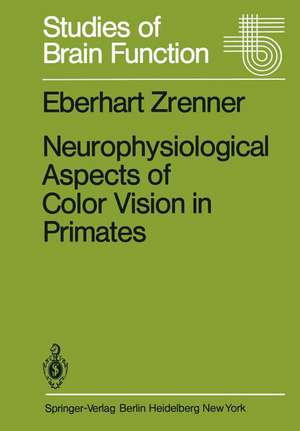
Neurophysiological Aspects of Color Vision in Primates: Comparative Studies on Simian Retinal Ganglion Cells and the Human Visual System: Studies of Brain Function, cartea 9
Autor E. Zrenneren Limba Engleză Paperback – 26 apr 2012
Din seria Studies of Brain Function
- 15%
 Preț: 607.34 lei
 - 15%
 Preț: 611.89 lei
 - 15%
 Preț: 622.73 lei
 - 15%
 Preț: 562.05 lei
 -
 Preț: 368.79 lei
 - 18%
 Preț: 753.77 lei
 -
 Preț: 379.51 lei
 - 15%
 Preț: 616.95 lei
 - 15%
 Preț: 615.35 lei
 - 15%
 Preț: 616.95 lei
 - 15%
 Preț: 614.73 lei
 - 15%
 Preț: 617.25 lei
 - 18%
 Preț: 693.72 lei
 - 15%
 Preț: 615.52 lei
 - 15%
 Preț: 607.96 lei
 - 15%
 Preț: 613.62 lei
Preț: 614.73 lei
Preț vechi: 723.21 lei
-15% Nou
Puncte Express: 922
Preț estimativ în valută:
108.80€ • 127.59$ • 95.39£
108.80€ • 127.59$ • 95.39£
Carte tipărită la comandă
Livrare economică 24 ianuarie-07 februarie 26
Preluare comenzi: 021 569.72.76
Specificații
ISBN-13: 9783642876080
ISBN-10: 3642876080
Pagini: 240
Ilustrații: XVI, 220 p.
Dimensiuni: 170 x 244 x 13 mm
Greutate: 0.39 kg
Ediția:Softcover reprint of the original 1st ed. 1983
Editura: Springer Berlin, Heidelberg
Colecția Springer
Seria Studies of Brain Function
Locul publicării:Berlin, Heidelberg, Germany
ISBN-10: 3642876080
Pagini: 240
Ilustrații: XVI, 220 p.
Dimensiuni: 170 x 244 x 13 mm
Greutate: 0.39 kg
Ediția:Softcover reprint of the original 1st ed. 1983
Editura: Springer Berlin, Heidelberg
Colecția Springer
Seria Studies of Brain Function
Locul publicării:Berlin, Heidelberg, Germany
V-ar putea interesa
-
 The Private Life of the BrainBaroness Susan Greenfield-21%Preț: 59.53 lei75.11 lei
 -
 Neurology of Cognitive and Behavioral DisordersOrrin Devinsky-29%Preț: 1086.28 lei1522.66 lei
 -
 -14%Preț: 370.73 lei430.15 lei
 -
 The Neuropsychology of VisionManfred Fahle-34%Preț: 1552.81 lei2363.08 lei
 -
 The Neurocognition of LanguageColin M. Brown-23%Preț: 436.21 lei566.37 lei
 -
 The Frontal Lobes and Voluntary ActionR. E. Passingham-24%Preț: 381.02 lei501.80 lei
 -
 Computational Neuroscience of VisionEdmund Rolls-34%Preț: 654.89 lei985.54 lei
 -
 Emotion, Evolution and RationalityDylan Evans-34%Preț: 645.04 lei979.46 lei
 -
 A User's Guide To The BrainJohn J. Ratey-26%Preț: 66.77 lei90.59 lei
 -
 The Self and Its Brain: An Argument for InteractionismJohn C. Eccles-15%Preț: 495.18 lei582.56 lei
 -
 Metabolic Basis of ObesityRexford S. Ahima-5%Preț: 754.51 lei794.23 lei
 -
 -15%Preț: 631.23 lei742.62 lei
 -
 Research Progress in Alzheimer's Disease & Dementia: Volume 6Miao-Kun Sun Ph.D.-26%Preț: 1298.26 lei1751.37 lei
 -
 -18%Preț: 1081.48 lei1318.88 lei
 -
 -18%Preț: 915.29 lei1116.22 lei
Public țintă
ResearchCuprins
1 Introduction.- 1.1 Color Vision Theories. Historical Aspects.- 1.2 Electrophysiological Studies Related to Color Vision.- 2 Methods.- 2.1 Methods of Single Cell Recording in Rhesus Monkeys.- 2.2 Identification of Cone Inputs in Retinal Ganglion Cells.- 3 Types of Retinal Ganglion Cells and Their Distribution.- 3.1 Introductory Remarks.- 3.2 The Concept of Color-Opponency.- 3.3 The Various Types of Color-Opponent Cells.- 3.4 Variations in Color-Opponency.- 3.5 Spectrally Non-Opponent Ganglion Cells.- 3.6 Distribution of Classes of Ganglion Cells Across the Retina.- 3.7 A Simplified Classification Procedure.- 3.8 Résumé: Some Implications for the Understanding of the Visual System’s Function.- 4 Special Properties of Blue-Sensitive Ganglion Cells.- 4.1 Some Recent Electrophysiological and Psychophysical Data on the Blue-Sensitive Cone System.- 4.2 Chromatic Adaptation and Spectral Sensitivity.- 4.3 Paradoxical Phenomena Occurring During Light and Dark Adaptation in Blue-Sensitive Ganglion Cells.- 4.4 A Model Describing the Interaction Between Cone Mechanisms in Blue-Sensitive, Color-Opponent Ganglion Cells.- 4.5 Résumé: What is Special About the Blue Cone Mechanism?.- 5 Temporal Properties of Color-Opponent Ganglion Cells..- Flicker-Stimulation; Testing the “Channel” Hypothesis.- 5.1 Critical Flicker Frequencies (CFF) in Tonic and Phasic Ganglion Cells.- 5.2 Influence of Stimulation Frequency on the Spectral Sensitivity Function: Loss of Color-Opponency at Higher Flicker Rates.- 5.3 The Basic Mechanism: Phase-Shift Between Center and Surround Responses.- 5.4 Latency of Center and Surround Responses.- 5.5 The Processing of Luminous and Chromatic Flicker.- 5.6 Stimulus Duration Changes the Action Spectrum.- 5.7 Résumé: Possible Implication of the TransitionBetween Antagonism and Synergism in Color-Opponent Ganglion Cells.- 6 The Spectral Properties of the Human Visual System as Revealed by Visually Evoked Cortical Potentials (VECP) and Psychophysical Investigations.- 6.1 Methods as Applied in Human Observers.- 6.2 Rods and Cones.- 6.3 Fundamental Cone Functions.- 6.4 Color-Opponency in the VECP and in Psychophysical Measurements.- 6.5 The Influence of Flicker Frequency on Spectral Sensitivity.- 6.6 Conclusion: To What Extent Can Visually Evoked Cortical Potentials Reveal the Function of Individual Receptor Mechanisms?.- Epilogue.- Summary.- References.