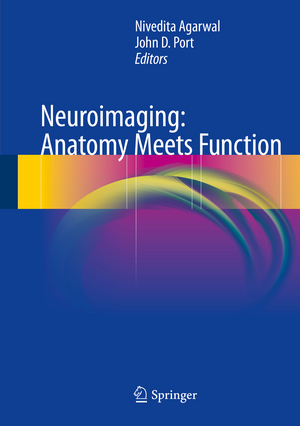
Neuroimaging: Anatomy Meets Function
Editat de Nivedita Agarwal, John Porten Limba Engleză Hardback – 11 oct 2017
Observăm o schimbare de paradigmă în radiologia modernă, unde simpla identificare a structurilor nu mai este suficientă fără o înțelegere profundă a substratului funcțional. Lucrarea Neuroimaging: Anatomy Meets Function, editată de Nivedita Agarwal și John D. Port, răspunde nevoii actuale de a integra noile ghiduri de neuroplasticitate și conectivitate în practica clinică. Actualizarea recomandărilor în neuroștiințe pune astăzi accent pe vizualizarea creierului ca un întreg (abordare holistică), depășind analiza segmentată a părților componente, esențială în protocoalele de reabilitare pentru accidentele vasculare cerebrale sau bolile neurodegenerative. Ne-a atras atenția rigoarea cu care volumul este structurat, pornind de la anatomia substanței albe și vasculare, până la secțiuni avansate de imagistică la 7T, oferind o claritate vizuală superioară standardelor clinice obișnuite. Acolo unde Neuroimaging Anatomy, Part 1: Brain and Skull de Tarik F. Massoud acoperă fundamentele anatomice și connectomica sub formă de articole tematice, acest volum aprofundează corelația directă dintre morfologie și funcție, incluzând un atlas detaliat al nervilor cranieni și repere chirurgicale pentru abordări endoscopice. Suntem de părere că expertiza editorului Nivedita Agarwal, vizibilă și în lucrarea sa anterioară Imaging of Neurofluids, se reflectă aici printr-o precizie clinică remarcabilă. Cartea progresează logic de la emisferele cerebrale către complexitatea trunchiului cerebral și a cerebelului, culminând cu ilustrații de anatomie chirurgicală pentru unghiul cerebelopontin și sinusul cavernos. Este o resursă care transformă imagistica RM dintr-un instrument de observație într-unul de diagnostic fin, reducând riscul de interpretare eronată prin raportarea constantă la funcția neurologică subiacentă.
Preț: 766.48 lei
Preț vechi: 806.81 lei
-5%
Carte tipărită la comandă
Livrare economică 17-23 noiembrie
Specificații
ISBN-10: 3319574264
Pagini: 250
Ilustrații: 140 schwarz-weiße und 10 farbige Abbildungen, Bibliographie
Dimensiuni: 183 x 260 x 21 mm
Greutate: 0.76 kg
Ediția:1st ed. 2018
Editura: Springer
Locul publicării:Cham, Switzerland
V-ar putea interesa
-
 Managing Common Interventional Radiology ComplicationsLakshmi Ratnam-5%Preț: 367.47 lei386.80 lei
 -
 Atlas of Pediatric Cardiac CTARandy Ray Richardson-5%Preț: 733.61 lei772.22 lei
 -
 Image-Guided Spine InterventionsJohn Mathis-5%Preț: 770.32 lei810.86 lei
 -
 Imaging of the Cervical Spine in ChildrenLeonard E. Swischuk-5%Preț: 1067.76 lei1123.96 lei
 -
 Radiology: The Oral Boards PrimerAmit Mehta-5%Preț: 1094.09 lei1151.68 lei
 -
 Diseases of the Chest: Imaging Diagnosis Based on Pattern ClassificationToshiharu Matsushima-11%Preț: 651.88 lei733.40 lei
 -
 Imaging Endocrine Diseases in ChildrenFred Avni-5%Preț: 1063.72 lei1119.71 lei
 -
 Radiology Education: The Evaluation and Assessment of Clinical CompetenceKathryn M. Hibbert-5%Preț: 690.39 lei726.72 lei
 -
 Imaging Tumor Response to TherapyMassimo Aglietta-5%Preț: 381.15 lei401.21 lei
 -
 Imaging Coronary ArteriesDavid A Dowe-5%Preț: 734.05 lei772.69 lei
De ce să citești această carte
Această lucrare este esențială pentru neuroradiologi și neurologi care doresc să stăpânească interpretarea imaginilor la rezoluție înaltă (3T și 7T). Cititorul câștigă o înțelegere clară a modului în care leziunile anatomice specifice influențează funcția cerebrală, un avantaj critic în stabilirea diagnosticelor diferențiale complexe și în planificarea intervențiilor neurochirurgicale de precizie.
Despre autor
Nivedita Agarwal este un radiolog renumit, specializat în neuroimagistică, recunoscută pentru capacitatea de a sintetiza concepte complexe de neuroștiințe în ghiduri clinice aplicabile. Pe lângă rolul de editor pentru Neuroimaging: Anatomy Meets Function, ea a coordonat publicații de referință precum Imaging of Neurofluids în cadrul seriei „Neuroimaging Clinics of North America”. Interesele sale academice acoperă un spectru larg, de la inovația în tehnologia medicală până la corelațiile funcționale avansate, contribuind constant la literatura de specialitate prin lucrări ce pun accent pe acuratețea diagnostică și pe integrarea noilor tehnologii RM în rutina medicală.
Descriere scurtă
The relatively recent concepts of structural and functional connectivity make it even more important to visualize the brain as a whole rather than looking at its individual parts. This holistic approach is vital in understanding concepts such as neuroplasticity that are currently incorporated into physical and cognitive rehabilitation programs for patients with stroke or neurodegenerative diseases. Ultimately this combined approach may reduce both overdiagnosis and misdiagnosis when integrated into routine clinical routine. This book will be of interest to neuroradiologists, general radiologists and neurologists alike, as well as medical students, residents and fellows.
Cuprins
proach. - Orbital Surgery. - Pineal Gland Surgery. - Craniotomies. - Sellar and parasellar surgery. - Neurovascular conflict (Trigeminal nerve). - Part VI Sample cases (Imaging and interpretative pearls).
Recenzii
Notă biografică
John D. Port, M.D., Ph.D. received his BS in computer engineering from the Massachusetts Institute of Technology in 1986. He received his Ph.D. in Neuroanatomy from the University of Illinois in Chicago in 1992, and his M.D. from the University of Illinois College of Medicine in 1994. He completed his medical residency and fellowship in Radiology and Neuroradiology, respectively, at the Johns Hopkins Hospital in 2000. He is currently an Associate Professor of Radiology as well as an Assistant Professor of Psychiatry at Mayo Clinic in Rochester Minnesota. He is a board certified radiologist and neuroradiologist, and spends the majority of his time in clinical practice. His research primarily involves developing magnetic resonance (MR) spectroscopy and MR imaging tools for various clinical applications including psychiatric, metabolic, and endocrinology diseases. To date he has written over 50 peer-reviewed publications, 5 book chapters, and over 100 abstracts that were presented at national and international meetings. He is well known internationally for his research and educational presentations on psychiatric illness, specifically schizophrenia and mood disorders.