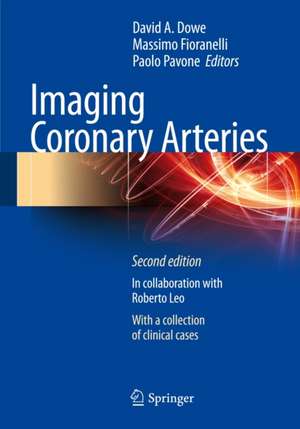
Imaging Coronary Arteries
Editat de David A Dowe, Massimo Fioranelli, Paolo Pavoneen Limba Engleză Paperback – 6 dec 2012
Recomandăm Imaging Coronary Arteries, editat de David A Dowe, Massimo Fioranelli și Paolo Pavone, ca o resursă esențială pentru cardiologi, radiologi fără experiență directă în imagistica cardiacă, medici de familie și rezidenți care doresc să stăpânească diagnosticul non-invaziv al bolii coronariene. Această a doua ediție, publicată de Springer, rafinează utilizarea tomografiei computerizate (CT) ca instrument principal pentru vizualizarea locației și extinderii implicării aterosclerotice, oferind o perspectivă clinică asupra plăcilor marginale non-stenoze, responsabile de majoritatea evenimentelor cardiace subite. Subliniem rigoarea organizării conținutului în cele 19 capitole. Progresia este logică și clinică: de la bazele anatomiei circulației coronariene și tehnicile de achiziție a imaginilor, până la aplicații complexe precum evaluarea bypass-ului aorto-coronarian și a stenturilor. Remarcăm introducerea unor capitole noi despre ecografia intravasculară (IVUS), angiografia prin cateter și imagistica nucleară, elemente care transformă acest volum într-un ghid hibrid între radiologia tradițională și tehnicile intervenționale. Clinicienii care folosesc Computed Tomography of the Coronary Arteries de Pim J. de Feyter ca referință vor găsi aici o completare valoroasă prin secțiunea extinsă de peste 70 de cazuri clinice, care ancorează teoria în scenarii reale de diagnostic. Suntem de părere că includerea discuțiilor despre tomografia în coerență optică (OCT) și riscurile expunerii la radiații X (capitolul 14) demonstrează o abordare responsabilă și actualizată a specialității. Structura permite atât o parcurgere sistematică a fiziopatologiei, cât și o consultare rapidă pentru protocolul „Triple Rule Out” în unitățile de primiri urgențe.
Preț: 734.05 lei
Preț vechi: 772.69 lei
-5%
Carte disponibilă
Livrare economică 29 octombrie-12 noiembrie
Specificații
ISBN-10: 8847026814
Pagini: 261
Ilustrații: XII, 261 p.
Dimensiuni: 177 x 254 x 17 mm
Greutate: 0.75 kg
Ediția:2nd 2013 edition
Editura: Springer
Locul publicării:Milano, Italy
V-ar putea interesa
-
 Chest ImagingLes R. Folio-5%Preț: 351.38 lei369.87 lei
 -
 In Vivo Cellular Imaging Using Fluorescent ProteinsRobert Hoffman-5%Preț: 730.85 lei769.31 lei
 -
 Spectroscopic Methods of AnalysisWlodek M. Bujalowski-5%Preț: 740.26 lei779.22 lei
 -
 Forensic Microscopy for Skeletal TissuesLynne S. Bell-5%Preț: 730.68 lei769.14 lei
 -
 Atlas of Diffuse Lung DiseasesGiorgia Dalpiaz-5%Preț: 782.78 lei823.99 lei
 -
 -5%Preț: 995.43 lei1047.82 lei
 -
 Atlas of Handheld UltrasoundBret P. Nelson-5%Preț: 1521.31 lei1601.37 lei
 -
 Thoracic Ultrasound and Integrated ImagingFrancesco Feletti-5%Preț: 891.59 lei938.51 lei
 -
 The Internet for RadiologistsDavide Caramella-5%Preț: 683.37 lei719.34 lei
 -
 Imaging of Gynecological Disorders in Infants and ChildrenGurdeep S. Mann-5%Preț: 1067.21 lei1123.38 lei
 -
 Atlas Klinische Neuroradiologie des GehirnsJennifer Linn-5%Preț: 2419.29 lei2546.62 lei
 -
 High-Resolution Sonography of the Peripheral Nervous SystemSiegfried Peer-5%Preț: 784.73 lei826.03 lei
 -
 Imaging Pelvic Floor DisordersJaap Stoker-5%Preț: 818.94 lei862.04 lei
 -
 Digital Imaging and Communications in Medicine (DICOM)Oleg S. Pianykh-5%Preț: 903.61 lei951.16 lei
 -
 Stereotactic Body Radiation TherapySimon S. Lo-5%Preț: 2139.57 lei2252.18 lei
 -
 -5%Preț: 794.05 lei835.84 lei
 -
 Imaging for Pediatricians: 100 Key CasesMaría I. Martínez-León-5%Preț: 362.27 lei381.34 lei
 -
 MR CholangiopancreatographyPaolo Pavone-5%Preț: 363.67 lei382.81 lei
 -
 AngiofibelBoris Radeleff-5%Preț: 1673.67 lei1761.76 lei
 -
 Cardiologia dello SportMassimo Fioranelli-5%Preț: 424.24 lei446.58 lei
 -
 Ultrasound-guided Musculoskeletal ProceduresLuca Maria Sconfienza-5%Preț: 711.97 lei749.44 lei
 -
 Sports Cardiology: From Diagnosis to Clinical ManagementMassimo Fioranelli-5%Preț: 1073.37 lei1129.86 lei
Public țintă
Professional/practitionerDe ce să citești această carte
Această ediție este indispensabilă pentru medicii care doresc să integreze CT-ul coronarian în fluxul de lucru clinic. Cititorul câștigă o înțelegere profundă a caracterizării plăcii aterosclerotice și acces la o vastă bibliotecă de 70 de cazuri clinice comentate. Este instrumentul ideal pentru a trece de la interpretarea radiologică de bază la planificarea terapeutică avansată în cardiologia modernă.