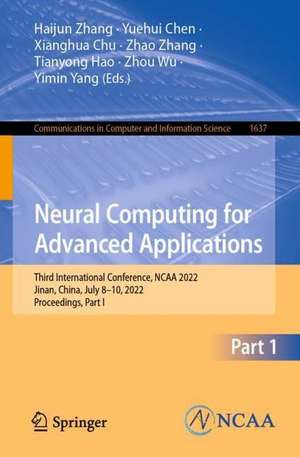
Neural Computing for Advanced Applications
Editat de Haijun Zhang, Yuehui Chen, Xianghua Chu, Zhao Zhang, Tianyong Hao, Zhou Wu, Yimin Yangen Limba Engleză Paperback – 21 oct 2022
The 77 papers included in these proceedings were carefully reviewed and selected from 205 submissions. These papers were categorized into 10 technical tracks, i.e., neural network theory, and cognitive sciences, machine learning, data mining, data security & privacy protection, and data-driven applications, computational intelligence, nature-inspired optimizers, and their engineering applications, cloud/edge/fog computing, the Internet of Things/Vehicles (IoT/IoV), and their system optimization, control systems, network synchronization, system integration, and industrial artificial intelligence, fuzzy logic, neuro-fuzzy systems, decision making, and their applications in management sciences, computer vision, image processing, and theirindustrial applications, natural language processing, machine translation, knowledge graphs, and their applications, Neural computing-based fault diagnosis, fault forecasting, prognostic management, and system modeling, and Spreading dynamics, forecasting, and other intelligent techniques against coronavirus disease (COVID-19).
Preț: 663.25 lei
Preț vechi: 829.06 lei
-20%
Puncte Express: 995
Carte tipărită la comandă
Livrare economică 05-19 decembrie
Livrare prin curier în România Termenul estimat este afișat lângă disponibilitate.
Transport gratuit pentru acest produs Plată online sau ramburs, în funcție de opțiunile comenzii.
Retur gratuit în 14 zile Comandă securizată și suport în română.
Specificații
ISBN-13: 9789811961410
ISBN-10: 9811961417
Pagini: 568
Ilustrații: XX, 546 p. 215 illus., 153 illus. in color.
Dimensiuni: 155 x 235 x 31 mm
Greutate: 0.85 kg
Ediția:1st edition 2022
Editura: Springer
Locul publicării:Singapore, Singapore
ISBN-10: 9811961417
Pagini: 568
Ilustrații: XX, 546 p. 215 illus., 153 illus. in color.
Dimensiuni: 155 x 235 x 31 mm
Greutate: 0.85 kg
Ediția:1st edition 2022
Editura: Springer
Locul publicării:Singapore, Singapore
V-ar putea interesa
-
 Preț: 296.35 lei
 -
 Nonlinear Combinatorial OptimizationDing-Zhu Du-15%Preț: 588.52 lei692.38 lei
 -
 5G for Future Wireless NetworksVictor C. M. Leung-20%Preț: 358.73 lei448.41 lei
 -
 -20%Preț: 353.77 lei442.21 lei
 -
 6GN for Future Wireless NetworksXiaofei Wang-20%Preț: 777.41 lei971.76 lei
 -
 -20%Preț: 921.46 lei1151.82 lei
 -
 Geospatial IntelligenceFatimazahra Barramou-20%Preț: 1103.94 lei1379.93 lei
 -
 Intelligent Systems Modeling and Simulation IISamsul Ariffin Abdul Karim-18%Preț: 1289.69 lei1572.79 lei
 -
 -20%Preț: 669.40 lei836.74 lei
 -
 Signal Processing and Machine Learning with ApplicationsMichael M. Richter-20%Preț: 381.10 lei476.37 lei
 -
 Game Theory for NetworksJulian Cheng-20%Preț: 344.13 lei430.17 lei
 -
 5G for Future Wireless NetworksKeping Long-20%Preț: 649.77 lei812.22 lei
 -
 Automated Deduction - CADE-19Franz Baader-20%Preț: 333.62 lei417.03 lei
 -
 Cooperative Information Agents VIIMatthias Klusch-20%Preț: 325.71 lei407.14 lei
 -
 Extensions of Logic ProgrammingPeter Schroeder-Heister-20%Preț: 326.05 lei407.56 lei
 -
 Truth Maintenance SystemsJoao P. Martins-20%Preț: 316.62 lei395.77 lei
 -
 Instantiation TheoryJames G. Williams-20%Preț: 314.37 lei392.97 lei
 -
 Nonmonotonic and Inductive LogicKlaus P. Jantke-20%Preț: 320.14 lei400.17 lei
 -
 Trends in Artificial IntelligenceEdoardo Ardizzone-20%Preț: 332.39 lei415.48 lei
 -
 Processing Declarative KnowledgeHarold Boley-20%Preț: 329.94 lei412.42 lei
 -
 Intelligent Tutoring SystemsClaude Frasson-20%Preț: 644.77 lei805.96 lei
 -
 Logic Programming in ActionGerard Comyn-20%Preț: 337.17 lei421.47 lei
 -
 Mechanical Harvest of Fresh Market ApplesZhao Zhang-18%Preț: 1146.87 lei1398.63 lei
 -
 -18%Preț: 1146.27 lei1397.89 lei
 -
 -20%Preț: 1022.91 lei1278.64 lei
 -
 ICT with Intelligent ApplicationsJyoti Choudrie-20%Preț: 1538.78 lei1923.47 lei
 -
 IOT with Smart SystemsJyoti Choudrie-20%Preț: 1359.20 lei1698.99 lei
 -
 Recent Challenges in Intelligent Information and Database SystemsEdward Szczerbicki-20%Preț: 1189.12 lei1486.40 lei
 -
 Big DataTianrui Li-20%Preț: 412.76 lei515.96 lei
Cuprins
TE-BiLSTM: Improved Transformer and BiLSTM on Fraudulent Phone Text Recognition.- Cross elitist learning multifactorial evolutionary algorithm.- Heterogeneous Adaptive Denoising Networks for Recommendation.- Formation Control Optimization via Leader Selection for Rotor Unmanned Aerial Vehicles.- Dynamic Monitoring Method Based on Compara-tive Study of Power and Environmental Protection Indicators.- Combustion State Recognition Method in Municipal Solid Waste Incineration Process Based on Improved Deep Forest.- RPCA-induced Graph Tensor Learning for Incomplete Multi-view Inferring and Clustering.- TRUST-TECH Assisted GA-SVM Ensembles and its Applications.
Textul de pe ultima copertă
The two-volume Proceedings set CCIS 1637 and 1638 constitutes the refereed proceedings of the Third International Conference on Neural Computing for Advanced Applications, NCAA 2022, held in Jinan, China, during July 8–10, 2022.
The 77 papers included in these proceedings were carefully reviewed and selected from 205 submissions. These papers were categorized into 10 technical tracks, i.e., neural network theory, and cognitive sciences, machine learning, data mining, data security & privacy protection, and data-driven applications, computational intelligence, nature-inspired optimizers, and their engineering applications, cloud/edge/fog computing, the Internet of Things/Vehicles (IoT/IoV), and their system optimization, control systems, network synchronization, system integration, and industrial artificial intelligence, fuzzy logic, neuro-fuzzy systems, decision making, and their applications in management sciences, computer vision, image processing, and theirindustrial applications, natural language processing, machine translation, knowledge graphs, and their applications, Neural computing-based fault diagnosis, fault forecasting, prognostic management, and system modeling, and Spreading dynamics, forecasting, and other intelligent techniques against coronavirus disease (COVID-19).