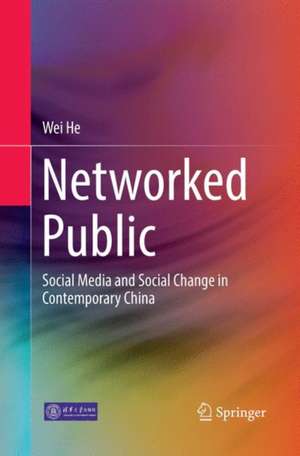
Networked Public
Autor Wei Heen Limba Engleză Paperback – 16 iun 2018
Preț: 410.43 lei
Puncte Express: 616
Carte tipărită la comandă
Livrare economică 28 noiembrie-04 decembrie
Livrare prin curier în România Termenul estimat este afișat lângă disponibilitate.
Transport gratuit pentru acest produs Plată online sau ramburs, în funcție de opțiunile comenzii.
Retur gratuit în 14 zile Comandă securizată și suport în română.
Specificații
ISBN-13: 9783662569023
ISBN-10: 3662569027
Pagini: 320
Ilustrații: X, 308 p. 35 illus., 29 illus. in color.
Dimensiuni: 155 x 235 x 17 mm
Greutate: 0.55 kg
Ediția:Softcover reprint of the original 1st edition 2017
Editura: Springer
Locul publicării:Berlin, Heidelberg, Germany
ISBN-10: 3662569027
Pagini: 320
Ilustrații: X, 308 p. 35 illus., 29 illus. in color.
Dimensiuni: 155 x 235 x 17 mm
Greutate: 0.55 kg
Ediția:Softcover reprint of the original 1st edition 2017
Editura: Springer
Locul publicării:Berlin, Heidelberg, Germany
V-ar putea interesa
-
 Activism on the Web: Everyday Struggles against Digital CapitalismVeronica Barassi-18%Preț: 1430.40 lei1744.39 lei
-
 Personal Connections in the Digital AgeNancy K BaymPreț: 142.06 lei
-
 Video Game Narrative and CriticismT. ThabetPreț: 464.78 lei
-
 Media Management: A Casebook ApproachAnn Hollifield-18%Preț: 709.86 lei865.68 lei
-
 Preț: 395.49 lei
-
 Law and Popular CultureMichael AsimowPreț: 401.12 lei
-
 -15%Preț: 666.97 lei784.67 lei
-
 Media and Translation: An Interdisciplinary ApproachDr Dror Abend-David-24%Preț: 281.65 lei371.49 lei
-
 Infinite DistractionDominic PettmanPreț: 170.03 lei
-
 Understanding Media EthicsDavid Sanford HornerPreț: 338.11 lei
-
 Karrierewege als Thema der internen KommunikationAstrid NelkePreț: 338.91 lei
-
 Vom Betrachten zum VerstehenDagmar GehlPreț: 410.60 lei
-
 Grundlagen der SchmalfilmtechnikHans-H. HeunertPreț: 487.32 lei
-
 Analysis of the Proposed Ghana Broadband StrategyBotwe, Yvonne AdwoaPreț: 347.30 lei
-
 Knowledge Development Follows TrendsDarko LugonjaPreț: 95.78 lei
-
 Praxishandbuch FernsehenEric KarstensPreț: 264.19 lei
-
 Musik und WerbungPinie WangPreț: 438.11 lei
Cuprins
Introduction: the emergence of networked public communication.- Context of Networked Public Communication.- Networked users: the subject of networked public communication.- Social media: tools and space for networked public communication.- The flow of information: features and models of networked public communication.- Resistance to Regulation: Group behavior and culture in networked public communication.- Power Game: Networked public communication and social transition.
Textul de pe ultima copertă
This book coins the term “Networked Public” to describe the active social actors in new media ecology. The author argues that, in today’s network society, Networked Public Communication is different than, yet has similarities with, mass communication and interpersonal communication. As such it is the emergent paradigm for research. The book reviews the historical, technological and social context for the rising of Networked Public, analyzes its constituents and characteristics, and discusses the categories and features of social media in China. By analyzing abundant cases from recent years, the book provides answers to the key questions at micro, meso and macro-levels, including how information flows under regulation in the process of Networked Public Communication; what its features and models are; what collective action strategies and“resistance culture”have been developed as a result of Internet regulate; the nature of power games among Networked Public, mass media, political forces and capital, and the links with the development of Chinese civil society.
Caracteristici
Introduces the original concepts of “networked public communication,” “networked public” and “networked user” Reflects on the realities and conditions “netizens” face within the context of contemporary Chinese society Embeds networked public communication in the broader framework of “power games” Includes supplementary material: sn.pub/extras
Notă biografică
Professor Wei received his PhD from Department of Electrical & Computer Engineering, the National University of Singapore (NUS), Singapore, in 2011, his M.Eng. and B.Eng. degrees both from School of Automation Science and Engineering, South China University of Technology (SCUT), Guangzhou, China, in 2008 and 2006 respectively. He was a Research Fellow at the Department of Electrical & Computer Engineering, the National University of Singapore (NUS), Singapore, from 2011 to 2012. He is currently working as the Full Professor at School of Automation and Electric Engineering, University of Science and Technology Beijing (USTB), China. He has (co)-authored 1 book published in Springer, 80 international journal papers, and 51 conference papers. 4 of them is the Essential Science Indicator (ESI) Hot Paper, and 10 of them is the Essential Science Indicator (ESI) Highly Cited Paper. He is a senior member of IEEE, the member of IEEE Control System Society (CSS), and the member of IEEEIndustrial Electronics Society (IES). He is a receipt of The National Natural Science Fund for Excellent Young Scholars of China in 2015. He is serving as the Associate Editor of IEEE Transactions on Systems, Man, and Cybernetics: Systems, a Leading Guest Editor for of IEEE Transactions on Neural Networks and Learning Systems special issue on "Intelligent Control through Neural Learning and Optimization for Human Machine Hybrid Systems", Editor of Journal of Intelligent & Robotic Systems, Springer, and the Editor of IEEE/CAA Journal of Automatica Sinica. He is the member of the IFAC TC on Distributed Parameter Systems, IFAC TC on Computational Intelligence in Control and IEEE TC on Distributed Parameter Systems. His current research interests include vibration control, adaptive control and robotics.Professor Jinkun Liu received BS, MS and PhD degrees from Northeastern University, Shenyang, China, in 1989, 1994 and 1997, respectively. He was a postdoctoral fellow in Zhejiang University from 1997 to 1999. He is currently a full professor in Beihang University. He has published more than 100 research papers and eight books. His research interests include Intelligent Control and Sliding Mode Control; PDE modeling and boundary control.