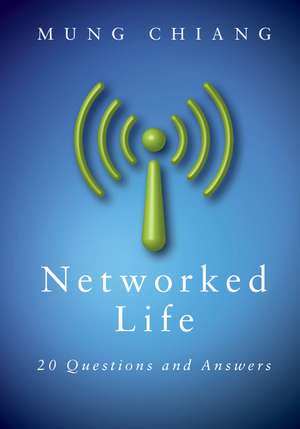
Networked Life
Autor Mung Chiangen Limba Engleză Hardback – noi 2012
Notăm cu interes modul în care Networked Life transformă studiul rețelelor dintr-o disciplină abstractă într-o analiză riguroasă a realității cotidiene. Putem afirma că rigoarea tehnică este demonstrată încă din primele capitole, unde exercițiul de înțelegere a modului în care Google licitează spațiul publicitar sau a modului în care Netflix gestionează recomandările de conținut devine o lecție de inginerie aplicată. Găsim în această carte o structură socratică, organizată în jurul a 20 de întrebări fundamentale care acoperă de la funcționarea sistemelor CDMA pentru telefoane mobile, până la scalabilitatea serviciilor cloud și dinamica viralizării pe YouTube. Spre deosebire de lucrări precum The Internet Book de Douglas E. Comer, care oferă o introducere generală în terminologie, lucrarea de față plonjează în mecanismele matematice și economice ale sistemelor complexe. Cititorul care a aplicat ideile din Google's PageRank and Beyond va găsi aici o extensie necesară, care nu se limitează doar la algoritmi de clasificare, ci analizează și congestia traficului, structura ierarhică a internetului și modelele de tarifare a datelor mobile. Această abordare reflectă expertiza autorului Mung Chiang, consolidând temele explorate în lucrările sale anterioare, cum ar fi Power Control in Wireless Cellular Networks sau Smart Data Pricing, integrându-le într-un context multidisciplinar ce îmbină ingineria cu economia. Cele 100 de exerciții și cele 300 de ilustrații tehnice ghidează cititorul prin progresia logică a volumului, de la nivelul dispozitivului individual la arhitecturi globale. Este o resursă care explică de ce WiFi-ul de acasă depășește viteza unui hotspot public sau de ce infrastructura digitală nu se prăbușește sub presiunea congestiei, oferind răspunsuri documentate pentru profesioniștii din industrie și studenții la inginerie.
Preț: 307.81 lei
Carte tipărită la comandă
Livrare economică 07-21 decembrie
Specificații
ISBN-10: 1107024943
Pagini: 506
Ilustrații: 300 b/w illus. 20 tables 100 exercises
Dimensiuni: 175 x 250 x 32 mm
Greutate: 1.04 kg
Ediția:New.
Editura: Cambridge University Press
Locul publicării:New York, United States
V-ar putea interesa
-
 Computer Networks: A Systems ApproachLarry L. Peterson-41%Preț: 558.53 lei941.05 lei
 -
 TubesAndrew Blum-20%Preț: 67.53 lei84.42 lei
 -
 Networks: OxfordGuido Caldarelli-36%Preț: 48.67 lei75.59 lei
 -
 Recommendation EnginesMichael Schrage-16%Preț: 98.14 lei116.65 lei
 -
 Preț: 255.86 lei
 -
 The Power of NetworksChristopher G BrintonPreț: 205.82 lei
 -
 -26%Preț: 68.27 lei92.57 lei
 -
 Preț: 122.01 lei
 -
 Preț: 124.25 lei
 -
 AI First, Human AlwaysSandy CarterPreț: 132.84 lei
 -
 Networking All-In-One for DummiesDoug Lowe-20%Preț: 258.11 lei322.63 lei
 -
 -19%Preț: 58.35 lei71.82 lei
 -
 Inside Digital Advertising: Platforms, Power, and Material PoliticsDonald MackenziePreț: 156.81 lei
 -
 The Dark Forest Theory of the InternetBogna KoniorPreț: 86.72 lei
 -
 -18%Preț: 118.87 lei144.69 leiRecomandat
 -
 -27%Preț: 89.98 lei122.60 lei
 -
 The Internet ConCory DoctorowPreț: 84.03 lei
 -
 EnshittificationCory DoctorowPreț: 170.65 lei
 -
 -24%Preț: 66.23 lei86.76 lei
De ce să citești această carte
Recomandăm această carte oricărui profesionist sau student care dorește să înțeleagă arhitectura invizibilă a lumii digitale. Prin cele 20 de studii de caz, veți câștiga o înțelegere profundă a modului în care algoritmii și protocoalele de rețea influențează economia globală și interacțiunile sociale. Este o lectură esențială pentru a trece de la simpla utilizare a tehnologiei la înțelegerea principiilor de inginerie care o fac funcțională.
Despre autor
Mung Chiang este profesor de inginerie electrică la Universitatea Princeton și director al Princeton EDGE Lab. Recunoscut la nivel internațional pentru cercetările sale în domeniul rețelelor, a fost onorat cu IEEE Kiyo Tomiyasu Award și US Presidential Award for Scientists and Engineers. În calitate de cofondator al mai multor startup-uri și consilier tehnologic, Chiang aduce în scrierile sale o perspectivă unică ce îmbină rigoarea academică cu inovația industrială, fiind de asemenea membru ales (Fellow) al IEEE.
Descriere scurtă
Cuprins
Recenzii
'We are entering a new Internet era - the era of the likes of Google, Amazon, Netflix, and Facebook with entirely new types of problems. This book captures the new era, taking a fresh approach to both topic coverage and pedagogic style. Often at the end [of] a section it leaves the reader asking questions; then exactly those questions are answered in the subsequent section. Every university should offer a course based on this book. It could be taught out of both ECE or CS departments at the undergraduate or graduate levels.' Keith Ross, Leonard J. Shustek Chair Professor in Computer Science, Polytechnic Institute of New York University, and co-author of Computer Networking: A Top-Down Approach
'Mung Chiang's Networked Life has an intriguing premise and an ambitious vision … Chiang's framing of the material as 20 intriguing questions about networks, their architectures, and associated phenomena ties theory to practical systems that students encounter every day … Chiang's course surely pushes the boundaries of the traditional lecture, and the book similarly is meant to be a next-generation work.' Lynn Andrea Stein, Science
'… an engaging undergraduate textbook that explains the foundations of many of the networks that now are part of our daily routine … The author organizes the material in the Socratic style, using practical questions instead of the more common (dry) survey of concepts and techniques. It provides just enough information to whet the reader's appetite and spur interest in networks …' Fernando Berzal, Computing Reviews