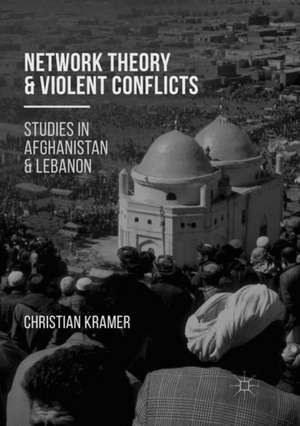
Network Theory and Violent Conflicts
Autor Christian R. Krameren Limba Engleză Paperback – 4 iul 2018
This book offers a novel approach to understanding violence and violent conflict using complexity and network theories, borrowed from the natural sciences, together with social network analysis. Because violence is both a universal and central component of human communication and identity formation, it has a fundamental function in shaping social behavior. Using Manuel Castells’ work on the programming of social networks, this book explores the Lebanese Civil War and the ongoing war in Afghanistan under the perspective of violence within networks. The approach presents a unique and compelling argument that counters the long-held assumption that war is caused by specific events, or is the unavoidable culmination of existing conditions or grievances. Rather, this book argues that violence emerges when the structure of social networks becomes too rigid and hierarchic to adapt to stresses and challenges that materialize on a constant basis from both within and without the network. This is important not only for the study of war, but as a method of improving the success of contemporary peace building efforts.
Preț: 697.89 lei
Preț vechi: 851.08 lei
-18%
Puncte Express: 1047
Carte tipărită la comandă
Livrare economică 13-27 noiembrie
Livrare prin curier în România Termenul estimat este afișat lângă disponibilitate.
Transport gratuit pentru acest produs Plată online sau ramburs, în funcție de opțiunile comenzii.
Retur gratuit în 14 zile Comandă securizată și suport în română.
Specificații
ISBN-13: 9783319823430
ISBN-10: 3319823434
Pagini: 240
Ilustrații: VII, 230 p.
Dimensiuni: 148 x 210 x 14 mm
Greutate: 0.32 kg
Ediția:Softcover reprint of the original 1st edition 2017
Editura: Springer
Locul publicării:Cham, Switzerland
ISBN-10: 3319823434
Pagini: 240
Ilustrații: VII, 230 p.
Dimensiuni: 148 x 210 x 14 mm
Greutate: 0.32 kg
Ediția:Softcover reprint of the original 1st edition 2017
Editura: Springer
Locul publicării:Cham, Switzerland
V-ar putea interesa
-
 The Cultural Nature of Human DevelopmentBarbara Rogoff-21%Preț: 274.14 lei345.90 lei
 -
 Inclusion and DemocracyIris Marion Young-21%Preț: 354.43 lei448.93 lei
 -
 Seeing Reason: Image and Language in Learning to ThinkKeith Stenning-33%Preț: 709.75 lei1053.55 lei
 -
 -29%Preț: 396.14 lei555.17 lei
 -
 A General Jurisprudence of Law and SocietyBrian Z. Tamanaha-28%Preț: 405.01 lei565.79 lei
 -
 Modern Social Theory: An IntroductionAustin Harrington-22%Preț: 395.35 lei504.02 lei
 -
 Reassembling the Social: BestsellerBruno Latour-13%Preț: 267.70 lei306.85 lei
 -
 International Migration and Social TheoryKaren O'ReillyPreț: 291.43 lei
 -
 Services Marketing: Text and CasesSteve Baron-11%Preț: 509.49 lei572.46 lei
 -
 The Future Of MoneyBernard LietaerPreț: 117.15 lei
 -
 Understanding Social TheoryDerek Layder-14%Preț: 686.71 lei798.50 lei
 -
 The Risk Society and BeyondBarbara Adam-18%Preț: 694.47 lei846.92 lei
 -
 Key Contemporary ConceptsJohn Lechte-18%Preț: 685.23 lei835.64 lei
 -
 Reproduction in Education, Society and CulturePierre Bourdieu-11%Preț: 526.05 lei591.06 lei
 -
 Risk SocietyUlrich Beck-22%Preț: 430.71 lei552.20 lei
 -
 A New Philosophy of Society: Assemblage Theory and Social ComplexityProfessor Manuel DeLanda-31%Preț: 210.40 lei305.16 lei
Cuprins
Chapter 1: Introduction.- Chapter 2: Networks, Complexity, and International Relations.- Chapter 3: Networks and Violence.- Chapter 4: Disintegrative Violence.- Chapter 5: Lebanon.- Chapter 6: Afghanistan.- Chapter 7: Network-centric Peacebuilding.
Notă biografică
Christian Kramer is an academic, researcher, and consultant, who has spent the past 15 years studying, working, and teaching in Europe, Latin America, the Middle East, Asia, and Australia. He obtained his PhD in International Relations from the London School of Economics, UK. His research interests focus on conflict studies and peace building, complexity and networks, and risk management. Christian is currently based in Melbourne, Australia.
Textul de pe ultima copertă
This book offers a novel approach to understanding violence and violent conflict using complexity and network theories, borrowed from the natural sciences, together with social network analysis. Because violence is both a universal and central component of human communication and identity formation, it has a fundamental function in shaping social behavior. Using Manuel Castells’ work on the programming of social networks, this book explores the Lebanese Civil War and the ongoing war in Afghanistan under the perspective of violence within networks. The approach presents a unique and compelling argument that counters the long-held assumption that war is caused by specific events, or is the unavoidable culmination of existing conditions or grievances. Rather, this book argues that violence emerges when the structure of social networks becomes too rigid and hierarchic to adapt to stresses and challenges that materialize on a constant basis from both within and without the network. This is important not only for the study of war, but as a method of improving the success of contemporary peace building efforts.
Caracteristici
Creates original connections among questions of networks and complexity theory, the role of violence in society, and explaining why wars end Presents incisive case studies applying network theory to the Lebanese Civil War and the ongoing war in Afghanistan Examines how networking principles can be used to forge a durable and resilient peace in societies that have been in conflict for some time