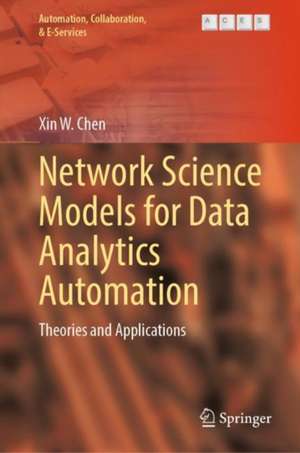
Network Science Models for Data Analytics Automation: Automation, Collaboration, & E-Services, cartea 9
Autor Xin W. Chenen Limba Engleză Hardback – 22 feb 2022
Engineers, researchers, and managers would benefit from the extensive theoretical background and practical examples discussed in this book. Advanced undergraduate students and graduate students in mathematics, statistics, engineering, business, public health, and social science may use this book as a one-semester textbook or a reference book. Readers who are more interested in applications may skip Chapter 1 and peruse through the rest of the book with ease.
Din seria Automation, Collaboration, & E-Services
- 20%
 Preț: 1106.44 lei
 - 20%
 Preț: 1124.29 lei
 - 18%
 Preț: 910.19 lei
 - 20%
 Preț: 1011.05 lei
 - 20%
 Preț: 943.96 lei
 - 24%
 Preț: 1354.21 lei
 - 18%
 Preț: 702.12 lei
 - 18%
 Preț: 919.70 lei
 - 24%
 Preț: 877.57 lei
 - 15%
 Preț: 632.34 lei
 - 18%
 Preț: 859.33 lei
 - 15%
 Preț: 621.56 lei
 - 20%
 Preț: 647.50 lei
 - 20%
 Preț: 615.98 lei
 - 15%
 Preț: 612.18 lei
 - 18%
 Preț: 964.09 lei
 - 18%
 Preț: 746.75 lei
 - nou
 Preț: 785.36 lei
Preț: 752.09 lei
Preț vechi: 917.18 lei
-18%
Puncte Express: 1128
Carte tipărită la comandă
Livrare economică 18 noiembrie-02 decembrie
Livrare prin curier în România Termenul estimat este afișat lângă disponibilitate.
Transport gratuit pentru acest produs Plată online sau ramburs, în funcție de opțiunile comenzii.
Retur gratuit în 14 zile Comandă securizată și suport în română.
Specificații
ISBN-13: 9783030964696
ISBN-10: 3030964698
Pagini: 128
Ilustrații: VI, 122 p. 40 illus., 21 illus. in color.
Dimensiuni: 160 x 241 x 13 mm
Greutate: 0.37 kg
Ediția:1st ed. 2022
Editura: Springer
Colecția Automation, Collaboration, & E-Services
Seria Automation, Collaboration, & E-Services
Locul publicării:Cham, Switzerland
ISBN-10: 3030964698
Pagini: 128
Ilustrații: VI, 122 p. 40 illus., 21 illus. in color.
Dimensiuni: 160 x 241 x 13 mm
Greutate: 0.37 kg
Ediția:1st ed. 2022
Editura: Springer
Colecția Automation, Collaboration, & E-Services
Seria Automation, Collaboration, & E-Services
Locul publicării:Cham, Switzerland
Cuprins
Network Science Models.- Interdependent Critical Infrastructures.- Public Health.- Smart and Autonomous Power Grid.- Water Distribution Systems.- Transportation Systems.
Textul de pe ultima copertă
This book explains network science and its applications in data analytics for critical infrastructures, engineered systems, and knowledge acquisition. Each chapter describes step-by-step processes of how network science enables and automates data analytics through examples. The book not only dissects modeling techniques and analytical results but also explores the intrinsic development of these models and analyses. This unique approach bridges the gap between theory and practice and channels’ managerial and problem-solving skills.
Engineers, researchers, and managers would benefit from the extensive theoretical background and practical examples discussed in this book. Advanced undergraduate students and graduate students in mathematics, statistics, engineering, business, public health, and social science may use this book as a one-semester textbook or a reference book. Readers who are more interested in applications may skip Chapter 1 and peruse through the rest of the book with ease.
Engineers, researchers, and managers would benefit from the extensive theoretical background and practical examples discussed in this book. Advanced undergraduate students and graduate students in mathematics, statistics, engineering, business, public health, and social science may use this book as a one-semester textbook or a reference book. Readers who are more interested in applications may skip Chapter 1 and peruse through the rest of the book with ease.
Caracteristici
Presents network science theoretical work in system modeling and analysis using big data Shows an in-depth treatment of the theoretical aspects of network science for data analytics Provides detailed illustration of how network science models enable better automation of the data analytics tools