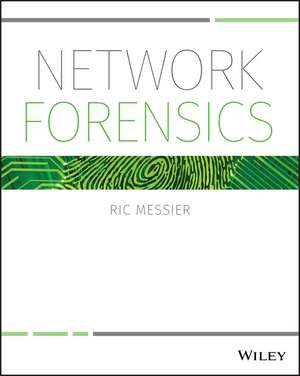
Network Forensics
Autor Ric Messieren Limba Engleză Paperback – 14 sep 2017
Descoperim aici o resursă tehnică riguroasă, concepută pentru a transforma un specialist IT într-un investigator capabil să identifice dovezi digitale în fluxuri de date volatile. Prin parcurgerea acestui volum, cititorul va implementa metodologii de analiză a traficului de rețea, învățând să disece pachete de date pentru a reconstrui comunicații suspecte. Abordarea propusă de Ric Messier este eminamente practică: nu se limitează la concepte abstracte, ci pune accentul pe manipularea directă a capturilor de pachete și pe interpretarea artefactelor de tip host.
Notăm cu interes structura progresivă a cărții, care începe cu fundamentele protocoalelor TCP/IP și modelul OSI, esențiale pentru orice investigație, pentru a trece rapid către utilizarea instrumentelor de diagnostic precum netstat, ntop sau suita Sysinternals. Față de Fundamentals of Network Forensics de R.C. Joshi, care adoptă o perspectivă mai academică asupra protocoalelor Internetului, lucrarea de față este orientată spre acțiune imediată și răspuns la incidente. De asemenea, dacă Tactical Wireshark se concentrează strict pe un singur instrument, Network Forensics oferă o viziune de ansamblu, integrând analiza log-urilor și sistemele de detecție a intruziunilor (IDS) în fluxul de lucru al investigatorului.
Această lucrare se poziționează ca o extensie naturală a expertizei autorului, completând ghidurile sale de certificare, precum Ceh V11 Certified Ethical Hacker Study Guide. Dacă lucrările anterioare se concentrau pe testarea penetrării, Network Forensics schimbă perspectiva către defensivă și investigație post-incident, oferind instrumentele necesare pentru a menține integritatea probelor prin hash-uri criptografice și lanțul de custodie.
Preț: 389.64 lei
Preț vechi: 487.06 lei
-20%
Carte tipărită la comandă
Livrare economică 25 septembrie-09 octombrie
Specificații
ISBN-10: 1119328284
Pagini: 360
Dimensiuni: 188 x 233 x 17 mm
Greutate: 0.59 kg
Editura: Wiley
Locul publicării:Hoboken, United States
V-ar putea interesa
-
 Incident Response & Computer Forensics, Third EditionJason Luttgens-30%Preț: 314.78 lei452.20 lei
 -
 Computer Networks: A Systems ApproachLarry L. Peterson-41%Preț: 558.53 lei940.13 lei
 -
 CCNA 200-301 Hands-on Mastery with Packet TracerAnthony Sequeira-20%Preț: 301.85 lei377.31 lei
 -
 Comptia Network+ N10-008 Cert GuideAnthony Sequeira-20%Preț: 279.53 lei349.42 lei
 -
 Computer Security FundamentalsWilliam Easttom-20%Preț: 495.87 lei619.84 lei
 -
 TCP/IP ILLUS 2/EKevin Fall-20%Preț: 396.88 lei496.10 lei
 -
 Hands-On Ethical Hacking and Network DefenseMichael Simpson-23%Preț: 409.83 lei534.82 lei
 -
 Introduction to Security and Network ForensicsWilliam J. Buchanan-8%Preț: 543.84 lei591.13 lei
 -
 Hands on HackingMatthew Hickey-20%Preț: 233.70 lei292.13 lei
 -
 CEH v11 Certified Ethical Hacker Study GuideRic MessierPreț: 299.18 lei
 -
 -24%Preț: 432.06 lei571.07 lei
 -
 Cryptography and Network SecurityWilliam Stallings-20%Preț: 623.17 lei778.95 lei
 -
 Fundamentals of Network ForensicsR. C. Joshi-20%Preț: 766.83 lei958.54 lei
 -
 CCNA Cybersecurity Operations Course BookletCisco Networking AcademyPreț: 266.28 lei
 -
 Attacking Network ProtocolsJames Forshaw-36%Preț: 276.75 lei432.68 lei
 -
 -36%Preț: 247.63 lei386.07 lei
 -
 The Book of PF, 4th Edition: A No-Nonsense Guide to the OpenBSD FirewallPeter N.M. Hansteen-37%Preț: 270.70 lei428.17 lei
 -
 Digital Forensics for Enterprises Beyond Kali LinuxAbhirup GuhaPreț: 308.45 lei
Public țintă
- IT networking practitioners
- Security practitioners
- Law enforcement officials gaining first exposure to cyber security networking forensics prior to a certification
De ce să citești această carte
Recomandăm această carte profesioniștilor care doresc să treacă dincolo de securitatea teoretică spre investigația digitală aplicată. Veți câștiga abilitatea de a identifica intruziunile în timp real și de a extrage dovezi solide din traficul de rețea. Este un ghid esențial pentru pregătirea certificărilor de profil sau pentru ofițerii care investighează criminalitatea informatică, oferind un echilibru perfect între analiza de protocol și utilizarea utilitarelor de sistem.
Despre autor
Ric Messier, posesor al certificărilor CEH și CISSP, este un consultant de securitate IT cu o experiență de zeci de ani în gestionarea rețelelor enterprise. În prezent, acesta predă cursuri de securitate și rețele la Brandeis University și Champlain College. Autor prolific, Messier a publicat numeroase ghiduri de referință pentru certificările de ethical hacking și programare în Rust. Expertiza sa practică este reflectată în abordarea didactică a cărții, fiind recunoscut și pentru contribuțiile sale în publicații de specialitate precum Hakin9 și PenTest Magazines.