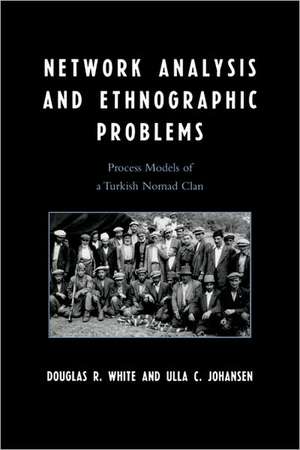
Network Analysis and Ethnographic Problems: Process Models of a Turkish Nomad Clan
Autor Douglas R. White, Ulla C. Johansenen Limba Engleză Paperback – 20 oct 2006
Preț: 384.50 lei
Preț vechi: 581.66 lei
-34%
Puncte Express: 577
Carte tipărită la comandă
Livrare economică 28 noiembrie-12 decembrie
Livrare prin curier în România Termenul estimat este afișat lângă disponibilitate.
Transport gratuit de la 400.00 lei Plată online sau ramburs, în funcție de opțiunile comenzii.
Retur gratuit în 14 zile Comandă securizată și suport în română.
Specificații
ISBN-13: 9780739118924
ISBN-10: 0739118927
Pagini: 496
Dimensiuni: 146 x 220 x 30 mm
Greutate: 0.68 kg
Editura: Bloomsbury Publishing
Colecția Lexington Books
Locul publicării:New York, United States
ISBN-10: 0739118927
Pagini: 496
Dimensiuni: 146 x 220 x 30 mm
Greutate: 0.68 kg
Editura: Bloomsbury Publishing
Colecția Lexington Books
Locul publicării:New York, United States
V-ar putea interesa
-
 The Rise And Fall Of The Third ChimpanzeeJared Diamond-20%Preț: 73.43 lei92.12 lei
 -
 The Origin of Our SpeciesChris StringerPreț: 78.32 lei
 -
 -31%Preț: 571.78 lei824.87 lei
 -
 The Thinking Ape: Evolutionary Origins of IntelligenceRichard Byrne-17%Preț: 357.06 lei432.39 lei
 -
 -31%Preț: 679.72 lei985.04 lei
 -
 The Menace of Multiculturalism: Trojan Horse in AmericaAlvin J. Schmidt-30%Preț: 413.66 lei588.99 lei
 -
 After Empire: Melancholia or Convivial Culture?Paul GilroyPreț: 405.99 lei
 -
 -15%Preț: 445.93 lei524.62 lei
 -
 Human Population GeneticsJohn H. Relethford-23%Preț: 535.99 lei696.08 lei
 -
 The Human StoryRobin DunbarPreț: 92.15 lei
 -
 The Mirage of ChinaXin LiuPreț: 262.69 lei
 -
 Handbook of EthnographyPaul Atkinson-8%Preț: 636.73 lei692.10 lei
 -
 Catching Fire: How Cooking Made Us HumanRichard Wrangham-19%Preț: 75.36 lei93.10 lei
 -
 Organizational EthnographySierk Ybema-15%Preț: 482.45 lei567.59 lei
Cuprins
1 Introduction:Networks, Ethnography and Emergence
Chapter 2 Problems of Analysis
Chapter 3 Ethnographic Setting
4 Theories, Rules and Exceptions
Chapter 5 Network Models and Complexity: Measures, Graphs, and Context
Chapter 6 Clan Structures and Dynamics
Chapter 7 Marriage, Rank and Migration: Fractality in Social Structure
Chapter 8 Demography, Structure, and Social Change
Chapter 9 Decentralized Leadership and Network Cohesion
Chapter 10 Graphic Approaches to Nomad Solidarity: The Endoconical Clan
Chapter 11 Conclusions
Chapter 2 Problems of Analysis
Chapter 3 Ethnographic Setting
4 Theories, Rules and Exceptions
Chapter 5 Network Models and Complexity: Measures, Graphs, and Context
Chapter 6 Clan Structures and Dynamics
Chapter 7 Marriage, Rank and Migration: Fractality in Social Structure
Chapter 8 Demography, Structure, and Social Change
Chapter 9 Decentralized Leadership and Network Cohesion
Chapter 10 Graphic Approaches to Nomad Solidarity: The Endoconical Clan
Chapter 11 Conclusions
Recenzii
This book presents a brilliant example of the application of network analysis to kinship. . . .The applied value of this study cannot be overestimated because kin structures still play important social (and sometimes political) roles in many societies. . . .This pioneering study establishes methodology that will be in demand in anthropology, political science, economics, legal studies, and Middle Eastern studies.
Network analysis, as White has been developing it and as he and Johansen apply it here, is not just one technique or method but a whole armamentarium of them, united under a system of general and powerful conceptions of social organization as such. It is such an enormous advance over what anthropologists called network analysis in the 1960s and 70s that it is almost a type of negative advertising to call it by the same name, yet there is a connection. White and Johansen actually deliver what those analyses promised-and then keep going.
[W]hat could be the most important book in anthropology in fifty years begins with an introduction to network analysis in relation to ethnography, providing a succinct history of network thinking including very recent developments in various disciplines about network topology and dynamics.... In addition to its contribution to our understanding kinship theory in a quite new way, this book makes an outstanding contribution by reintroducing ethnographers to the network perspective.... The authors point outthat 'taking a network path to coding and analysis' in ethnography leads to the ability to understand the emergence of social structural phenomena that would otherwise remain unobserved.... Whether the reader is interested in kinship, in economics, in politics or history, this book should be considered must reading..
This book shows how network analysis can usefully illuminate complex ethnographic situations that result from long term fieldwork in ways that go beyond the intuitive results of functionalism, (social) structuralism and practice theory.
Network analysis, as White has been developing it and as he and Johansen apply it here, is not just one technique or method but a whole armamentarium of them, united under a system of general and powerful conceptions of social organization as such. It is such an enormous advance over what anthropologists called network analysis in the 1960s and 70s that it is almost a type of negative advertising to call it by the same name, yet there is a connection. White and Johansen actually deliver what those analyses promised-and then keep going.
[W]hat could be the most important book in anthropology in fifty years begins with an introduction to network analysis in relation to ethnography, providing a succinct history of network thinking including very recent developments in various disciplines about network topology and dynamics.... In addition to its contribution to our understanding kinship theory in a quite new way, this book makes an outstanding contribution by reintroducing ethnographers to the network perspective.... The authors point outthat 'taking a network path to coding and analysis' in ethnography leads to the ability to understand the emergence of social structural phenomena that would otherwise remain unobserved.... Whether the reader is interested in kinship, in economics, in politics or history, this book should be considered must reading..
This book shows how network analysis can usefully illuminate complex ethnographic situations that result from long term fieldwork in ways that go beyond the intuitive results of functionalism, (social) structuralism and practice theory.