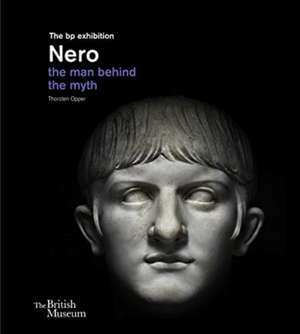
Nero
Autor Thorsten Opperen Limba Engleză Paperback – 12 aug 2021
Găsim în acest volum, publicat sub egida British Museum Press, un catalog monografic de o rară bogăție vizuală, care își propune să reevalueze una dintre cele mai controversate figuri ale antichității. Departe de imaginea clișeică a tiranului care „cânta la liră în timp ce Roma ardea”, Thorsten Opper utilizează cele 280 de ilustrații color pentru a ancora narațiunea istorică în dovezi materiale concrete. Suntem de părere că această abordare transformă lectura dintr-o simplă biografie într-o explorare multisenzorială a epocii neroniene. Structura volumului este riguros cronologică și tematică, pornind de la moștenirea lui Augustus și sistemul principatului, trecând prin conflictele externe din Armenia și Britania, până la politicile „populiste” și spectacolele publice care i-au asigurat lui Nero o popularitate durabilă în rândul claselor inferioare. Subliniem importanța capitolului dedicat dovezilor arheologice precum graffiti-urile din Pompeii, care oferă o voce „oamenilor de rând”, ignorată sistematic de autorii antici ostili din rândul elitelor senatoriale. Cartea acoperă aceeași arie tematică precum The Cambridge Companion to the Age of Nero, dar cu o abordare mai vizuală și mai axată pe cultura materială, oferind o perspectivă palpabilă asupra arhitecturii (Domus Aurea) și a limbajului vizual al puterii. În timp ce Nero Caesar Augustus de David Shotter se concentrează pe analiza politică și psihologică a împăratului, lucrarea lui Thorsten Opper pune accent pe contextul social și economic al unei imperiu în plină expansiune. Este o resursă esențială pentru înțelegerea modului în care s-a prăbușit prima dinastie imperială a Romei, oferind o interpretare nuanțată care echilibrează reformele administrative curajoase cu dezastrele naturale și intrigile de la curte.
Preț: 172.77 lei
Preț vechi: 207.96 lei
-17%
Carte disponibilă
Livrare economică 16-30 noiembrie
Livrare express 31 octombrie-06 noiembrie pentru 128.37 lei
Specificații
ISBN-10: 0714122912
Pagini: 304
Ilustrații: 280 Illustrations, color
Dimensiuni: 252 x 278 x 28 mm
Greutate: 1.65 kg
Editura: British Museum Press
V-ar putea interesa
-
 -15%Preț: 442.47 lei520.55 lei
 -
 -15%Preț: 503.86 lei592.77 lei
 -
 Trade, Traders and the Ancient CityHelen Parkins-15%Preț: 452.47 lei532.32 lei
 -
 Object in Focus: The Meroe Head of AugustusThorsten Opper-18%Preț: 36.25 lei43.96 lei
 -
 Household and Family Religion in AntiquityJohn BodelPreț: 392.66 lei
 -
 MéhtelekNándor KaliczPreț: 420.27 lei
 -
 -18%Preț: 1260.08 lei1536.68 lei
 -
 A Guide to Ancient HistorySohel A. BahjatPreț: 127.84 lei
 -
 Preț: 182.45 lei
 -
 Canaques de la Nouvelle-Calédonie, Esquisse Ethnographique (Éd.1895)J -B -Maurice VincentPreț: 105.84 lei
 -
 Histoire de la psychologie des Grecs. Tome 1 (Éd.1887-1893)Antelme-Édouard ChaignetPreț: 208.71 lei
 -
 Preț: 263.48 lei
 -
 Oeuvres Choisies de A.-J. Letronne. Série 1 (Éd.1881-1885)Antoine Jean LetronnePreț: 255.00 lei
 -
 Origine Du Peuple Romain (Éd.1846)CollectifPreț: 239.39 lei
 -
 Preț: 262.47 lei
 -
 Strabons Geographika: Epitome Und ChrestomathieStefan Radt-23%Preț: 1678.88 lei2180.35 lei
 -
 Preț: 87.04 lei
 -
 Arqueología particular y arqueología de rescateAlden YepezPreț: 377.60 lei
 -
 Pircas, Llamas y MaízGermán Gabriel Figueroa-8%Preț: 524.29 lei569.87 lei
De ce să citești această carte
Recomandăm această lucrare oricărui pasionat de istorie antică sau arheologie care dorește să treacă dincolo de miturile create de Tacitus sau Suetonius. Cititorul câștigă o viziune echilibrată asupra lui Nero, susținută de dovezi arheologice recente și ilustrații superbe. Este un instrument indispensabil pentru studenți și cercetători, oferind un context social clar asupra modului în care propaganda și realitatea materială s-au intersectat în secolul I d.Hr.
Despre autor
Thorsten Opper este curator principal în cadrul departamentului pentru Grecia și Roma al British Museum, fiind un specialist recunoscut în sculptura antică și portretistica imperială romană. Expertiza sa în gestionarea colecțiilor de antichități și participarea la numeroase proiecte de cercetare pe teren îi permit să analizeze istoria nu doar prin prisma textelor scrise, ci și prin cea a artefactelor. Munca sa la British Museum Press se concentrează pe aducerea istoriei clasice mai aproape de publicul larg prin publicații care îmbină rigoarea academică cu o prezentare grafică de excepție.
Descriere scurtă
This publication redresses the balance and provides a more nuanced interpretation of Nero's reign and Roman society of the time, reflecting on the traditional perceptions of his rule and revealing the substantial external and internal challenges with which the sixteen-year-old heir to the Roman empire had to contend.
Nero's rule fell in an extended period of transition and profound social and economic change. The empire had grown rapidly during previous centuries, and an astonishing era of peace and prosperity followed the introduction of one-man rule after decades of bloody civil war under Nero's great-great-grandfather Augustus. However, political institutions and elite mindsets were slow to adjust to the resulting rise of former outsiders, people from the provinces and freed slaves.
The book considers in detail the resulting tensions and the challenging role of Nero's family within them. Powerful individuals, among them many women, including Nero's mother Agrippina, and his tutor and advisor Seneca, come to life against the backdrop of these times, when different court factions thought to manipulate the young ruler. At the same time, intriguing evidence - doodles and graffiti - from Rome, Pompeii and other Vesuvian cities gives voice to often very different attitudes of common people, completely ignored by the ancient literary sources.
In addition to these internal challenges, Nero inherited a great conflict with the rival power of the Parthians and unrest in unsettled newly conquered territories, including Britain. The book examines his military and diplomatic response and the powerful visual language - often disregarded - that presented him as a successful young military leader throughout the empire. Administrative and tax reforms culminated in 'populist' policies that also saw him embrace enthusiastically the possibilities offered through public entertainments (the circus, arena and theater) to communicate directly with his subjects and project a more direct, charismatic form of rule. Yet his grand building projects and the beautification of his capital were offset by severe natural disasters and a devastating fire of Rome.
Popular with the common people to the very end, Nero could not reconcile the internal contradictions of the principate, the political system introduced by Augustus. Hostile segments of the elite were behind military rebellions in AD 68 that quickly drove Nero from power. His enforced suicide brought to an end the rule of Rome's first imperial dynasty, the Julio-Claudians. The subsequent vilification of his memory and the removal and desecration of his image are an enduring, but misleading, legacy that leave a fascinating reign to be explored anew.
Notă biografică
Cuprins
1. Nero and the family of Augustus - Augustus and the system of the principate; Julio-Claudian society; Nero's family
2. Power and succession - Nero's accession; expectations of the new reign; poetry and imagery
3. Conflict and reform - Nero and the military; external conflicts; the Armenian War; Britain and the Boudicca rebellion
4. Spectacle and splendor - Nero's reforms and major projects; public entertainment; Nero on stage
5. Passion and discord - the imperial family; Nero's wives and daughter
6. Fire - the great fire of Rome of AD 64
7. The new Apollo - Nero's palaces and the Domus Aurea; luxury and elite society; diplomacy and triumph
8. Crisis and death - internal conflict and elite resistance; rebellion; Nero's death; civil war; 'False Neros' and Nero's enduring popularity
Bibliography
Credits
Index