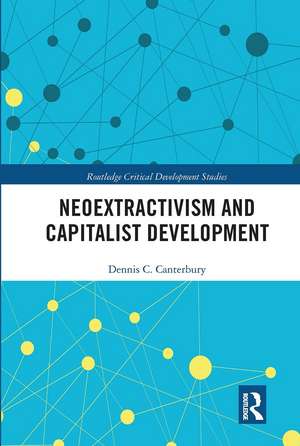
Neoextractivism and Capitalist Development: Routledge Critical Development Studies
Autor Dennis C. Canterburyen Limba Engleză Paperback – 30 sep 2020
With particular reference to the role of neoextractivism within Latin America and the Caribbean, using Guyana as a case study, the book aims to provide readers with the tools they need to critically analyze neoextractivism as a development model, identifying alternative paths for improving the human condition. This book will be of interest to academics and students in the fields of international development, political economy, sociology, and globalization, as well as to policymakers and political activists engaged in social movements in the natural resources sector.
Din seria Routledge Critical Development Studies
-
 Preț: 464.14 lei
 - 18%
 Preț: 1248.98 lei
 -
 Preț: 391.31 lei
 -
 Preț: 428.53 lei
 -
 Preț: 406.86 lei
 -
 Preț: 212.32 lei
 -
 Preț: 407.04 lei
 -
 Preț: 387.07 lei
 -
 Preț: 412.48 lei
 -
 Preț: 410.99 lei
 -
 Preț: 381.06 lei
 -
 Preț: 380.33 lei
 -
 Preț: 397.97 lei
 -
 Preț: 359.65 lei
 -
 Preț: 403.78 lei
 -
 Preț: 381.76 lei
 - 15%
 Preț: 434.37 lei
 - 18%
 Preț: 1123.53 lei
 - 22%
 Preț: 346.24 lei
 - nou
 Preț: 1129.11 lei
Preț: 460.11 lei
Puncte Express: 690
Carte tipărită la comandă
Livrare economică 27 noiembrie-11 decembrie
Livrare prin curier în România Termenul estimat este afișat lângă disponibilitate.
Transport gratuit pentru acest produs Plată online sau ramburs, în funcție de opțiunile comenzii.
Retur gratuit în 14 zile Comandă securizată și suport în română.
Specificații
ISBN-13: 9780367666644
ISBN-10: 0367666642
Pagini: 256
Dimensiuni: 156 x 234 x 21 mm
Greutate: 0.47 kg
Ediția:1
Editura: Taylor & Francis
Colecția Routledge
Seria Routledge Critical Development Studies
Locul publicării:Oxford, United Kingdom
ISBN-10: 0367666642
Pagini: 256
Dimensiuni: 156 x 234 x 21 mm
Greutate: 0.47 kg
Ediția:1
Editura: Taylor & Francis
Colecția Routledge
Seria Routledge Critical Development Studies
Locul publicării:Oxford, United Kingdom
Public țintă
Postgraduate and UndergraduateCuprins
Introduction
Part 1: The Debate on Neoextractivism
1. Neoextractivism and Capitalist Development: An Outline
2. Development Theory and Capitalist Development
3. Extractivism and Neoextractivism
4. Neoextractivism: Myth or Reality
5. Extractive Capitalism, Extractive Imperialism and Imperialism
Part 2: Neoextractivism and Capitalist Centre-Periphery Relations
6. Natural Resources Extraction and Expanded Capitalist Relations
7. The Foundations of Post-Colonial 'New' Extractivism
8. The Post-Colonial Authoritarian State
9. The Criminalized Authoritarian State
10. Political Change and Foreign Intervention
Conclusion
Part 1: The Debate on Neoextractivism
1. Neoextractivism and Capitalist Development: An Outline
2. Development Theory and Capitalist Development
3. Extractivism and Neoextractivism
4. Neoextractivism: Myth or Reality
5. Extractive Capitalism, Extractive Imperialism and Imperialism
Part 2: Neoextractivism and Capitalist Centre-Periphery Relations
6. Natural Resources Extraction and Expanded Capitalist Relations
7. The Foundations of Post-Colonial 'New' Extractivism
8. The Post-Colonial Authoritarian State
9. The Criminalized Authoritarian State
10. Political Change and Foreign Intervention
Conclusion
Notă biografică
Dennis C. Canterbury is a Professor of Sociology at Eastern Connecticut State University, USA
Recenzii
"Neoextractivism and Capitalist Development is a brilliant synthesis of economic structures, class relations and state power embedded in a historical analysis. Canterbury provides an insightful critique of the regressive role and impact of international extractive capitalist development. His incisive discussion provides a framework for identifying a progressive and dynamic alternative development model which will be of interest to students, academics and policymakers." James Petras, Bartle Professor (Emeritus), Binghamton University, USA
"Karl Marx chronicled how human activity is essentially the interaction with nature to produce the basic needs for reproduction, and each epoch is characterized by who controls both the process and the outcome of those interactions. Capitalism, as a system of production, is predicated on private ownership of productive forces that appropriates the surplus generated by working men and women. With the expansion of capitalist development worldwide comes the appropriation of natural resources from former colonies masked as beneficial to local populations by a range of development theories. Dennis Canterbury reveals how neoextractivism is but one more iteration of development theory, one informed by neoliberal policies that does little to benefit society. His important case study of Guyana details how neoextractivism creates the false illusion that developing countries have escaped capitalist exploitation through the natural resource extraction of the past, and instead undermines the struggles of working people in their opposition to the ravages of capitalism." David Fasenfest, Department of Sociology, Wayne State University, USA
"This is a work of consummate scholarship that will be of especial interest to members and supporters of left-wing social movements in developing countries. It reveals the limits of progressive development strategies that rely on extracting high world market price raw materials such as oil to finance social projects. The author is interested in development strategies that lead not just to conventional economic growth but also to substantive human progress." James W. Russell, Lecturer in Public Policy, Portland State University, USA
"The book offers a new and innovative perspective on neoextractivism in Latin America and the Caribbean. It uncovers and shares details of the relationships between stakeholders in the region’s extractive industries ‘space’, offering fresh explanations for its underwhelming economic performance. The book promises to be an invaluable tool for researchers active in Latin America, as well international organizations in the donor and NGO communities working on transparency, community development and environmental managerial aspects of the extractive industries in the region." Gavin Hilson, Chair of Sustainability in Business, The Surrey Business School, UK
"Neoextractivism and Capitalist Development is an exceptional contribution to the scholarly literature on global capitalism, and its influences on development in the Caribbean and other regions in the Global South transitioning from neoliberalism to post-neoliberalism models of capital accumulation. To expound contemporary theories of global capitalism and imperialism in the post-neoliberal phase, Dennis Canterbury operationalizes the concept neoextractivism with its attendant misrepresentations of ideas of development, its promises of social mobility and empowerment, and the alleged enhancement in the quality of life for ordinary citizens. Fundamentally, Neoextractivism makes special reference to Latin America and the Caribbean; employing Guyana as a case study, the book aims to provide readers with the analytical tools they need for improving the human condition. This book will be of special interest to academics and students in the fields of international development, political economy, area studies, political science, sociology and globalization, as well as policymakers and political activists engaged in social movements in the natural resources sector." Darryl C. Thomas, Associate Professor of African American Studies, Penn State University, USA
"Karl Marx chronicled how human activity is essentially the interaction with nature to produce the basic needs for reproduction, and each epoch is characterized by who controls both the process and the outcome of those interactions. Capitalism, as a system of production, is predicated on private ownership of productive forces that appropriates the surplus generated by working men and women. With the expansion of capitalist development worldwide comes the appropriation of natural resources from former colonies masked as beneficial to local populations by a range of development theories. Dennis Canterbury reveals how neoextractivism is but one more iteration of development theory, one informed by neoliberal policies that does little to benefit society. His important case study of Guyana details how neoextractivism creates the false illusion that developing countries have escaped capitalist exploitation through the natural resource extraction of the past, and instead undermines the struggles of working people in their opposition to the ravages of capitalism." David Fasenfest, Department of Sociology, Wayne State University, USA
"This is a work of consummate scholarship that will be of especial interest to members and supporters of left-wing social movements in developing countries. It reveals the limits of progressive development strategies that rely on extracting high world market price raw materials such as oil to finance social projects. The author is interested in development strategies that lead not just to conventional economic growth but also to substantive human progress." James W. Russell, Lecturer in Public Policy, Portland State University, USA
"The book offers a new and innovative perspective on neoextractivism in Latin America and the Caribbean. It uncovers and shares details of the relationships between stakeholders in the region’s extractive industries ‘space’, offering fresh explanations for its underwhelming economic performance. The book promises to be an invaluable tool for researchers active in Latin America, as well international organizations in the donor and NGO communities working on transparency, community development and environmental managerial aspects of the extractive industries in the region." Gavin Hilson, Chair of Sustainability in Business, The Surrey Business School, UK
"Neoextractivism and Capitalist Development is an exceptional contribution to the scholarly literature on global capitalism, and its influences on development in the Caribbean and other regions in the Global South transitioning from neoliberalism to post-neoliberalism models of capital accumulation. To expound contemporary theories of global capitalism and imperialism in the post-neoliberal phase, Dennis Canterbury operationalizes the concept neoextractivism with its attendant misrepresentations of ideas of development, its promises of social mobility and empowerment, and the alleged enhancement in the quality of life for ordinary citizens. Fundamentally, Neoextractivism makes special reference to Latin America and the Caribbean; employing Guyana as a case study, the book aims to provide readers with the analytical tools they need for improving the human condition. This book will be of special interest to academics and students in the fields of international development, political economy, area studies, political science, sociology and globalization, as well as policymakers and political activists engaged in social movements in the natural resources sector." Darryl C. Thomas, Associate Professor of African American Studies, Penn State University, USA
Descriere
The term neoextractivism was coined to describe how income from natural resources sales can be used for development objectives and to improve the lives of a country's citizens. However, this book argues that neoextractivism is merely another outlet for capitalist development, reinforcing the position of elites, with few benefits for working