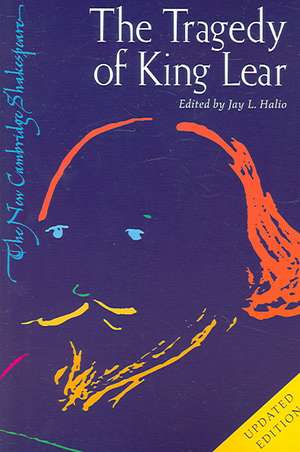
NCS
Autor William Shakespeare Editat de Jay L. Halioen Limba Engleză Paperback – 25 sep 2018
Preț: 72.23 lei
Preț vechi: 81.44 lei
-11%
Puncte Express: 108
Carte indisponibilă temporar
Livrare prin curier în România Termenul estimat este afișat lângă disponibilitate.
Transport gratuit de la 400.00 lei Plată online sau ramburs, în funcție de opțiunile comenzii.
Retur gratuit în 14 zile Comandă securizată și suport în română.
Specificații
ISBN-13: 9780521612630
ISBN-10: 0521612632
Pagini: 336
Ilustrații: 17 b/w illus.
Dimensiuni: 152 x 229 x 19 mm
Greutate: 0.54 kg
Ediția:Revizuită
Editura: Cambridge University Press
Locul publicării:Cambridge, United Kingdom
ISBN-10: 0521612632
Pagini: 336
Ilustrații: 17 b/w illus.
Dimensiuni: 152 x 229 x 19 mm
Greutate: 0.54 kg
Ediția:Revizuită
Editura: Cambridge University Press
Locul publicării:Cambridge, United Kingdom
V-ar putea interesa
-
 HamletCollins GcsePreț: 28.01 lei
 -
 A Midsummer Night's DreamWilliam ShakespearePreț: 28.01 lei
 -
 Twelfth NightWilliam ShakespearePreț: 28.01 lei
 -
 XSONNETS_CLASSICS PBWilliam ShakespearePreț: 29.15 lei
 -
 The TempestWilliam ShakespearePreț: 28.01 lei
 -
 The History of King Lear: The Oxford ShakespeareWilliam ShakespearePreț: 70.76 lei
 -
 The Tragedy of King Richard III: The Oxford ShakespeareWilliam ShakespearePreț: 72.64 lei
 -
 Oedipus the King, Second EditionSophoclesPreț: 65.45 lei
 -
 All's Well that Ends WellProf. Eric Rasmussen-20%Preț: 65.90 lei81.91 lei
 -
 King LearProf. Eric Rasmussen-18%Preț: 67.75 lei82.82 lei
 -
 King LearWilliam ShakespearePreț: 34.84 lei
 -
 Measure for MeasureWilliam ShakespearePreț: 27.29 lei
 -
 The PoemsWilliam ShakespearePreț: 58.34 lei
 -
 King Lear: York Notes Advanced - for 2026, 2027 examsWilliam ShakespearePreț: 60.95 lei
 -
 King Henry VWilliam ShakespearePreț: 41.64 lei
 -
 All's Well That Ends WellWilliam ShakespearePreț: 38.47 lei
 -
 Troilus and CressidaWilliam ShakespearePreț: 39.47 lei
 -
 King JohnWilliam ShakespearePreț: 37.70 lei
 -
 The Tragedy of HamletWilliam ShakespearePreț: 44.09 lei
 -
 King Lear - Ed. Best & JoubinWilliam Shakespeare-16%Preț: 132.74 lei158.72 lei
 -
 The Tragedy of King LearWilliam Shakespeare-18%Preț: 67.41 lei81.86 lei
 -
 -27%Preț: 46.42 lei63.73 lei
 -
 Shakespeare's King LearRichard Knowles-9%Preț: 2401.93 lei2639.48 lei
 -
 Pericles: Discover Primary & Early YearsWilliam Shakespeare-25%Preț: 39.78 lei53.29 lei
 -
 Antony and CleopatraWilliam ShakespearePreț: 28.01 lei
 -
 Taming of the ShrewWilliam ShakespearePreț: 30.08 lei
 -
 King LearWilliam ShakespearePreț: 29.68 lei
 -
 Winter''s TaleWilliam ShakespearePreț: 30.04 lei
 -
 Much Ado About NothingWilliam ShakespearePreț: 28.01 lei
 -
 The Life and Death of King Richard the SecondWilliam ShakespearePreț: 84.46 lei
Descriere
For this second edition of King Lear, Jay L. Halio has added a new introductory section on recent stage, film, and critical interpretations of the play. He also discusses Shakespeare's sources, including literary, political and folkloric influences on the work. An updated reading list completes the edition.
Cuprins
List of illustrations; Preface; Acknowledgements; List of abbreviations and conventions; Introduction: The play and its date; The coercive Chorus; Context and sources; Structure and language; Staging and stage history; Recent critical and stage interpretations; Note on the text; List of characters; The Play; Textual analysis; Appendices: Theatre sources: The Famous Victories; Historical Sources: Holinshed's Chronicles; Background sources: Richard Crompton, The Mansion of Magnanimitie; Reading list.
Recenzii
'Here in the elegant format emblematic of this collected edition … is a play entitled King Edward III … Giorgio Melchiori's introduction to the New Cambridge Edward III, together with the actual editorial presentation and appendix on the play's sources are models of learned scruple. What this superb edition compels us to keep asking is simply this: 'how did Shakespeare become Shakespeare?' Neither the history of literature nor of language provides a richer ground for wonder.' George Steiner, The Observer
'Anyone who reads through Edward III with an open mind will, I believe, accept that the Shakespeare canon is permanently enlarged. It is an exhilarating experience.' Contemporary Review
'Anyone who reads through Edward III with an open mind will, I believe, accept that the Shakespeare canon is permanently enlarged. It is an exhilarating experience.' Contemporary Review
Notă biografică
William Shakespeare (1564 - 1616) was an English poet, playwright, and actor, widely regarded as the greatest writer in the English language and the world's greatest dramatist. He is often called England's national poet and the "Bard of Avon". His extant works, including collaborations, consist of some 39 plays, 154 sonnets, and two long narrative poems. His plays have been translated into every major living language and are performed more often than those of any other playwright. Shakespeare was born and raised in Stratford-upon-Avon, Warwickshire. At the age of 18, he married Anne Hathaway, with whom he had three children: Susanna and twins Hamnet and Judith. Sometime between 1585 and 1592, he began a successful career in London as an actor, writer, and part-owner of a playing company called the Lord Chamberlain's Men, later known as the King's Men. At age 49 (around 1613), he appears to have retired to Stratford, where he died three years later. Shakespeare produced most of his known works between 1589 and 1613. His early plays were primarily comedies and histories and are regarded as some of the best work produced in these genres. Until about 1608, he wrote mainly tragedies, among them Hamlet, Othello, King Lear, and Macbeth, all considered to be among the finest works in the English language.