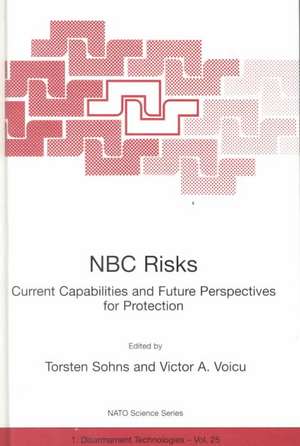
NBC Risks Current Capabilities and Future Perspectives for Protection: NATO Science Partnership Subseries: 1, cartea 25
Editat de Victor A. Voicu, Torsten Sohnsen Limba Engleză Hardback – 30 iun 1999
Din seria NATO Science Partnership Subseries: 1
- 15%
 Preț: 612.85 lei
 - 15%
 Preț: 662.95 lei
 - 18%
 Preț: 978.38 lei
 - 18%
 Preț: 980.46 lei
 - 18%
 Preț: 908.45 lei
 - 18%
 Preț: 908.00 lei
 - 18%
 Preț: 1264.78 lei
 - 18%
 Preț: 1219.90 lei
 -
 Preț: 382.57 lei
 - 18%
 Preț: 973.09 lei
 - 18%
 Preț: 1268.20 lei
 - 18%
 Preț: 1172.77 lei
 - 18%
 Preț: 976.03 lei
 - 18%
 Preț: 904.53 lei
 - 18%
 Preț: 981.53 lei
 - 18%
 Preț: 909.21 lei
 - 18%
 Preț: 990.10 lei
 - 15%
 Preț: 662.95 lei
 - 15%
 Preț: 612.68 lei
 - 18%
 Preț: 906.34 lei
 - 18%
 Preț: 1062.99 lei
 - 18%
 Preț: 1176.72 lei
 - 18%
 Preț: 1269.42 lei
 - 15%
 Preț: 670.80 lei
 - 18%
 Preț: 978.38 lei
 - 15%
 Preț: 615.66 lei
 - 15%
 Preț: 639.35 lei
 - 18%
 Preț: 1263.31 lei
 - 18%
 Preț: 1171.58 lei
 -
 Preț: 376.55 lei
 - 18%
 Preț: 908.45 lei
 - 18%
 Preț: 978.99 lei
 - 5%
 Preț: 1458.72 lei
 - 5%
 Preț: 1353.09 lei
 -
 Preț: 388.39 lei
 -
 Preț: 379.80 lei
 - 15%
 Preț: 660.08 lei
 - 18%
 Preț: 915.58 lei
Preț: 2204.16 lei
Preț vechi: 2320.17 lei
-5%
Puncte Express: 3306
Carte tipărită la comandă
Livrare economică 07-21 decembrie
Livrare prin curier în România Termenul estimat este afișat lângă disponibilitate.
Transport gratuit pentru acest produs Plată online sau ramburs, în funcție de opțiunile comenzii.
Retur gratuit în 14 zile Comandă securizată și suport în română.
Specificații
ISBN-13: 9780792358022
ISBN-10: 0792358023
Pagini: 560
Ilustrații: XIII, 543 p. 64 illus.
Dimensiuni: 160 x 241 x 35 mm
Greutate: 0.95 kg
Ediția:1999
Editura: SPRINGER NETHERLANDS
Colecția NATO Science Partnership Subseries: 1
Seria NATO Science Partnership Subseries: 1
Locul publicării:Dordrecht, Netherlands
ISBN-10: 0792358023
Pagini: 560
Ilustrații: XIII, 543 p. 64 illus.
Dimensiuni: 160 x 241 x 35 mm
Greutate: 0.95 kg
Ediția:1999
Editura: SPRINGER NETHERLANDS
Colecția NATO Science Partnership Subseries: 1
Seria NATO Science Partnership Subseries: 1
Locul publicării:Dordrecht, Netherlands
V-ar putea interesa
-
 -5%Preț: 1135.40 lei1195.16 lei
 -
 -15%Preț: 665.77 lei783.26 lei
 -
 Drug Delivery StrategiesDennis Douroumis-5%Preț: 1344.71 lei1415.48 lei
 -
 Preț: 432.16 lei
 -
 Health Effects of Ambient Air PollutionJane Q. Koenig-15%Preț: 668.72 lei786.73 lei
 -
 Theoretical and Mathematical Foundations of Human Health Risk AnalysisDouglas J. Crawford-Brown-15%Preț: 662.49 lei779.41 lei
 -
 Principles of ToxicologyKaren E. Stine-5%Preț: 803.18 lei845.45 lei
 -
 -27%Preț: 1250.75 lei1703.36 lei
 -
 -23%Preț: 608.29 lei793.96 lei
 -
 Botulinum Toxins & BotulismCharlotte Reynolds-23%Preț: 1041.81 lei1361.38 lei
 -
 -28%Preț: 52.21 lei72.72 lei
 -
 Estrogens and Antiestrogens IMichael Oettel-5%Preț: 2199.29 lei2315.04 lei
 -
 Englisch in der ApothekeDagmar CarraPreț: 269.27 lei
 -
 ToxicogenomicsTohru Inoue-5%Preț: 748.11 lei787.48 lei
Public țintă
ResearchCuprins
I Nuclear, Biological and Chemical Risks — General Approach.- 1. The Proliferation of Weapons of Mass Destruction: Health Risks — An Analysis from a Medical Perspective.- 2. Intervention in a Chemical, Biological or Nuclear Disaster. A Romanian Point of View.- 3. Are the Civilians prepared for Chemical and/or Biological Warfare? The Need of a Cooperative Effort for a simple Guideline.- 4. Defense against Biological Terrorism — Scope and Limits.- 5. NBC Medical Planning System (NBCMedPlanS) — An Expert System.- 6. Planning of Medical Support for a Threatened or Actual Biological Environment. Principles, Policies and Procedures.- II Pharmacoprotection and Treatment.- 7. Finite Interactions Theory — A Biophysical Approach to Xenobiotic — Membrane Interface Interactions.- 8. A Theoretical Study of the Interactions of Acetylcholinesterase, Irreversible Inhibitors, and their Antidotes.- 9. Electrochemical Properties of Platelets: Clinical and Pharmacological Applications.- 10. Features of Apoptotic Cell Death in SCL II Cells after Exposure to 2,2-Dichlorodiethylsulfide.- 11. A NewView on the Mechanism of Action of Reversible Cholinesterase Inhibitors as Drugs for Prophylaxis.- 12. Cholinesterases as Bioscavengers for Protection against Organophosphate Chemical Warfare Agents.- 13. Selectivity and Protective Activity of Muscarinic Receptor’s Antagonists in Organophosphates Poisoning.- 14. Reactivators, from Classic to a New Generation.- 15. Convulsions in Organophosphate Intoxications: Their Mechanism and Treatment.- 16. Treatment of Organophosphate Nerve Agents, Current Therapy and Future Prospectives.- 17. Reactivation of Organophosphorus — Inhibited Human Erythrocyte-Acetylcholinesterase by Oximes in vitro.- 18. Cholinesterase Status in OrganophosphatePoisoned Patients.- 19. Testing the Antidotal Efficiency in the Treatment of Aflatoxin Poisoning.- 20. Zeolites as (Potential) Decorporating Agents.- III Skin Protection and Decontamination.- 21. New Concepts of Prophylaxis and Decontamination of Chemical Warfare Agents.- 22. Sorption-Mechanical Principle in Skin Decontamination.- 23. Reduction of the Skin Permeation of Xenobiotics Using Chemical Penetration Retarders.- 24. Effects of Protective Clothing on the Skin Penetration of Xenobiotics.- 25. Powders, Ointments and Solutions as First Aid, Nonspecific Antidotes for Organophosphorous Compounds at Skin Level.- 26. Protective Properties of Standard Combat Clothing against Skin Penetration of Supertoxic Lethal Chemical Warfare Agents.- IV Pharmaceutical Aspects of Protectants.- 27. Studies Concerning some Effects of Drugs, Colloid Vectors for Drugs and Decorporators on Blood Global Physico-Chemical Parameters.- 28. Transdermal Systems with Poly-2-Hydroxyethylmeth-Acrylates and new Biological Models for their Study.- 29. New Pharmaceutical Forms for Skin Protection.- 30. New Systems of Polyacrylate Copolymers for Controlled Delivery of Drugs.- 31. Researches on the Embedding of Decorporators in Microemulsions.- 32. Controlled Release Microspheres Prepared by using an Emulsion Solvent-Diffusion Technique as a Tool in Design of new Antidotes.- 33. Micro and Nanoparticles as Drug Carriers.- 34. A Structure — Property Relationship and Quantitative Approach to the Development of Universal Transdermal Drug Delivery System.- 35. The Dependence between Physico-Chemical and Allergenic Properties of Xenobiotics.- 36. Some Physical Chemical Aspects of Albumin-Alkali Halide Interaction.- V Environment Aspects of NBC Disarmament.- 37. Considerations in Investigations of MilitaryInstallation Decommissioning: Determining how Clean is Clean.- 38. The Comparative Danger of Chemical Weapons and Organophosphorous Pesticides for Aquatic Ecosystem Health.- 39. Direct Methods in the Evaluation of the Internal Contamination with Radionuclides.- 40. Retrospective Detection of Exposure to Organophosphates: Analyses in Blood of Human Beings and Rhesus Monkeys.- 41. Radiochemical Analysis of Environmental Samples in the Era of Disarmament.- List of Participants.