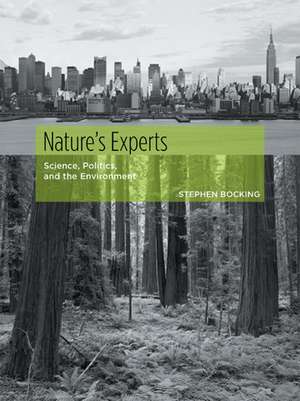
Nature's Experts: Science, Politics, and the Environment
Autor Stephen Bockingen Limba Engleză Paperback – 29 sep 2004
"With clarity and grace, Stephen Bocking tackles the complicated question of the role of scientific expertise in environmental policy making. Nature’s Experts is a timely and important book."—David H. Guston, author of Between Politics and Science: Assuring the Integrity and Productivity of Research
"This book by Stephen Bocking is as much about deliberative democracy as it is about science and the environment. Stephen Bocking’s treatment is deep, perceptive, and profoundly wise. He has caught the heart of present and future environmental science, politics, and democratic governance."—C. S. Holling, The Resilience Alliance and emeritus professor, Arthur R. Marshall Jr. Chair in Ecological Sciences at the University of Florida
"If knowledge is power, how should expert advice be deployed by a would-be democratic society? This perennial question is newly illuminated by this timely and wide-ranging review of the role played by science in the making of environmental policy."—William C. Clark, Harvey Brooks Professor of International Science, Public Policy, and Human Development, Harvard University, John F. Kennedy School of Government
It seems self-evident that science plays a central role in environmental affairs. Regulatory agencies, businesses, and public interest groups all draw on scientific research to support their claims. Some critics, however, describe science not as the solution to environmental problems, but as their source. Moreover, the science itself is often controversial, as debates over global warming and environmental health risks have shown.
Nature’s Experts explores the contributions and challenges presented when scientific authority enters the realm of environmental affairs. Stephen Bocking focuses on four major areas of environmental politics: the formation of environmental values and attitudes, management of natural resources such as forests and fish, efforts to address international environmental issues such as climate change, and decisions relating to environmental and health risks. In each area, practical examples and case studies illustrate that science must fulfill two functions if it is to contribute to resolving environmental controversies. First, science must be relevant and credible, and second, it must be democratic, where everyone has access to the information they need to present and defend their views.
"If knowledge is power, how should expert advice be deployed by a would-be democratic society? This perennial question is newly illuminated by this timely and wide-ranging review of the role played by science in the making of environmental policy."—William C. Clark, Harvey Brooks Professor of International Science, Public Policy, and Human Development, Harvard University, John F. Kennedy School of Government
It seems self-evident that science plays a central role in environmental affairs. Regulatory agencies, businesses, and public interest groups all draw on scientific research to support their claims. Some critics, however, describe science not as the solution to environmental problems, but as their source. Moreover, the science itself is often controversial, as debates over global warming and environmental health risks have shown.
Nature’s Experts explores the contributions and challenges presented when scientific authority enters the realm of environmental affairs. Stephen Bocking focuses on four major areas of environmental politics: the formation of environmental values and attitudes, management of natural resources such as forests and fish, efforts to address international environmental issues such as climate change, and decisions relating to environmental and health risks. In each area, practical examples and case studies illustrate that science must fulfill two functions if it is to contribute to resolving environmental controversies. First, science must be relevant and credible, and second, it must be democratic, where everyone has access to the information they need to present and defend their views.
Preț: 298.55 lei
Puncte Express: 448
Preț estimativ în valută:
52.85€ • 61.38$ • 45.78£
52.85€ • 61.38$ • 45.78£
Carte tipărită la comandă
Livrare economică 03-17 martie
Preluare comenzi: 021 569.72.76
Specificații
ISBN-13: 9780813533988
ISBN-10: 0813533988
Pagini: 312
Dimensiuni: 152 x 229 x 23 mm
Greutate: 0.42 kg
Ediția:None
Editura: Rutgers University Press
Colecția Rutgers University Press
ISBN-10: 0813533988
Pagini: 312
Dimensiuni: 152 x 229 x 23 mm
Greutate: 0.42 kg
Ediția:None
Editura: Rutgers University Press
Colecția Rutgers University Press
V-ar putea interesa
-
 -33%Preț: 718.87 lei1077.38 lei
 -
 -30%Preț: 370.45 lei527.29 lei
 -
 Natural Resource and Environmental EconomicsRoger Perman-12%Preț: 656.53 lei746.05 lei
 -
 Oil, Water, and Climate: An IntroductionCatherine Gautier-11%Preț: 463.51 lei520.80 lei
 -
 The Big Thirst: The Secret Life and Turbulent Future of WaterCharles FishmanPreț: 102.40 lei
 -
 Drilling Down: The Gulf Oil Debacle and Our Energy DilemmaJoseph A. TainterPreț: 200.52 lei
 -
 The Limits to Growth RevisitedUgo Bardi-15%Preț: 499.82 lei588.02 lei
 -
 United States Energy SecurityBrandon E. Mcdonald-31%Preț: 912.43 lei1314.95 lei
 -
 Clean Energy Standard ActAaron C. K. Kim-30%Preț: 457.20 lei651.57 lei
 -
 Spent Nuclear FuelPhillip T. Crawford-31%Preț: 911.98 lei1314.64 lei
 -
 Shared Solar PowerEmily Rose-31%Preț: 910.91 lei1313.97 lei
 -
 Biomass Resource AllocationRyan Daly-31%Preț: 811.05 lei1168.08 lei
 -
 Fossil FuelsCharles M. Wright-30%Preț: 562.64 lei808.66 lei
Notă biografică
Stephen Bocking is associate professor of environmental studies at Trent University, Peterborough, Ontario. He is the author of Ecologists and Environmental Politics: A History of Contemporary Ecology, and editor of Biodiversity in Canada: Ecology, Ideas, and Action.
Recenzii
If knowledge is power, how should expert advice be deployed by a would-be democratic society? This perennial question is newly illuminated by this timely and wide-ranging review of the role played by science in the making of environmental policy.
This book by Stephen Bocking is as much about deliberative democracy as it is about science and the environment. Stephen Bocking's treatment is deep, perceptive and profoundly wise. He has caught the heart of present and future environmental science, politics and democratic governance.
With clarity and grace, Stephen Bocking tackles the complicated question of the role of scientific expertise in environmental policy making. Nature's Experts is a timely and important book.
This book by Stephen Bocking is as much about deliberative democracy as it is about science and the environment. Stephen Bocking's treatment is deep, perceptive and profoundly wise. He has caught the heart of present and future environmental science, politics and democratic governance.
With clarity and grace, Stephen Bocking tackles the complicated question of the role of scientific expertise in environmental policy making. Nature's Experts is a timely and important book.
Descriere
Nature’s Experts explores the contributions and challenges presented when scientific authority enters the realm of environmental affairs. Stephen Bocking focuses on four major areas of environmental politics: the formation of environmental values and attitudes, management of natural resources such as forests and fish, efforts to address international environmental issues such as climate change, and decisions relating to environmental and health risks. In each area, practical examples and case studies illustrate that science must fulfill two functions if it is to contribute to resolving environmental controversies. First, science must be relevant and credible, and second, it must be democratic, where everyone has access to the information they need to present and defend their views.