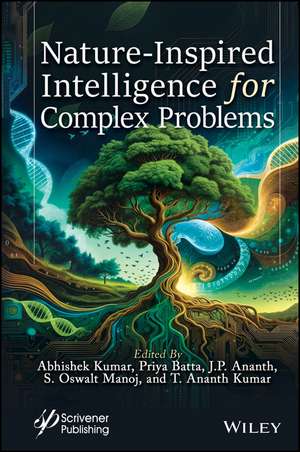
Nature-Inspired Intelligence for Complex Problems
Editat de Abhishek Kumar, Priya Batta, J P Ananth, S Oswalt Manoj, T Ananth Kumaren Limba Engleză Hardback – 22 sep 2026
Nature-inspired intelligence is a rapidly evolving field that draws from biological and physical phenomena, such as evolution, swarm behavior, neural processing, and immune systems, to develop algorithms capable of handling complexity, uncertainty, and scalability. Unlike conventional computational approaches, these techniques adapt dynamically, mimic resilience, and exhibit problem-solving strategies observed in nature. As industries face increasingly complex and data-intensive challenges, nature-inspired intelligence provides robust, efficient, and innovative solutions, positioning it as a cornerstone of future technological and scientific progress.
This book presents a comprehensive exploration of how biological, physical, and ecological principles can be transformed into powerful computational tools for solving some of today's most challenging problems. Drawing inspiration from natural processes, the book highlights a broad spectrum of algorithms that push beyond traditional approaches to optimization and decision-making. Blending theory with application, the book demonstrates how nature-inspired intelligence can address complexity across domains including healthcare, energy, finance, engineering, and emerging technologies.
Readers will find the volume:
- Offers an in-depth exploration of a wide range of nature-inspired computational techniques, including evolutionary algorithms, swarm intelligence, neural models, and physics-inspired methods;
- Bridges the gap between natural systems and computational problem-solving, appealing to a diverse audience of researchers and practitioners;
- Features case studies in robotics, healthcare, finance, engineering, and environmental sustainability, and highlights how these algorithms are used to tackle practical challenges across industries;
- Addresses the latest advancements in combining multiple nature-inspired techniques and explores cutting-edge topics like quantum computing and bio-hybrid systems. ensuring the content remains relevant to current research and innovation.
Computer scientists, engineers, applied mathematicians, data scientists, and researchers in optimization and complex systems, as well as professionals in healthcare, energy, finance, and technology seeking innovative problem-solving approaches.
Preț: 1294.39 lei
Preț vechi: 1617.99 lei
-20% Precomandă
Puncte Express: 1942
Carte nepublicată încă
Livrare prin curier în România Precomanda se expediază când titlul devine disponibil.
Transport gratuit pentru acest produs Plată online sau ramburs, în funcție de opțiunile comenzii.
Retur gratuit în 14 zile Comandă securizată și suport în română.
Doresc să fiu notificat când acest titlu va fi disponibil:
Se trimite...
Specificații
Notă biografică
Abhishek Kumar, PhD is an Assistant Director and Professor in the Computer Science and Engineering Department, Chandigarh University, Mohali, Punjab, India. He has more than 230 publications to his credit, including books, chapters in books, and journal articles. His research interests span artificial intelligence, renewable energy systems, image processing, and data mining.
Priya Batta, PhD is an Associate Professor in the Computer Science and Engineering Department, Amity University, Mohali, Punjab, India. She received her Doctorate in Computer Science and Engineering from Chandigarh University. Her research specializes in artificial intelligence, blockchain, and IoT.
J.P. Ananth, PhD is a Professor and Director of the Internal Quality Assurance Cell, Dayananda Sagar University, Bangalore, India, with more than 23 years of experience. He has published more than 60 articles in international journals and conferences. His research interests include computer vision, pattern recognition, artificial intelligence, and data analytics.
S. Oswalt Manoj, PhD is an Associate Professor in the Department of Computer Science and Engineering, Alliance University, Bengaluru, Karnataka, India. He holds a Doctorate in Information Science and Engineering from Anna University in Chennai. His research areas include big data analytics, artificial intelligence, computer vision, machine learning, deep learning, and cloud computing.
T. Ananth Kumar, PhD is an Associate Professor and Research Head in Computer Science and Engineering, IFET College of Engineering, Villupuram, Tamil Nadu, India. He has more than 250 publications to his credit, including books, book chapters, and articles in international journals and conferences. His fields of interest include networks on chips, computer architecture, and ASIC design.
Priya Batta, PhD is an Associate Professor in the Computer Science and Engineering Department, Amity University, Mohali, Punjab, India. She received her Doctorate in Computer Science and Engineering from Chandigarh University. Her research specializes in artificial intelligence, blockchain, and IoT.
J.P. Ananth, PhD is a Professor and Director of the Internal Quality Assurance Cell, Dayananda Sagar University, Bangalore, India, with more than 23 years of experience. He has published more than 60 articles in international journals and conferences. His research interests include computer vision, pattern recognition, artificial intelligence, and data analytics.
S. Oswalt Manoj, PhD is an Associate Professor in the Department of Computer Science and Engineering, Alliance University, Bengaluru, Karnataka, India. He holds a Doctorate in Information Science and Engineering from Anna University in Chennai. His research areas include big data analytics, artificial intelligence, computer vision, machine learning, deep learning, and cloud computing.
T. Ananth Kumar, PhD is an Associate Professor and Research Head in Computer Science and Engineering, IFET College of Engineering, Villupuram, Tamil Nadu, India. He has more than 250 publications to his credit, including books, book chapters, and articles in international journals and conferences. His fields of interest include networks on chips, computer architecture, and ASIC design.
Cuprins
Preface xxv
Part I: Foundations and Introduction to Nature-Inspired Intelligence 1
1 Introduction to Nature-Inspired Intelligence 3
Simarpreet Kaur and Vikas Wasson
1.1 Overview of Nature-Inspired Computing 4
1.2 The Need for Bio-Inspired Solutions 9
1.3 Key Characteristics of Nature-Inspired Algorithms 18
1.4 Conclusion and Future Scope 20
2 Exploring Swarm Intelligence: A Comparative Analysis of Nature-Inspired Optimization Techniques 27
Inderdeep Kaur and Aleem Ali
2.1 Introduction to Swarm Intelligence 28
2.2 Fundamentals of Swarm Intelligence 30
2.3 Ant Colony Optimization (ACO) 34
2.4 Particle Swarm Optimization (PSO) 39
2.5 Grey Wolf Optimizer (GWO) 44
2.6 Comparative Analysis of Swarm Intelligence Algorithms 49
2.7 Applications of Swarm Intelligence Algorithms in Real-World Problems 53
2.8 Challenges and Future Research Directions 58
2.9 Conclusion 59
3 Swarm Dynamics in Optimization: A Deep Dive into PSO 63
Benjamin Franklin S., Justin Jayaraj K., Monisha A., Balasubramaniam V., Sasi Kala and N.S. Kavitha
3.1 Particle Swarm Optimization (PSO) 64
3.2 Engineering Designs in PSO 69
3.3 Variants of PSO 75
3.4 Swarm Intelligence in PSO 84
3.5 PSO in Healthcare and Logistic 86
3.6 Enhancements in PSO for Improved Performance 89
4 Genetic Algorithms: Fundamentals and Applications 97
Satya Reddy Satti, Chanchal Alam, Ajay Sharma and Shamneesh Sharma
4.1 Fundamentals of Genetic Algorithms 99
4.2 Mathematical Foundations of Genetic Algorithms 102
4.3 Schema Theorem and Building Block Hypothesis 102
4.4 Multi-Objective Optimization 103
4.5 Applications of Genetic Algorithms 106
4.6 Challenges and Mitigations 110
4.7 Practical Implementation for Genetic Algorithms 112
4.8 Future Directions in Genetic Algorithm Research 114
5 Challenges and Future Directions in Nature-Inspired Intelligence 121
Thayanithi C.A., Elipe Arjun and Priyanka Singh
5.1 Introduction 122
5.2 Contemporary Challenges 124
5.3 Emerging Technologies and Trends 130
5.4 Future Research Directions 137
5.5 Implementation Strategies 142
5.6 Impact Analysis 148
5.7 Future Recommendations 152
5.8 Conclusion 155
Part II: Methods and Hybrid Models 161
6 Hybrid Swarm Intelligence for Enhancing Optimization through Multi Swarm and Quantum Inspired Models in Decision Making and Robotics 163
Barakkath Nisha U., Yasir Abdullah R., Sindhu V., Raihana A. and Anitha G.
6.1 Introduction 164
6.2 Background and Related Work 167
6.3 Framework of Hybrid Swarm Intelligence 171
6.4 Applications of Hybrid Swarm Intelligence 175
6.5 Experimental Results and Performance Analysis 179
6.6 Conclusion 187
7 Swarm Intelligence and Differential Evolution in Robotics and Decision-Making 191
Devendra Babu Pesarlanka, Abhinav Kumar, Ajay Sharma, Arun Malik and Shamneesh Sharma
7.1 Introduction 192
7.2 Fundamentals of Swarm Intelligence 194
7.3 Key Swarm Intelligence Algorithms 196
7.4 Particle Swarm Optimization (PSO) 200
7.5 Applications of Swarm Intelligence in Robotics 204
7.6 Swarm Intelligence in Decision-Making 207xiv Contents
7.7 Challenges and Future Directions 210
7.8 Conclusion 213
8 Hybrid Nature-Inspired Systems: A Computational Intelligence Perspective 219
Anitha Subbarayan
8.1 Evolutionary Computation for Global Search Optimization 220
8.2 Swarm Intelligence in Local Search and Refinement 224
8.3 Neuro-Evolutionary Models for Adaptive Learning 230
8.4 Hybridization Strategies for Balancing Exploration and Exploitation 237
8.5 Co-Evolutionary and Memetic Algorithms 238
8.6 Applications of Hybrid Nature-Inspired Systems 239
8.7 Performance Metrics and Computational Efficiency of Hybrid Nature-Inspired Systems 243
9 Optimizing Engineering Systems: Differential Evolution Algorithm and Hybrid Approaches for PID Controller 249
G. Saravanan, C. Pazhanimuthu, P.N. Senthil Prakash and N.R. Wilfred Blessing
9.1 Introduction 250
9.2 Related Works 252
9.3 Algorithms 254
9.4 System Model 261
9.5 Simulation Results and Discussion 271
10 Novel Aspects of Ant Colony Optimization and Particle Swarm Optimization 279
Rohan Gupta and Gurpreet Singh
10.1 MANET Routing Strategies 280
10.2 Routing Protocols 281
10.3 Ant Based Routing Protocols 286
10.4 PSO Routing Protocols 287
10.5 Hybrid Routing Protocols 288
10.6 Results and Discussion 289
10.7 Conclusion 292
11 Physics-Inspired Algorithms: Applications in Energy and Environmental Systems 297
Naman Srivastava, Samyak Varia, Scaria Alex, Aswathy K. Cherian, Ashwini S. and Arshey M.
11.1 Introduction 298
11.2 Foundations of Physics-Inspired Algorithms (PIAs) 301
11.3 Application of Physics-Inspired Algorithms (PIAs) in Energy Systems [1492 and 0%] 308
11.4 Application of PIAs in Environmental Systems 316
11.5 Case Studies and Real-Life Implementations 322
11.6 Challenges and Way Forward 325
11.7 Conclusion 329
Part III: Applications Across Domains 333
12 Optimization-Driven Deep CNN with PFCM Clustering for Enhanced MRI-Based Brain Tumor Detection 335
P. Sathish, Sashikanth Reddy Avula and Channabasava
12.1 Introduction 336
12.2 Related Work 337
12.3 Proposed Exponential Cuckoo-Based DCNN for Automatic Brain Tumor Classification 339
12.4 Discussion of Results 344
12.5 Summary 353
13 Explainable AI and Ensemble Learning for Genetic Disorder Diagnosis Advancing Accuracy and Interpretability
in Healthcare Predictions 357
Ishdeep and Neetu Rani
13.1 Introduction 358
13.2 Literature Review 359
13.3 Materials and Methods 364
13.4 Results and Discussion 375
13.5 Conclusion 380
13.6 Future Scope 381
14 Optimizing Complex Weights of Linear Antenna Array for Combating Real World Wireless Traffic Congestion 385
Surekha Rani and Himanshu Sharma
14.1 Introduction 385
14.2 Problem Formulation 386xx Contents
14.3 Simulation and Results 392
14.4 Conclusion and Future Scope 402
15 Nature-Inspired Intelligence for Enhanced Disease Detection in Medical Image Analysis 405
R. Karthick Manoj, Aasha Nandhini S. and D. Lakshmi
15.1 Introduction 406
15.2 Related Work 407
15.3 Proposed Methodology 409
15.4 Result and Discussion 417
15.5 Conclusion and Future Work 425
16 Nature-Inspired Hybrid Model for Dysgraphia Diagnosis in Educational Settings 429
A. Devi, B. Elizebeth Caroline, J. Vidhya, D. Sathish Kumar, T.D. Subha and L. Manimegalai
16.1 Introduction 430
16.2 Related Works 434
16.3 Proposed Hybrid Model 440
16.4 Feature Selection Using ACO 449
16.5 Results and Discussions 451
16.6 Conclusion 457
17 Particle Swarm Optimization for Effective Feature Selection in Smart Logistics 461
Asha K. and Nakul Ramesh Varma
17.1 Introduction 461
17.2 Particle Swarm Optimization 462
17.3 Literature Survey 469
17.4 Computational Analysis on Realtime-Case 471
17.5 Legal and Ethical Considerations 473
17.6 Methodology 474
17.7 Implementation and Results 476
17.8 Conclusion 477
18 The Integration of IoT and Blockchain for Enhanced Security and Real-Time Updates 483
Priya Batta and Abhishek Kumar
18.1 Introduction 483
18.2 Related Works 488
18.3 Proposed Methodology 491
18.4 Results and Discussions 493
18.5 Conclusion and Future Scope 494
19 Advancing Rehabilitation with Virtual Reality 497
Charu Chhabra, Fowquiya, Sohrab A. Khan and Ifra Aman
19.1 Introduction to Virtual Reality 497
19.2 Methodology 498
19.3 Literature 498
19.4 Discussion 508
19.5 Result 509
19.6 Conclusion 509
Part IV: Case Studies and Specific Implementations 515
20 AI for Preserving Indian Knowledge Systems and Philosophy 517
Aditya Atal, Shaurya Sharma and G.Y. Rajaa Vikhram
20.1 Introduction 518
20.2 AI in Preserving Ancient Hindu Texts and Literature 518
20.3 AI-Driven Religious Chatbots and Q&A Systems 520
20.4 AI and Digital Preservation of Oral Traditions and Folklore 521
20.5 AI in Ayurveda and Traditional Healing 522
20.6 AI in Yoga and Meditation Guidance 523
20.7 AI-Powered Knowledge Systems for Hindu Ethics and Philosophy 524
20.8 Role of AI in Hindu Astrology and Vedic Mathematics 524
20.9 Ethical and Theological Considerations in AI-Based Hindu Studies 525
20.10 Role of Blockchain and Quantum Computing in Hindu Knowledge Systems 525
20.11 Future Scope and Challenges 533
20.12 Conclusion and Research Directions 538
20.13 Research Gaps and Areas for Further Exploration 540
21 Nature-Inspired Algorithms and Their Applications: A Healthcare Case Study with the Bee Algorithm 543
Puneet Kumar and Deepika Kumar
21.1 Introduction 544
21.2 Classification of Nature-Inspired Algorithms 548
21.3 Bees Algorithm: Foundation 551
21.4 Case Study: Bees Algorithm in Healthcare 556
References 559
Index 561
Part I: Foundations and Introduction to Nature-Inspired Intelligence 1
1 Introduction to Nature-Inspired Intelligence 3
Simarpreet Kaur and Vikas Wasson
1.1 Overview of Nature-Inspired Computing 4
1.2 The Need for Bio-Inspired Solutions 9
1.3 Key Characteristics of Nature-Inspired Algorithms 18
1.4 Conclusion and Future Scope 20
2 Exploring Swarm Intelligence: A Comparative Analysis of Nature-Inspired Optimization Techniques 27
Inderdeep Kaur and Aleem Ali
2.1 Introduction to Swarm Intelligence 28
2.2 Fundamentals of Swarm Intelligence 30
2.3 Ant Colony Optimization (ACO) 34
2.4 Particle Swarm Optimization (PSO) 39
2.5 Grey Wolf Optimizer (GWO) 44
2.6 Comparative Analysis of Swarm Intelligence Algorithms 49
2.7 Applications of Swarm Intelligence Algorithms in Real-World Problems 53
2.8 Challenges and Future Research Directions 58
2.9 Conclusion 59
3 Swarm Dynamics in Optimization: A Deep Dive into PSO 63
Benjamin Franklin S., Justin Jayaraj K., Monisha A., Balasubramaniam V., Sasi Kala and N.S. Kavitha
3.1 Particle Swarm Optimization (PSO) 64
3.2 Engineering Designs in PSO 69
3.3 Variants of PSO 75
3.4 Swarm Intelligence in PSO 84
3.5 PSO in Healthcare and Logistic 86
3.6 Enhancements in PSO for Improved Performance 89
4 Genetic Algorithms: Fundamentals and Applications 97
Satya Reddy Satti, Chanchal Alam, Ajay Sharma and Shamneesh Sharma
4.1 Fundamentals of Genetic Algorithms 99
4.2 Mathematical Foundations of Genetic Algorithms 102
4.3 Schema Theorem and Building Block Hypothesis 102
4.4 Multi-Objective Optimization 103
4.5 Applications of Genetic Algorithms 106
4.6 Challenges and Mitigations 110
4.7 Practical Implementation for Genetic Algorithms 112
4.8 Future Directions in Genetic Algorithm Research 114
5 Challenges and Future Directions in Nature-Inspired Intelligence 121
Thayanithi C.A., Elipe Arjun and Priyanka Singh
5.1 Introduction 122
5.2 Contemporary Challenges 124
5.3 Emerging Technologies and Trends 130
5.4 Future Research Directions 137
5.5 Implementation Strategies 142
5.6 Impact Analysis 148
5.7 Future Recommendations 152
5.8 Conclusion 155
Part II: Methods and Hybrid Models 161
6 Hybrid Swarm Intelligence for Enhancing Optimization through Multi Swarm and Quantum Inspired Models in Decision Making and Robotics 163
Barakkath Nisha U., Yasir Abdullah R., Sindhu V., Raihana A. and Anitha G.
6.1 Introduction 164
6.2 Background and Related Work 167
6.3 Framework of Hybrid Swarm Intelligence 171
6.4 Applications of Hybrid Swarm Intelligence 175
6.5 Experimental Results and Performance Analysis 179
6.6 Conclusion 187
7 Swarm Intelligence and Differential Evolution in Robotics and Decision-Making 191
Devendra Babu Pesarlanka, Abhinav Kumar, Ajay Sharma, Arun Malik and Shamneesh Sharma
7.1 Introduction 192
7.2 Fundamentals of Swarm Intelligence 194
7.3 Key Swarm Intelligence Algorithms 196
7.4 Particle Swarm Optimization (PSO) 200
7.5 Applications of Swarm Intelligence in Robotics 204
7.6 Swarm Intelligence in Decision-Making 207xiv Contents
7.7 Challenges and Future Directions 210
7.8 Conclusion 213
8 Hybrid Nature-Inspired Systems: A Computational Intelligence Perspective 219
Anitha Subbarayan
8.1 Evolutionary Computation for Global Search Optimization 220
8.2 Swarm Intelligence in Local Search and Refinement 224
8.3 Neuro-Evolutionary Models for Adaptive Learning 230
8.4 Hybridization Strategies for Balancing Exploration and Exploitation 237
8.5 Co-Evolutionary and Memetic Algorithms 238
8.6 Applications of Hybrid Nature-Inspired Systems 239
8.7 Performance Metrics and Computational Efficiency of Hybrid Nature-Inspired Systems 243
9 Optimizing Engineering Systems: Differential Evolution Algorithm and Hybrid Approaches for PID Controller 249
G. Saravanan, C. Pazhanimuthu, P.N. Senthil Prakash and N.R. Wilfred Blessing
9.1 Introduction 250
9.2 Related Works 252
9.3 Algorithms 254
9.4 System Model 261
9.5 Simulation Results and Discussion 271
10 Novel Aspects of Ant Colony Optimization and Particle Swarm Optimization 279
Rohan Gupta and Gurpreet Singh
10.1 MANET Routing Strategies 280
10.2 Routing Protocols 281
10.3 Ant Based Routing Protocols 286
10.4 PSO Routing Protocols 287
10.5 Hybrid Routing Protocols 288
10.6 Results and Discussion 289
10.7 Conclusion 292
11 Physics-Inspired Algorithms: Applications in Energy and Environmental Systems 297
Naman Srivastava, Samyak Varia, Scaria Alex, Aswathy K. Cherian, Ashwini S. and Arshey M.
11.1 Introduction 298
11.2 Foundations of Physics-Inspired Algorithms (PIAs) 301
11.3 Application of Physics-Inspired Algorithms (PIAs) in Energy Systems [1492 and 0%] 308
11.4 Application of PIAs in Environmental Systems 316
11.5 Case Studies and Real-Life Implementations 322
11.6 Challenges and Way Forward 325
11.7 Conclusion 329
Part III: Applications Across Domains 333
12 Optimization-Driven Deep CNN with PFCM Clustering for Enhanced MRI-Based Brain Tumor Detection 335
P. Sathish, Sashikanth Reddy Avula and Channabasava
12.1 Introduction 336
12.2 Related Work 337
12.3 Proposed Exponential Cuckoo-Based DCNN for Automatic Brain Tumor Classification 339
12.4 Discussion of Results 344
12.5 Summary 353
13 Explainable AI and Ensemble Learning for Genetic Disorder Diagnosis Advancing Accuracy and Interpretability
in Healthcare Predictions 357
Ishdeep and Neetu Rani
13.1 Introduction 358
13.2 Literature Review 359
13.3 Materials and Methods 364
13.4 Results and Discussion 375
13.5 Conclusion 380
13.6 Future Scope 381
14 Optimizing Complex Weights of Linear Antenna Array for Combating Real World Wireless Traffic Congestion 385
Surekha Rani and Himanshu Sharma
14.1 Introduction 385
14.2 Problem Formulation 386xx Contents
14.3 Simulation and Results 392
14.4 Conclusion and Future Scope 402
15 Nature-Inspired Intelligence for Enhanced Disease Detection in Medical Image Analysis 405
R. Karthick Manoj, Aasha Nandhini S. and D. Lakshmi
15.1 Introduction 406
15.2 Related Work 407
15.3 Proposed Methodology 409
15.4 Result and Discussion 417
15.5 Conclusion and Future Work 425
16 Nature-Inspired Hybrid Model for Dysgraphia Diagnosis in Educational Settings 429
A. Devi, B. Elizebeth Caroline, J. Vidhya, D. Sathish Kumar, T.D. Subha and L. Manimegalai
16.1 Introduction 430
16.2 Related Works 434
16.3 Proposed Hybrid Model 440
16.4 Feature Selection Using ACO 449
16.5 Results and Discussions 451
16.6 Conclusion 457
17 Particle Swarm Optimization for Effective Feature Selection in Smart Logistics 461
Asha K. and Nakul Ramesh Varma
17.1 Introduction 461
17.2 Particle Swarm Optimization 462
17.3 Literature Survey 469
17.4 Computational Analysis on Realtime-Case 471
17.5 Legal and Ethical Considerations 473
17.6 Methodology 474
17.7 Implementation and Results 476
17.8 Conclusion 477
18 The Integration of IoT and Blockchain for Enhanced Security and Real-Time Updates 483
Priya Batta and Abhishek Kumar
18.1 Introduction 483
18.2 Related Works 488
18.3 Proposed Methodology 491
18.4 Results and Discussions 493
18.5 Conclusion and Future Scope 494
19 Advancing Rehabilitation with Virtual Reality 497
Charu Chhabra, Fowquiya, Sohrab A. Khan and Ifra Aman
19.1 Introduction to Virtual Reality 497
19.2 Methodology 498
19.3 Literature 498
19.4 Discussion 508
19.5 Result 509
19.6 Conclusion 509
Part IV: Case Studies and Specific Implementations 515
20 AI for Preserving Indian Knowledge Systems and Philosophy 517
Aditya Atal, Shaurya Sharma and G.Y. Rajaa Vikhram
20.1 Introduction 518
20.2 AI in Preserving Ancient Hindu Texts and Literature 518
20.3 AI-Driven Religious Chatbots and Q&A Systems 520
20.4 AI and Digital Preservation of Oral Traditions and Folklore 521
20.5 AI in Ayurveda and Traditional Healing 522
20.6 AI in Yoga and Meditation Guidance 523
20.7 AI-Powered Knowledge Systems for Hindu Ethics and Philosophy 524
20.8 Role of AI in Hindu Astrology and Vedic Mathematics 524
20.9 Ethical and Theological Considerations in AI-Based Hindu Studies 525
20.10 Role of Blockchain and Quantum Computing in Hindu Knowledge Systems 525
20.11 Future Scope and Challenges 533
20.12 Conclusion and Research Directions 538
20.13 Research Gaps and Areas for Further Exploration 540
21 Nature-Inspired Algorithms and Their Applications: A Healthcare Case Study with the Bee Algorithm 543
Puneet Kumar and Deepika Kumar
21.1 Introduction 544
21.2 Classification of Nature-Inspired Algorithms 548
21.3 Bees Algorithm: Foundation 551
21.4 Case Study: Bees Algorithm in Healthcare 556
References 559
Index 561