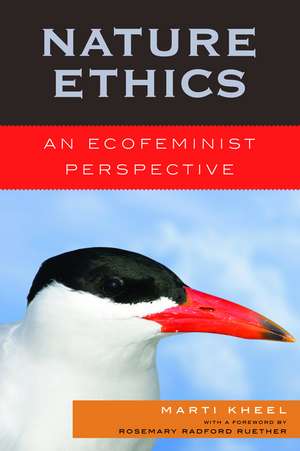
Nature Ethics: An Ecofeminist Perspective
Autor Marti Kheel Cuvânt înainte de Rosemary Radford Ruetheren Limba Engleză Paperback – 6 dec 2007
Preț: 330.14 lei
Preț vechi: 410.06 lei
-19%
Puncte Express: 495
Carte tipărită la comandă
Livrare economică 07-21 decembrie
Livrare prin curier în România Termenul estimat este afișat lângă disponibilitate.
Transport gratuit de la 400.00 lei Plată online sau ramburs, în funcție de opțiunile comenzii.
Retur gratuit în 14 zile Comandă securizată și suport în română.
Specificații
ISBN-13: 9780742552012
ISBN-10: 0742552012
Pagini: 339
Dimensiuni: 146 x 226 x 22 mm
Greutate: 0.52 kg
Editura: Bloomsbury Publishing
Colecția Rowman & Littlefield
Locul publicării:New York, United States
ISBN-10: 0742552012
Pagini: 339
Dimensiuni: 146 x 226 x 22 mm
Greutate: 0.52 kg
Editura: Bloomsbury Publishing
Colecția Rowman & Littlefield
Locul publicării:New York, United States
V-ar putea interesa
-
 Sex and Social JusticeMartha C. Nussbaum-27%Preț: 410.98 lei560.32 lei
 -
 Women, Culture, and Development: A Study of Human CapabilitiesMartha C. Nussbaum-26%Preț: 385.50 lei523.53 lei
 -
 Feminism and HistoryJoan Wallach Scott-26%Preț: 360.83 lei488.78 lei
 -
 Feminism and FilmE. Ann Kaplan-20%Preț: 434.70 lei545.27 lei
 -
 Feminism and Renaissance StudiesLorna Hutson-33%Preț: 639.48 lei961.29 lei
 -
 Greed, Lust and Gender: A History of Economic IdeasNancy Folbre-30%Preț: 641.55 lei919.34 lei
 -
 -11%Preț: 301.68 lei337.86 lei
 -
 Anatomy of FreedomRobin MorganPreț: 167.51 lei
 -
 Language and SexismSara MillsPreț: 221.32 lei
 -
 The Cambridge Companion to Feminism in PhilosophyMiranda FrickerPreț: 249.83 lei
 -
 Introducing FeminismCathia Jenainati-19%Preț: 52.26 lei64.50 lei
 -
 The Trouble and Strife ReaderDeborah Cameron-13%Preț: 237.98 lei274.91 lei
 -
 Zeros and OnesSadie PlantPreț: 81.27 lei
 -
 Preț: 200.84 lei
Cuprins
Chapter 1 - Finding a Niche for All Animals in Nature Ethics
Chapter 2 - Masculine Identity: Born Again 'Man'
Chapter 3 - Origins of the Conservation Movement: Preserving Manhood
Chapter 4 - Thinking Like a Mountain or Thinking Like a Man?
Chapter 5 - The Ecophilosophy of Holmes Rolston
Chapter 6 - The Transpersonal Ecology of Warwick Fox
Chapter 7 - Ecofeminist Holist Philosophy
Chapter 2 - Masculine Identity: Born Again 'Man'
Chapter 3 - Origins of the Conservation Movement: Preserving Manhood
Chapter 4 - Thinking Like a Mountain or Thinking Like a Man?
Chapter 5 - The Ecophilosophy of Holmes Rolston
Chapter 6 - The Transpersonal Ecology of Warwick Fox
Chapter 7 - Ecofeminist Holist Philosophy
Recenzii
Why do so many environmentalists proclaim their love of nature but romanticize hunting and eat meat? Nature Ethics offers significant insight. There is very little that Kheel does not explore; reading Nature Ethics is like taking a fine course at a university. I would buy this book for the section on 'Vegan Practice alone.' Hats off to Marti Kheel and this wonderful book!
[This is a] comprehensive and fair-minded account of the contrasting positions, particularly with respect to animals, between ecofeminist nature ethics and the celebrated holistic views of Theodore Roosevelt, Aldo Leopold, Holmes Rolston III, and Warwick Fox. Anyone interested in women's studies, animal welfare, hunting, vegetarianism, or environmental ethics will find this impressive book helpful and challenging.
Nature Ethics is a major contribution to ecofeminist philosophy, animal liberation, and environmental ethics. Marti Kheel provides an invaluable critique of the ecological position that accepts violence toward individual beings while professing love and respect for the larger natural world.
Kheel's book is a ground-breaking contribution to the literature and a must-read for anyone concerned with the links between environmental ethics, animal liberation and feminist critique of male cultural bias.
A major figure in ecofeminism, Kheel's original thinking about nature ethics culminates in this sweeping volume. She offers vital insights into the destructive consequences of a detached masculine self-identity, and a path toward the development of a genuinely inclusive nature ethic that respects all living beings.
This precise focus and the rigorous way in which she challenges ecophilosophies by scrutinising their attitudes towards individual animals brings the author's inherent logic out into the open by applying it to individual action. Thus she is able to confront holist philosophers with an ethics of nature from an ecofeminist perspective. I have high regard for the transparency and the truly dialogical spirit in which Kheel carefully, and in a very accommodating way, puts forward her criticism and invites the reader to follow her line of argument, with its clear structure and precise naming of her standpoint and assumptions. Her challenging core thesis that the treatment of individual animals should be the benchmark for any nature ethic and her revelation of the underlying masculinist identity that permeates current concepts make the book a gainful read for feminist scholars, environmental philosophers at the graduate level, as well as activists interested in better understanding the traditions they bring forward.
[This is a] comprehensive and fair-minded account of the contrasting positions, particularly with respect to animals, between ecofeminist nature ethics and the celebrated holistic views of Theodore Roosevelt, Aldo Leopold, Holmes Rolston III, and Warwick Fox. Anyone interested in women's studies, animal welfare, hunting, vegetarianism, or environmental ethics will find this impressive book helpful and challenging.
Nature Ethics is a major contribution to ecofeminist philosophy, animal liberation, and environmental ethics. Marti Kheel provides an invaluable critique of the ecological position that accepts violence toward individual beings while professing love and respect for the larger natural world.
Kheel's book is a ground-breaking contribution to the literature and a must-read for anyone concerned with the links between environmental ethics, animal liberation and feminist critique of male cultural bias.
A major figure in ecofeminism, Kheel's original thinking about nature ethics culminates in this sweeping volume. She offers vital insights into the destructive consequences of a detached masculine self-identity, and a path toward the development of a genuinely inclusive nature ethic that respects all living beings.
This precise focus and the rigorous way in which she challenges ecophilosophies by scrutinising their attitudes towards individual animals brings the author's inherent logic out into the open by applying it to individual action. Thus she is able to confront holist philosophers with an ethics of nature from an ecofeminist perspective. I have high regard for the transparency and the truly dialogical spirit in which Kheel carefully, and in a very accommodating way, puts forward her criticism and invites the reader to follow her line of argument, with its clear structure and precise naming of her standpoint and assumptions. Her challenging core thesis that the treatment of individual animals should be the benchmark for any nature ethic and her revelation of the underlying masculinist identity that permeates current concepts make the book a gainful read for feminist scholars, environmental philosophers at the graduate level, as well as activists interested in better understanding the traditions they bring forward.