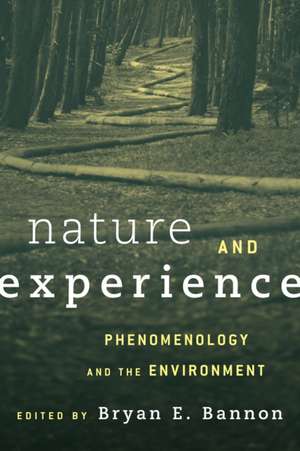
Nature and Experience: Phenomenology and the Environment
Editat de Bryan Bannonen Limba Engleză Paperback – 18 mai 2016
By bringing the concerns and methods of phenomenology to bear on questions such as these, this book seeks to redefine how environmental issues are perceived and discussed and demonstrates the relevance of phenomenological inquiry to a broader audience in environmental studies. The book examines what phenomenology must be like to address the practical and philosophical issues that emerge within environmental philosophy, what practical contributions phenomenology might make to environmental studies and policy making more generally, and the nature of our human relationship with the environment and the best way for us to engage with it.
Preț: 344.18 lei
Preț vechi: 461.33 lei
-25%
Puncte Express: 516
Carte tipărită la comandă
Livrare economică 28 octombrie-11 noiembrie
Livrare prin curier în România Termenul estimat este afișat lângă disponibilitate.
Transport gratuit de la 400.00 lei Plată online sau ramburs, în funcție de opțiunile comenzii.
Retur gratuit în 14 zile Comandă securizată și suport în română.
Specificații
ISBN-13: 9781783485215
ISBN-10: 1783485213
Pagini: 256
Ilustrații: 1 b/w illustratio
Dimensiuni: 154 x 230 x 17 mm
Greutate: 0.36 kg
Editura: Bloomsbury Publishing
Colecția Rowman & Littlefield
Locul publicării:New York, United States
ISBN-10: 1783485213
Pagini: 256
Ilustrații: 1 b/w illustratio
Dimensiuni: 154 x 230 x 17 mm
Greutate: 0.36 kg
Editura: Bloomsbury Publishing
Colecția Rowman & Littlefield
Locul publicării:New York, United States
V-ar putea interesa
-
 NauseaJean-Paul SartrePreț: 77.31 lei
 -
 Existentialism: A Very Short IntroductionThomas Flynn-20%Preț: 55.78 lei69.86 lei
 -
 The Measure of Things: Humanism, Humility, and MysteryDavid E. Cooper-11%Preț: 364.12 lei408.17 lei
 -
 Thomas Hobbes: Writings on Common Law and Hereditary RightAlan Cromartie-22%Preț: 381.20 lei491.33 lei
 -
 Objectivity and InsightMark Sacks-28%Preț: 348.87 lei484.04 lei
 -
 -28%Preț: 397.35 lei550.45 lei
 -
 Phenomenology and Philosophy of MindDavid Woodruff Smith-28%Preț: 394.33 lei548.70 lei
 -
 Irrational ManWilliam BarrettPreț: 96.97 lei
 -
 Existentialism and HumanismJean-Paul SartrePreț: 74.65 lei
 -
 Introduction to PhenomenologyDermont MoranPreț: 380.42 lei
 -
 The Jargon of AuthenticityTheodor AdornoPreț: 137.44 lei
 -
 Body Images: Embodiment as IntercorporealityGail WeissPreț: 395.84 lei
 -
 Essays on Heidegger and OthersRichard RortyPreț: 203.14 lei
 -
 PathmarksMartin HeideggerPreț: 214.93 lei
 -
 Heidegger Being and TimePaul GornerPreț: 360.83 lei
 -
 Introduction to PhenomenologyRobert SokolowskiPreț: 195.48 lei
 -
 Genesis and Structure of Hegel's "Phenomenology of Spirit"Jean HyppolitePreț: 243.33 lei
Cuprins
Nature and Experience, an Introduction, Bryan E. Bannon / Part I: Phenomenology of Nature / 1. Mythic Enlightenment: Phenomenology and the Question Concerning Nature, Bryan Smyth / 2. Towards a Phenomenology of Nature, Janet Donohoe / 3. Natural Phenomena: The Birth and Growth of Experience, Thomas Greaves / 4. Phenomenology and the Charge of Anthropocentrism, Simon James / 5. Nature, Meaning, and Value, Bryan E. Bannon / Part II: Metaphor, Agency, and the Human relation to Nature / 6. Intersubjectivity, the Environment, and Moral Failure, Mark Thorsby / 7. Metaphor and Weather: Thinking Ecologically about Metaphor, Experience, and Climate, Elise Springer / 8. Ecofeminism, Ecophenomenology, and the Metaphorics of Nature's Agency, Tim Christion Myers / 9. Re-Rivering Environmental Imagination: Meander Movement and Merleau-Ponty, Irene J. Klaver / Part III: Practicing Phenomenology / 10. Paradigms, Praxis and Environmental Phenomenology, Ingrid Leman Stefanovic, Zachary Shefman and Kristina Welch / 11. Re-appropriating the Ecosystem Services Concept for a Decolonization of 'Nature', Barbara Muraca / 12. Indigenous Experience, Environmental Justice and Settler Colonialism, Kyle Powys Whyte / 13. Music and the Presence of Nature, David E. Cooper / 14. Phenomenological Aesthetics of Landscape and Beauty, Guðbjörg Rannveig Jóhannesdóttir / Bibliography / Index / Notes on Contributors
Recenzii
A sparkling collection of essays from some of today's liveliest minds writing in a broadly phenomenological tradition. It highlights the complexity of our experience of nature, the range of metaphors, narratives and normativities woven into the idea of nature, and the relevance of an experiential approach to how our understanding of nature impacts education, decolonization and aesthetics. A compelling addition to the environmental philosophy literature.
Nature and Experience is an important contribution to the ongoing development of eco-phenomenology and environmental hermeneutics. Grounded in a commitment to the relationality at the heart of the phenomenological project, this volume sparkles with insight on topics as varied as anthropocentrism, moral responsibility, metaphor, ecological imagination, environmental justice, and aesthetics-and does so in a manner that is eminently accessible.
This collection deserves to be read not just by those working in "continental" environmental philosophy but also by environmental philosophers more broadly. Its clear, well-written essays grapple with and reconceptualize some of the area's key questions, and do so in novel and refreshing ways. Many of them would work well even in an undergraduate environmental philosophy course, and could bring something really new to such a setting.
Nature and Experience is an important contribution to the ongoing development of eco-phenomenology and environmental hermeneutics. Grounded in a commitment to the relationality at the heart of the phenomenological project, this volume sparkles with insight on topics as varied as anthropocentrism, moral responsibility, metaphor, ecological imagination, environmental justice, and aesthetics-and does so in a manner that is eminently accessible.
This collection deserves to be read not just by those working in "continental" environmental philosophy but also by environmental philosophers more broadly. Its clear, well-written essays grapple with and reconceptualize some of the area's key questions, and do so in novel and refreshing ways. Many of them would work well even in an undergraduate environmental philosophy course, and could bring something really new to such a setting.