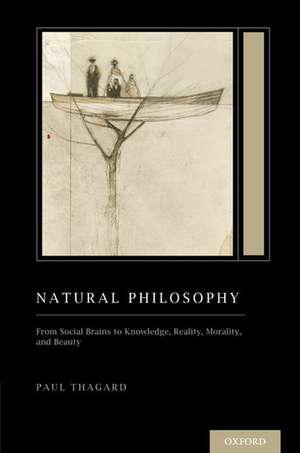
Natural Philosophy
Autor Paul Thagarden Limba Engleză Paperback – 6 aug 2021
| Toate formatele și edițiile | Preț | Express |
|---|---|---|
| Paperback (1) | 161.15 lei 41-52 zile | |
| Oxford University Press – 6 aug 2021 | 161.15 lei 41-52 zile | |
| Hardback (1) | 360.06 lei 41-52 zile | |
| Oxford University Press – 21 mar 2019 | 360.06 lei 41-52 zile |
Preț: 161.15 lei
Preț vechi: 216.96 lei
-26%
Puncte Express: 242
Preț estimativ în valută:
28.49€ • 34.04$ • 24.68£
28.49€ • 34.04$ • 24.68£
Carte tipărită la comandă
Livrare economică 13-24 martie
Specificații
ISBN-13: 9780197619681
ISBN-10: 0197619681
Pagini: 356
Dimensiuni: 156 x 236 x 21 mm
Greutate: 0.52 kg
Editura: Oxford University Press
Locul publicării:New York, United States
ISBN-10: 0197619681
Pagini: 356
Dimensiuni: 156 x 236 x 21 mm
Greutate: 0.52 kg
Editura: Oxford University Press
Locul publicării:New York, United States
Recenzii
Thagard embraces what he calls the "three analysis" method-i.e., providing exemplars, typical features, and explanations. He applies this methodology extensively throughout the text to philosophical questions related to such topics as mind, knowledge, reality, morality, meaning, and beauty. Though this strategy "does not yield answers that reign with unchallengeable certainty," as Thagard writes in chapter 1, it does provide answers-or, better, hypotheses that are consistent with a metaphysics based in scientific realism and an epistemology based in reliable coherentism.
With the appearance of Natural Philosophy, Paul Thagard, one of the foremost proponents of philosophical naturalism in our time, establishes how the social, cognitive, and brain sciences, and Chris Eliasmith's Semantic Pointer Architecture, in particular, provide resources for a rigorous, scientifically-informed, and systematic approach to the entire range of classical philosophical problems. Thagard's Natural Philosophy is not a program of reduction but rather one of integration, which examines what are, in a scientific age, the inevitable interconnections and interdependence of these sciences and the perennial projects of philosophy - including metaphysics and mind, epistemology and ethics, and political philosophy and the philosophy of art.
With the characteristic clarity, economy, and insight that have distinguished all of his work for more than four decades, Thagard demonstrates the strengths of a naturalistic philosophical program that attends to the relevant sciences, compared to its classical and contemporary competitors."
Drawing on the many original positions he has developed throughout his distinguished career in philosophy and cognitive science, Paul Thagard provides a synoptic overview of natural philosophy in his flowing, easy to read style. He makes use of the now widely accepted view, that he helped to develop, of interactions between mechanisms at multiple levels - the molecular, neuronal, mental, and social. The work admirably shows that philosophy can be, as he puts it 'extraverted, directing its attention to real world problems.'"
Rather than focusing on providing the necessary and sufficient conditions for a concept or an event or on conscious experience and introspection, Thagard embraces what he calls the "three analysis" method
With the appearance of Natural Philosophy, Paul Thagard, one of the foremost proponents of philosophical naturalism in our time, establishes how the social, cognitive, and brain sciences, and Chris Eliasmith's Semantic Pointer Architecture, in particular, provide resources for a rigorous, scientifically-informed, and systematic approach to the entire range of classical philosophical problems. Thagard's Natural Philosophy is not a program of reduction but rather one of integration, which examines what are, in a scientific age, the inevitable interconnections and interdependence of these sciences and the perennial projects of philosophy - including metaphysics and mind, epistemology and ethics, and political philosophy and the philosophy of art.
With the characteristic clarity, economy, and insight that have distinguished all of his work for more than four decades, Thagard demonstrates the strengths of a naturalistic philosophical program that attends to the relevant sciences, compared to its classical and contemporary competitors."
Drawing on the many original positions he has developed throughout his distinguished career in philosophy and cognitive science, Paul Thagard provides a synoptic overview of natural philosophy in his flowing, easy to read style. He makes use of the now widely accepted view, that he helped to develop, of interactions between mechanisms at multiple levels - the molecular, neuronal, mental, and social. The work admirably shows that philosophy can be, as he puts it 'extraverted, directing its attention to real world problems.'"
Rather than focusing on providing the necessary and sufficient conditions for a concept or an event or on conscious experience and introspection, Thagard embraces what he calls the "three analysis" method
Notă biografică
Paul Thagard is a distinguished philosopher and cognitive scientist who has written many books, including The Brain and the Meaning of Life (Princeton University Press, 2010) and The Cognitive Science of Science (MIT Press, 2012). He is a Fellow of the Royal Society of Canada, the Cognitive Science Society, and the Association for Psychological Science.