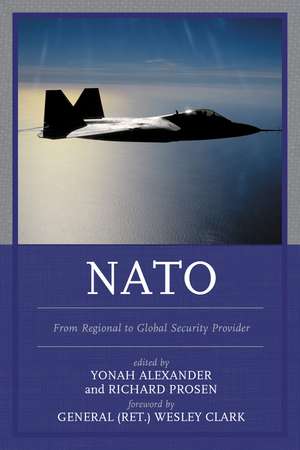
NATO: From Regional to Global Security Provider
Editat de Yonah Alexander, Richard Prosen Cuvânt înainte de Wesley K. Clark (Ret) Contribuţii de James Henry Bergeron, Derrick Busse, Georgiana Cavendish, Natividad Carpintero-Santamaría, Paul Dodge, R. David Edelman, Raffi Gregorian, Enrico Mueller, Patrick Murphy, Leslie Ordeman, Raphael Perl, Stefano Santamato, Carrie Shirtz, George Sinks, Bruce Weinrod, Richard Weitz, Michael Ziemkeen Limba Engleză Paperback – 18 iul 2017
Destinat nivelului de studiu masteral, doctoral și ca referință profesională pentru decidenții din politicile de securitate, NATO: From Regional to Global Security Provider oferă o analiză riguroasă a transformării Alianței în contextul noilor paradigme globale. Sub coordonarea editorilor Yonah Alexander și Richard Prosen, volumul depășește abordările clasice, concentrându-se pe implementarea Noului Concept Strategic și pe modul în care NATO își recalibrează misiunile pentru a răspunde unor amenințări transfrontaliere complexe.
Structura lucrării este organizată în șase părți care ghidează cititorul de la schimbările conceptuale și organizaționale către provocările verticale și orizontale ale securității moderne. Remarcăm profunzimea capitolelor dedicate „securității asimetrice”, unde sunt analizate detaliat războiul cibernetic, pirateria și proliferarea armelor de distrugere în masă. Comparabil cu NATO and the European Union de Hall Gardner în ceea ce privește rigoarea examinării relațiilor inter-instituționale, acest volum se distinge prin actualizarea perspectivelor asupra parteneriatelor globale, incluzând analize specifice despre relația cu India, China și Rusia, precum și rolul crescând al organizațiilor non-guvernamentale în arhitectura de securitate.
Poziționată în contextul operei lui Yonah Alexander, care a explorat extensiv fenomene precum The Islamic State sau Terrorism in Europe, această lucrare reprezintă o sinteză a maturității sale academice. Dacă în lucrările anterioare autorul s-a concentrat pe patologia amenințărilor teroriste, aici accentul cade pe capacitatea instituțională de răspuns. Cartea integrează armonios viziunea teoretică a mediului academic cu expertiza practică a contribuitorilor din departamentele de stat și organismele internaționale, oferind recomandări concrete pentru viitoarele opțiuni de politică externă ale Alianței Nord-Atlantice.
Preț: 361.94 lei
Preț vechi: 484.86 lei
-25%
Carte tipărită la comandă
Livrare economică 01-15 decembrie
Specificații
ISBN-10: 1498503705
Pagini: 308
Ilustrații: 1 b/w photos; 5 tables;
Dimensiuni: 149 x 231 x 23 mm
Greutate: 0.5 kg
Editura: Bloomsbury Publishing
Colecția Lexington Books
Locul publicării:New York, United States
V-ar putea interesa
-
 -18%Preț: 1252.16 lei1527.03 lei
 -
 New Directions in India's Foreign PolicyHarsh V Pant-17%Preț: 186.18 lei224.35 lei
 -
 Vengeful Citizens, Violent StatesRachel Michelle Stein-11%Preț: 666.80 lei749.22 lei
 -
 The International Law of Belligerent OccupationYoram Dinstein-14%Preț: 871.38 lei1013.23 lei
 -
 Bargaining Over the BombWilliam SpanielPreț: 217.73 lei
 -
 Politics and International Relations in EurasiaStylianos A Sotiriou-18%Preț: 695.36 lei848.00 lei
 -
 Syrian Forced Migration and Public Health in the European UnionChristine Crudo Blackburn-34%Preț: 508.55 lei767.24 lei
 -
 Understanding the Venezuelan RevolutionHugo ChavezPreț: 122.53 lei
 -
 Russia, BRICS, and the Disruption of Global OrderRachel S. Salzman-23%Preț: 638.46 lei829.17 lei
 -
 -19%Preț: 314.19 lei388.82 lei
 -
 Rethinking Peace: Discourse, Memory, Translation, and DialogueAlexander Laban Hinton-23%Preț: 286.85 lei372.05 lei
 -
 The Admiral's WardAlexanderPreț: 187.13 lei
De ce să citești această carte
Recomandăm această lucrare specialiștilor în relații internaționale și oficialilor guvernamentali care au nevoie de o înțelegere factuală a noilor direcții strategice NATO. Cititorul câștigă o perspectivă integrată asupra modului în care apărarea cibernetică, securitatea energetică și parteneriatele cu actori non-statali redefinesc misiunea Alianței. Este un instrument esențial pentru a înțelege nu doar „ce” face NATO astăzi, ci mai ales „cum” își proiectează stabilitatea la scară globală.
Despre autor
Yonah Alexander este în prezent Senior Fellow și Director al Centrului Internațional pentru Studii asupra Terorismului în cadrul Institutului Potomac. Cu o carieră academică distinsă, a ocupat funcții de profesor și director de studii la State University of New York și George Washington University. Expertiza sa este susținută de publicarea a aproape 95 de volume dedicate afacerilor internaționale și terorismului. În contextul volumului de față, experiența sa în analizarea amenințărilor transnaționale oferă greutate academică analizei despre tranziția NATO către un rol de securitate global.
Descriere
Specifically, the book focuses on six topic areas. Part I, the Introduction, relates to conceptual and organizational changes, membership expansion and enlargement. Part II consists of emerging security challenges, including terrorism, piracy, homeland threats, cyber defense and information warfare, energy security, non-proliferation and countering WMD. Part III incorporates national and regional challenges such as the Balkans, Iraq, Afghanistan/Pakistan, the Horn of Africa, North Africa and the Middle East.
Part IV deals with military and non-military assets. It integrates capability development, burden sharing, common funding, ballistic missile defenses and the phased adaptive approach, non-strategic nuclear weapons, and a broad-based comprehensive approach to security. Part V covers multifaceted collaborative relationships between NATO and various governmental, inter-governmental, and non-governmental bodies. This section incorporates outreach and engagement with Russia, India, Pakistan, and China, as well as with other non-NATO countries, the Mediterranean Dialogue (MD), and the Istanbul Cooperation Initiative (ICI). Formal and informal linkages with the EU, OSCE, and the UN are also essential features of such a cooperative activity. Additionally, the expanding participation of civil society and growing involvement of new key NATO interlocutors (e.g., NGOs, academics) have created new international partnering opportunities as a means of bolstering global security through innovative public-private partnerships.
Part VI includes a Summary and Conclusions.
Cuprins
Part I: Horizontal Security Challenges: Emerging Security Challenges and Threats
Chapter 1: Asymmetric Threats and New Security Challenges
Natividad Carpintero-Santamaria (General Secretary, Institute of Nuclear Fusion)
Chapter 2: NATO's Cyber Decade?
R. David Edelman (Director for Cyber Policy, National Security Staff)
Chapter 3: Counter-Piracy
Carrie Shirtz (Political Military Officer, Office of European Security and Political Affairs, U.S. Department of State)
Chapter 4: The New NATO Policy Guidelines on Counterterrorism: Analysis, Assessment, and Actions
Stefano Santamato (Senior Visiting Research Fellow, Institute for National Strategic Studies at the National Defense University) with Marie-Theres Beumler (European Peace University)
Part II: Vertical Security Challenges: National, Regional and Operational
Chapter 5: NATO and the Balkans: From Intervention to Integration
Raffi Gregorian (Director, Peace Operations, Sancti
Recenzii
This very thoughtful and insightful volume brings together an outstanding team of international experts to examine a variety of NATO activities and issues since the fall of the Soviet empire. In so doing, it helps prepare the reader to understand present NATO realities and to make informed judgments about its future. NATO: From Regional to Global Security Provider deserves a broad readership among public intellectuals, policymakers, students, and ordinary citizens who wish to remain current upon the major issues of the day.
This volume provides a rich survey of perspectives on NATO's activities over the past several years. The expert analysis is both insightful and prescriptive.