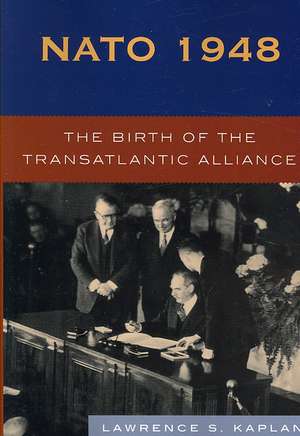
NATO 1948: The Birth of the Transatlantic Alliance
Autor Lawrence S. Kaplanen Limba Engleză Paperback – 21 iun 2007
Lawrence S. Kaplan, the leading historian of NATO, traces the tortuous and dramatic process, which struggled to reconcile the conflicting concerns on the part of the future partners. Although the allies could agree on the need to cope with the threat of Soviet-led Communism and on the vital importance of an American association with a unified Europe, they differed over the means of achieving these ends. The United States had to contend with domestic isolationist suspicions of Old World intentions, the military's worries about over extension of the nation's resources, and the apparent incompatibility of the projected treaty with the UN charter. For their part, Europeans had to be convinced that American demands to abandon their traditions would provide the sense of security that economic and political recovery from World War II required.
Kaplan brings to life the colorful diplomats and politicians arrayed on both sides of the debate. The end result was a remarkably durable treaty and alliance that has linked the fortunes of America and Europe for over fifty years. Despite differences that have persisted and occasionally flared over the past fifty years, NATO continues to bind America and Europe in the twenty-first century. Kaplan's detailed and lively account draws on a wealth of primary sources-newspapers, memoirs, and diplomatic documents-to illuminate how the United States came to assume international obligations it had scrupulously avoided for the previous 150 years.
Preț: 331.11 lei
Preț vechi: 408.19 lei
-19%
Puncte Express: 497
Carte tipărită la comandă
Livrare economică 09-23 noiembrie
Livrare express 02-08 octombrie pentru 226.75 lei
Livrare prin curier în România Termenul estimat este afișat lângă disponibilitate.
Transport gratuit de la 400.00 lei Plată online sau ramburs, în funcție de opțiunile comenzii.
Retur gratuit în 14 zile Comandă securizată și suport în română.
Specificații
ISBN-13: 9780742539174
ISBN-10: 0742539172
Pagini: 286
Dimensiuni: 148 x 228 x 18 mm
Greutate: 0.42 kg
Editura: Bloomsbury Publishing
Colecția Rowman & Littlefield
Locul publicării:New York, United States
ISBN-10: 0742539172
Pagini: 286
Dimensiuni: 148 x 228 x 18 mm
Greutate: 0.42 kg
Editura: Bloomsbury Publishing
Colecția Rowman & Littlefield
Locul publicării:New York, United States
V-ar putea interesa
-
 Beliefs in GovernmentMax Kaase-29%Preț: 423.96 lei593.21 lei
 -
 The Polarized Presidency of George W. BushGeorge C Edwards IIIPreț: 365.46 lei
 -
 -22%Preț: 507.01 lei648.50 lei
 -
 China Modernizes: Threat to the West or Model for the Rest?Randall PeerenboomPreț: 266.96 lei
 -
 -28%Preț: 521.87 lei726.59 lei
 -
 Transatlantic Economic Disputes: The EU, the US, and the WTOErnst-Ulrich Petersmann-28%Preț: 506.13 lei701.78 lei
 -
 What Kind of Europe?Loukas Tsoukalis-19%Preț: 367.10 lei454.72 lei
 -
 -19%Preț: 359.57 lei445.38 lei
 -
 Tragedy and International RelationsT. ErskinePreț: 390.39 lei
 -
 -30%Preț: 471.62 lei673.87 lei
 -
 -30%Preț: 471.54 lei673.81 lei
 -
 The Dark Sahara: America's War on Terror in AfricaJeremy KeenanPreț: 231.18 lei
 -
 The Ethics of War and PeaceNigel DowerPreț: 201.01 lei
 -
 -8%Preț: 548.01 lei595.66 lei
 -
 While Europe SleptBruce BawerPreț: 110.49 lei
 -
 -15%Preț: 524.40 lei616.94 lei
 -
 Doing Research in Political SciencePaul Pennings-11%Preț: 443.50 lei498.31 lei
 -
 Preț: 141.76 lei
Cuprins
Chapter 1: Introduction: The Isolationist Tradition, 1800-1947
Chapter 2: The "Speech": January 22, 1948
Chapter 3: The Brussels Pact: March 17, 1948
Chapter 4: The Vandenberg Resolution: June 11, 1948
Chapter 5: The "Exploratory" Talks: July-September 1948
Chapter 6: The Western Union Defense Organization: 1948-1949
Chapter 7: The Hiatus: September-December 1948
Chapter 8: The Treaty of Washington: April 4, 1949
Chapter 9: In Retrospect: The Relevance of NATO Today (or in the Post-Cold War Era)
Chapter 2: The "Speech": January 22, 1948
Chapter 3: The Brussels Pact: March 17, 1948
Chapter 4: The Vandenberg Resolution: June 11, 1948
Chapter 5: The "Exploratory" Talks: July-September 1948
Chapter 6: The Western Union Defense Organization: 1948-1949
Chapter 7: The Hiatus: September-December 1948
Chapter 8: The Treaty of Washington: April 4, 1949
Chapter 9: In Retrospect: The Relevance of NATO Today (or in the Post-Cold War Era)
Recenzii
Kaplan starts with the worsening of relations between the Soviet Union and the Western nations, and follows the twists and turns in the difficult negotiations that led to a treaty marking a radical change in US foreign policy. . . . Highly recommended.
This meticulously researched and well-written analysis builds on Kaplan's extensive earlier research on NATO's importance in the Cold War. . . . Its richly detailed analysis makes a significant contribution to the historical record. This judicious appraisal will be of interest to students of diplomatic history and international relations alike.
Larry Kaplan's book brings back to life the unique period in 1948-1949 that witnessed the birth of America's first 'entangling alliance.' His is an exceptionally lively, richly documented, and always enthralling study of the events that led to the greatest transformation of American diplomacy, of the men who made it happen, and of the challenges they had to overcome.
Lawrence Kaplan, a foremost specialist in the history of NATO, has written an insightful account of its birth. The relationship between the United States and Europe has suffered in recent years, making this book an especially timely reminder to a wider readership of just how much effort the past generation put into making the North Atlantic Alliance a reality in the aftermath of the Second World War. Elegantly written and cogent, the book should be read by all students of NATO, European affairs, and U.S. foreign policy on both sides of the Atlantic.
There is no better team than Lawrence Kaplan together with Morris Honick to recall the events that led to the creation of the West's chief Cold War instrument in opposing the Soviet Union. It is easy, in these post-Cold War days, not to acknowledge the difficulties that surrounded the creation of the international political-military institutions that are still in use today. Although constantly adapting to a changing international political environment, their basic functions of reinforcing common interests and denying 'divide and conquer' opportunities to actual or potential enemies, are still with us. It is also easy to forget the extreme reluctance on the American side to become 'entangled' in matters of European defense. For these reasons the detailed exposition of the debates and related considerations that underlay the formation of an anti-Soviet 'West' is a welcome addition to the extensive literature, most of it out of necessity based on secondary sources, that chronicles this vital period of our history.
This meticulously researched and well-written analysis builds on Kaplan's extensive earlier research on NATO's importance in the Cold War. . . . Its richly detailed analysis makes a significant contribution to the historical record. This judicious appraisal will be of interest to students of diplomatic history and international relations alike.
Larry Kaplan's book brings back to life the unique period in 1948-1949 that witnessed the birth of America's first 'entangling alliance.' His is an exceptionally lively, richly documented, and always enthralling study of the events that led to the greatest transformation of American diplomacy, of the men who made it happen, and of the challenges they had to overcome.
Lawrence Kaplan, a foremost specialist in the history of NATO, has written an insightful account of its birth. The relationship between the United States and Europe has suffered in recent years, making this book an especially timely reminder to a wider readership of just how much effort the past generation put into making the North Atlantic Alliance a reality in the aftermath of the Second World War. Elegantly written and cogent, the book should be read by all students of NATO, European affairs, and U.S. foreign policy on both sides of the Atlantic.
There is no better team than Lawrence Kaplan together with Morris Honick to recall the events that led to the creation of the West's chief Cold War instrument in opposing the Soviet Union. It is easy, in these post-Cold War days, not to acknowledge the difficulties that surrounded the creation of the international political-military institutions that are still in use today. Although constantly adapting to a changing international political environment, their basic functions of reinforcing common interests and denying 'divide and conquer' opportunities to actual or potential enemies, are still with us. It is also easy to forget the extreme reluctance on the American side to become 'entangled' in matters of European defense. For these reasons the detailed exposition of the debates and related considerations that underlay the formation of an anti-Soviet 'West' is a welcome addition to the extensive literature, most of it out of necessity based on secondary sources, that chronicles this vital period of our history.