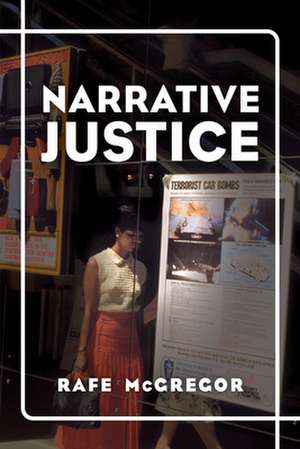
Narrative Justice
Autor Rafe McGregoren Limba Engleză Paperback – 9 mar 2020
Preț: 270.74 lei
Preț vechi: 352.86 lei
-23%
Puncte Express: 406
Carte tipărită la comandă
Livrare economică 07-21 decembrie
Livrare prin curier în România Termenul estimat este afișat lângă disponibilitate.
Transport gratuit de la 400.00 lei Plată online sau ramburs, în funcție de opțiunile comenzii.
Retur gratuit în 14 zile Comandă securizată și suport în română.
Specificații
ISBN-13: 9781786615565
ISBN-10: 1786615568
Pagini: 232
Dimensiuni: 148 x 228 x 14 mm
Greutate: 0.35 kg
Editura: Bloomsbury Publishing
Colecția Rowman & Littlefield
Locul publicării:New York, United States
ISBN-10: 1786615568
Pagini: 232
Dimensiuni: 148 x 228 x 14 mm
Greutate: 0.35 kg
Editura: Bloomsbury Publishing
Colecția Rowman & Littlefield
Locul publicării:New York, United States
Cuprins
Preface / 1. Narrative Representation / 2. Contemporary Aesthetic Education / 3. Narrative Ethics / 4. Narrative Knowledge / 5. Narrative Justice / 6. Narrative Value / 7. Responsibility for Inhumanity / 8. The Psychology of Inhumanity / 9. Undermining Inhumanity / Bibliography / Index
Recenzii
Can stories reduce crime? Rafe McGregor believes so, specifically when it comes to ideologically motivated crime, whether perpetrated by state actors or non-state actors. Narrative Justice is a major contribution to narrative criminology with criminological applications and ethical implications that make imperative reading for those tasked with law enforcement and policy making at the highest levels.
In Narrative Justice, McGregor applies meticulous philosophical reasoning to work out how we might reduce criminal inhumanity through narrative. His ideas on the ethical value of narrative representation and the knowledge-generating capacity of 'exemplary stories' will be of enduring value to social theory, criminology, and to anyone who hopes to change minds.
In Narrative Justice Rafe McGregoroffers a strikingly original defense of the idea that works of narrative art have a distinctive capacity to cultivate understanding and promote an ethical society. A fascinating feature of this books is its turn to criminology as a fresh site for thinking about art's ability to develop moral sensibilities and character. Narrative Justice is ultimately a plea for the importance of aesthetic education, an idea championed by Friedrich Schiller in 1794 and here modernized and made responsive to contemporary concerns and problems. This book is a must-read for anyone interested in why healthy societies need good narratives.
In Narrative Justice, McGregor applies meticulous philosophical reasoning to work out how we might reduce criminal inhumanity through narrative. His ideas on the ethical value of narrative representation and the knowledge-generating capacity of 'exemplary stories' will be of enduring value to social theory, criminology, and to anyone who hopes to change minds.
In Narrative Justice Rafe McGregoroffers a strikingly original defense of the idea that works of narrative art have a distinctive capacity to cultivate understanding and promote an ethical society. A fascinating feature of this books is its turn to criminology as a fresh site for thinking about art's ability to develop moral sensibilities and character. Narrative Justice is ultimately a plea for the importance of aesthetic education, an idea championed by Friedrich Schiller in 1794 and here modernized and made responsive to contemporary concerns and problems. This book is a must-read for anyone interested in why healthy societies need good narratives.