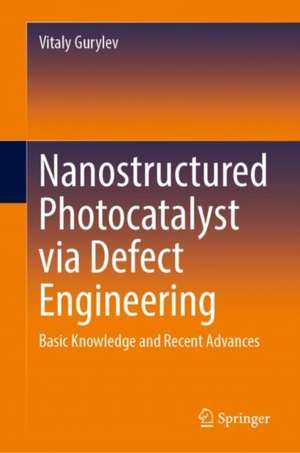
Nanostructured Photocatalyst via Defect Engineering
Autor Vitaly Guryleven Limba Engleză Hardback – 29 oct 2021
Preț: 1275.40 lei
Preț vechi: 1555.37 lei
-18%
Puncte Express: 1913
Carte disponibilă
Livrare economică 10-24 noiembrie
Livrare prin curier în România Termenul estimat este afișat lângă disponibilitate.
Transport gratuit pentru acest produs Plată online sau ramburs, în funcție de opțiunile comenzii.
Retur gratuit în 14 zile Comandă securizată și suport în română.
Specificații
ISBN-13: 9783030819101
ISBN-10: 3030819108
Pagini: 400
Ilustrații: XIX, 378 p. 76 illus., 73 illus. in color.
Dimensiuni: 160 x 241 x 26 mm
Greutate: 0.79 kg
Ediția:1st edition 2021
Editura: Springer International Publishing
Locul publicării:Cham, Switzerland
ISBN-10: 3030819108
Pagini: 400
Ilustrații: XIX, 378 p. 76 illus., 73 illus. in color.
Dimensiuni: 160 x 241 x 26 mm
Greutate: 0.79 kg
Ediția:1st edition 2021
Editura: Springer International Publishing
Locul publicării:Cham, Switzerland
V-ar putea interesa
-
 Quantum & Nano Technologies for PhotovoltaicsLoucas Tsakalakos-9%Preț: 670.37 lei736.67 lei
-
 Semiconductors and SemimetalsZetian Mi-41%Preț: 1078.52 lei1820.10 lei
-
 -9%Preț: 1191.03 lei1308.82 lei
-
 Photocatalysis: Fundamentals, Applications & ProspectsMargaret Howard-27%Preț: 998.11 lei1361.48 lei
-
 -30%Preț: 97.81 lei139.80 lei
-
 Introduction to PhotocatalysisYoshio Nosaka-22%Preț: 580.75 lei744.55 lei
-
 -15%Preț: 675.08 lei794.21 lei
-
 Nanostructured Materials for Environmental ApplicationsSubramanian Balakumar-19%Preț: 645.68 lei797.14 lei
-
 Green Photocatalytic SemiconductorsSeema Garg-18%Preț: 1361.15 lei1659.94 lei
-
 -24%Preț: 1049.03 lei1380.30 lei
-
 Pyrochlore OxidesDiana G. Fukina-18%Preț: 1039.94 lei1268.22 lei
-
 Advances in Catalysts ResearchShadia Jamil Ikhmayies-24%Preț: 951.43 lei1251.87 lei
-
 Surface Defects in Wide-Bandgap LiF, SiO2, and ZnO CrystalsUtkirjon SharopovPreț: 382.08 lei
-
 -9%Preț: 948.31 lei1042.09 lei
-
 PhotocatalysisJinlong Zhang-18%Preț: 1159.04 lei1413.46 lei
-
 -19%Preț: 439.52 lei542.61 lei
Cuprins
Dr. Vitaly Gurylev holds a M.S. in Chemical Engineering by Chung Yuan Christian University, Taiwan and a PhD in Materials Science and Engineering by National Tsing Hua University, Taiwan. After graduation in 2016, he spent three years to join several postdoctoral practices in the same institution and then relocated to neighbouring National Synchrotron Radiation Research Center to become a part of Molecular Science Group while continue serving the same position. In 2021 he moved to work in industry and at the same time creating a partial affiliation as a Research Scientist in National Tsing Hua University. His research interest is mainly related to defect engineering and its application to build various nanostructured functional materials with tuneable properties and characteristics that can be used in photocatalytic processing. Currently, he has published 14 papers in SCI journals of high impact index including two reviews and one Featured Article, 11 of which have designated him asa first or corresponding author. Besides, his work has given rise to several prominent contributions to national and international conferences and also invited talks. In additional he also authored a book under imprint of Springer Nature.
Textul de pe ultima copertă
This book helps readers comprehend the principles and fundamentals of defect engineering toward realization of an efficient photocatalyst. The volume consists of two parts, each of which addresses a particulate type of defects. The first, larger section provides a comprehensive and rigorous treatment of the behaviour and nature of intrinsic defects. The author describes how their controlled introduction and consequent manipulation over concentration, distribution, nature and diffusion is one of the most effective and practical methodologies to modify the properties and characteristics of target photocatalytic materials. The second part of the book explains the formation of extrinsic defects in the form of metallic and non-metallic dopants and gives a detailed description of their characteristics as this approach is also often used to fabricate an efficient photocatalyst. Filling the gap in knowledge on the correlation between introduction of defects in various semiconducting materials and their photocatalytic performance, the book is ideal for graduate students, academics and researchers interested in photocatalysts, defect engineering, clean energy, hydrogen production, nanoscale advanced functional materials, CO2 deactivation, and semiconductor engineering.
- Investigates the nature and behaviour of intrinsic and extrinsic defects in the most recognizable and promising semiconductor photocatalytic materials;
- Demonstrates how the advancement of structural, optical, electronic and electrical properties of photocatalytic materials can be achieved via introduction of defects;
- Illustrates application of defects engineering in building an efficient nanostructured photocatalyst;
- Compares intrinsic and extrinsic deficiencies in strict and accurate terms.