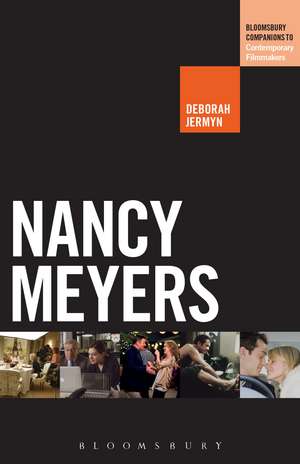
Nancy Meyers: The Bloomsbury Companions to Contemporary Filmmakers
Autor Deborah Jermynen Limba Engleză Hardback – 27 iul 2017
Including Nancy Meyers in the Bloomsbury Companions to Contemporary Filmmakers rectifies this omission, giving her the kind of detailed consideration and recognition she warrants and exploring how, notwithstanding the challenges authorship holds for feminist film studies, Meyers can be situated as a skilled 'auteur'. This book proposes that Meyers' box-office success, the consistency of style and theme across her films, and the breadth of her body of work as a writer/producer/director across more than three decades at the forefront of Hollywood, (thus importantly bridging the second/third waves of feminism) make her a key contemporary US filmmaker. Structured to meet the needs of both the student and scholar, Jermyn's volume situates Meyers within this historical and critical context, exploring the distinctive qualities of her body of work, the reasons behind the pervasive resistance to it and new ways of understanding her films.
Preț: 880.00 lei
Preț vechi: 1622.20 lei
-46%
Puncte Express: 1320
Carte tipărită la comandă
Livrare economică 27 noiembrie-11 decembrie
Livrare prin curier în România Termenul estimat este afișat lângă disponibilitate.
Transport gratuit pentru acest produs Plată online sau ramburs, în funcție de opțiunile comenzii.
Retur gratuit în 14 zile Comandă securizată și suport în română.
Specificații
ISBN-13: 9781628921748
ISBN-10: 1628921749
Pagini: 272
Ilustrații: 16 bw illus
Dimensiuni: 140 x 216 mm
Greutate: 0.45 kg
Editura: Bloomsbury Publishing
Colecția Bloomsbury Academic
Seria The Bloomsbury Companions to Contemporary Filmmakers
Locul publicării:New York, United States
ISBN-10: 1628921749
Pagini: 272
Ilustrații: 16 bw illus
Dimensiuni: 140 x 216 mm
Greutate: 0.45 kg
Editura: Bloomsbury Publishing
Colecția Bloomsbury Academic
Seria The Bloomsbury Companions to Contemporary Filmmakers
Locul publicării:New York, United States
V-ar putea interesa
-
 The English Patient: ScreenplayAnthony Minghella-7%Preț: 109.21 lei117.29 lei
 -
 -25%Preț: 92.88 lei123.86 lei
 -
 -26%Preț: 89.87 lei121.42 lei
 -
 -23%Preț: 215.75 lei280.61 lei
 -
 -21%Preț: 130.99 lei165.47 lei
 -
 A Companion to Spanish CinemaJo LabanyiPreț: 378.65 lei
 -
 Star WarsJ. W Rinzler-12%Preț: 439.88 lei501.55 lei
 -
 Alien Next DoorJoey Spiotto-18%Preț: 77.12 lei94.13 lei
 -
 Prime SuspectDeborah Jermyn-17%Preț: 174.48 lei209.65 lei
 -
 False identityMirela OpreaPreț: 305.53 lei
Cuprins
List of illustrations
Acknowledgements
Preface
Introduction: Women, Hollywood and the Politics of the Popular
1. KEY COLLABORATIVE RELATIONSHIPS
Meet The Shmeyers: Meyers as writer-producer and the 'writing couple' leitmotif
2. WAYS OF WATCHING
The Romcom Queen: Gender, genre and cultural value
3. RETHINKING AUTHORSHIP
The wrong kind of woman filmmaker?: Meyers, feminism, and the quandaries of the female auteur
4. KEY CONCEPTS
'Your age is my favourite thing about you': Meyers' older women and the gendered experience of ageing
Conclusion
Bibliography
Index
Acknowledgements
Preface
Introduction: Women, Hollywood and the Politics of the Popular
1. KEY COLLABORATIVE RELATIONSHIPS
Meet The Shmeyers: Meyers as writer-producer and the 'writing couple' leitmotif
2. WAYS OF WATCHING
The Romcom Queen: Gender, genre and cultural value
3. RETHINKING AUTHORSHIP
The wrong kind of woman filmmaker?: Meyers, feminism, and the quandaries of the female auteur
4. KEY CONCEPTS
'Your age is my favourite thing about you': Meyers' older women and the gendered experience of ageing
Conclusion
Bibliography
Index
Recenzii
Jermyn's book is much more than a carefully researched, well written and brilliantly argued study of Nancy Meyers. In providing her analysis with a multiplicity of well-chosen contexts --postfeminist culture, the politics of the popular, the hidden complexities of romantic comedy-- she ends up contributing as much to those contexts as to the work of the Hollywood director. Both passionate and nuanced, this is film scholarship at its very best.
Timely and well overdue, Jermyn's monograph thoroughly examines writer/director/producer Nancy Meyers's oeuvre. To this date and despite a long and successful career, Meyers has still not found a place in either film history or studies of authorship that are unfortunately stories of male cinematic success, or studies of "women's" cinema that tend to avoid and/or "suspect" female mainstream filmmaking. Delving into rich archival material and based on insightful textual analysis, Jermyn poignantly proves not only that Meyers could easily be placed among the revered male auteurs of contemporary American cinema (although this is not her aim) and that her place in post-classical Hollywood history is unquestionable but also how her career and cultural outputs have been diminished exactly because of her gender and the female characters she has created. At a time when Hollywood is more than ever invested in simplistic franchise productions despite increasing outcry against this obvious discrimination, Jermyn's study is a most valuable work that should complement the reading lists of many a film, media and gender studies syllabus.
Nancy Meyers' films are easily and often dismissed for their visual allure and aspirational aesthetics. (A hint of their complexity, though, may lie in these films' awareness of a truth we don't want to hear, namely that a key form of contemporary intimacy is our relationship with our possessions and ability to "stage" them). Deborah Jermyn rigorously and compellingly elicits a set of counter-evidence to the "standard line" on Meyers' work; this lively, engaging and highly readable work exemplifies the very best kind of high-quality film studies scholarship.
Deborah Jermyn argues for Nancy Meyers not as a feminist auteur but as an auteur that feminists need to think about. And it's fun to think through the questions Jermyn explores in this book, from the lowly status of rom coms to the meanings of auteurism itself. Jermyn wittily calls out and thinks critically about her own strategies of analysis, offering a savvy model of film scholarship as well as an engaging reading of movies we now need to see again.
Timely and well overdue, Jermyn's monograph thoroughly examines writer/director/producer Nancy Meyers's oeuvre. To this date and despite a long and successful career, Meyers has still not found a place in either film history or studies of authorship that are unfortunately stories of male cinematic success, or studies of "women's" cinema that tend to avoid and/or "suspect" female mainstream filmmaking. Delving into rich archival material and based on insightful textual analysis, Jermyn poignantly proves not only that Meyers could easily be placed among the revered male auteurs of contemporary American cinema (although this is not her aim) and that her place in post-classical Hollywood history is unquestionable but also how her career and cultural outputs have been diminished exactly because of her gender and the female characters she has created. At a time when Hollywood is more than ever invested in simplistic franchise productions despite increasing outcry against this obvious discrimination, Jermyn's study is a most valuable work that should complement the reading lists of many a film, media and gender studies syllabus.
Nancy Meyers' films are easily and often dismissed for their visual allure and aspirational aesthetics. (A hint of their complexity, though, may lie in these films' awareness of a truth we don't want to hear, namely that a key form of contemporary intimacy is our relationship with our possessions and ability to "stage" them). Deborah Jermyn rigorously and compellingly elicits a set of counter-evidence to the "standard line" on Meyers' work; this lively, engaging and highly readable work exemplifies the very best kind of high-quality film studies scholarship.
Deborah Jermyn argues for Nancy Meyers not as a feminist auteur but as an auteur that feminists need to think about. And it's fun to think through the questions Jermyn explores in this book, from the lowly status of rom coms to the meanings of auteurism itself. Jermyn wittily calls out and thinks critically about her own strategies of analysis, offering a savvy model of film scholarship as well as an engaging reading of movies we now need to see again.