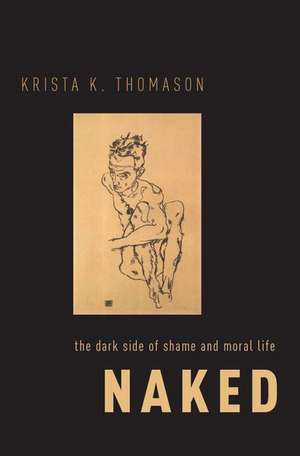
Naked: The Dark Side of Shame and Moral Life
Autor Krista K. Thomasonen Limba Engleză Hardback – 15 mar 2018
Această monografie semnată de Krista K. Thomason reprezintă o incursiune riguroasă în mecanismele psihologiei morale, explorând latura întunecată a unei emoții adesea stigmatizate. Observăm o abordare care refuză simplificarea rușinii la o simplă busolă a virtuții; autoarea ne invită să privim rușinea ca pe o tensiune fundamentală între identitate (ceea ce suntem) și concepția de sine (ceea ce credem că suntem). Remarcăm faptul că Naked nu se limitează la dezbateri teoretice abstracte, ci ancorează analiza în realități corporale imediate — vulnerabilitatea nudității sau imperfecțiunile fizice — și în dinamica socială contemporană a platformelor digitale.
În contextul operei sale, Krista K. Thomason continuă investigarea „emoțiilor negative” începută în Dancing with the Devil, unde argumenta necesitatea furiei sau a invidiei pentru echilibrul uman. Dacă în Embodied Difference se concentra pe corp ca platformă discursivă, în Naked corpul devine sursa viscerală a unei rușini care poate fi atât distructivă, cât și un instrument de corecție socială împotriva rasismului sau sexismului. Reținem că această lucrare constituie o alternativă solidă la The Moral Psychology of Shame de Alessandra Fussi pentru cursurile de etică aplicată, având avantajul unei analize aplicate pe fenomenul de „online shaming” și pe complexitatea identitară în era digitală. Tonul este unul analitic și precis, evitând scuzele morale și preferând o explorare onestă a modului în care rușinea ne definește umanitatea.
Preț: 718.51 lei
Preț vechi: 1072.90 lei
-33%
Carte tipărită la comandă
Livrare economică 10-16 decembrie
Specificații
ISBN-10: 0190843276
Pagini: 256
Dimensiuni: 236 x 163 x 25 mm
Greutate: 0.59 kg
Editura: Oxford University Press
Colecția OUP USA
Locul publicării:New York, United States
V-ar putea interesa
-
 Write Yourself RichHollister, BrentPreț: 93.77 lei
 -
 Family Multilingualism in Medium-Sized Language CommunitiesEmili Boix-Fuster-23%Preț: 485.41 lei630.40 lei
 -
 Mass in E flat majorFranz SchubertPreț: 134.80 lei
De ce să citești această carte
Această carte este esențială pentru studenții și cercetătorii în filozofie și psihologie morală care doresc să înțeleagă de ce rușinea rămâne o componentă vitală, deși dureroasă, a vieții noastre. Cititorul va câștiga o perspectivă nuanțată asupra modului în care rețelele sociale transformă această emoție privată într-o armă politică și socială, oferind argumente teoretice pentru a naviga între valoarea morală a rușinii și potențialul ei distructiv.
Despre autor
Krista K. Thomason este o voce distinctă în filozofia morală contemporană, specializată în studiul emoțiilor și al psihologiei etice. Prin lucrările sale publicate la edituri de prestigiu precum Oxford University Press, ea a explorat constant rolul funcțional al sentimentelor considerate în mod tradițional negative. Interesele sale de cercetare includ etica kantiană, filozofia socială și impactul noilor tehnologii asupra interacțiunilor umane. Experiența sa în analizarea conceptelor de marginalizare și întrupare, vizibilă în proiecte precum Embodied Difference, îi permite să abordeze tema rușinii dintr-o perspectivă multidisciplinară, combinând rigoarea analitică cu relevanța socială.
Descriere
Recenzii
Thomason's unified account of shame is ambitious and compelling. Her constitutive account of moral emotions is independently plausible and worthy of further attention. And both accounts are developed within a sharply written piece of philosophy that is rich with engaging literary examples. Thomason has shown that the darker side of shame can illuminate this complicated emotion's brighter side.
Thomason's book is provocative, insightful, and loaded with interesting and colorful examples. It will be of interest to theorists in normative ethics and philosophy of emotion, but also to advanced undergraduates and non-philosophers
there is also much to be appreciated by anyone with an interest in moral psychology. It formulates an understanding of the emotion of shame and advances powerful but controversial arguments about the permissibility of inducing shame in others. I could envision it being used as a main text in a seminar on moral psychology, in conjunction with other books or papers that bring alternative perspectives (consequentialist, virtue theoretic, pluralist) to bear.
This book is undoubtedly a valuable contribution to furthering the conversation about shame and its proper place in morality. Thomason's account of the nature of shame is alluring and deserves serious consideration... Philosophers seeking to better inform their own bets would do well in reading this book.
Embracing shame in all its variety from that of the teenage boy discovered masturbating by his mother to that of the liar, the cheat, and the thief Thomason's refreshingly accessible book yields a unified account of shame as an emotion that marks dissonance between the identities that define us and the self-conceptions we hold dear. In arriving at her account, Thomason acknowledges shame's destructive features but defends a place for it among the emotions the liability to which is constitutive of our moral commitments. Proponents of the competing traditional, naturalistic, and pessimistic views of shame likely will find areas in which to disagree with Thomason, but her arguments should not be ignored.
Drawing on philosophy and imaginative literature, this is an informative and stimulating exploration of the nature and moral status of the emotion of shameone that forced me to rethink some of my own views on the topic. Clearly written and well argued, it should be of value both to those who have given considerable thought to the topic and those who are starting to think about it for the first time. I recommend it with enthusiasm.
This is an elegant and original account of shame, with a striking explanatory power. Thomason shows with style how even the darkest features of shame have and deserve a place in our moral life. Naked is a must-read for anyone interested in ethics, the moral emotions, and moral psychology.