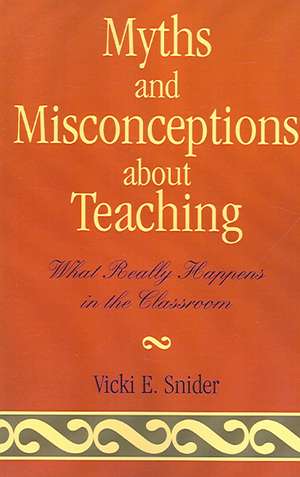
Myths and Misconceptions about Teaching: What Really Happens in the Classroom
Autor Vicki Snideren Limba Engleză Paperback – 14 mar 2006
The six myths:
· Process
· Fun
· Eclectic instruction
· Good teacher
· Learning style, and
· Disability
Myths and Misconceptions about Teaching features:
· A description of the historical, sociological, and philosophical forces that reinforce these myths
· A comparison of the field of education to medicine in an attempt to explain why there is so much reluctance to embrace a science of teaching
This book should be of interest to teachers, professors, parents, school board members, and graduate students.
Preț: 336.62 lei
Preț vechi: 416.11 lei
-19%
Puncte Express: 505
Carte tipărită la comandă
Livrare economică 02-16 decembrie
Livrare prin curier în România Termenul estimat este afișat lângă disponibilitate.
Transport gratuit de la 400.00 lei Plată online sau ramburs, în funcție de opțiunile comenzii.
Retur gratuit în 14 zile Comandă securizată și suport în română.
Specificații
ISBN-13: 9781578863464
ISBN-10: 1578863465
Pagini: 226
Dimensiuni: 148 x 226 x 16 mm
Greutate: 0.35 kg
Editura: Bloomsbury Publishing
Colecția R&L Education
Locul publicării:New York, United States
ISBN-10: 1578863465
Pagini: 226
Dimensiuni: 148 x 226 x 16 mm
Greutate: 0.35 kg
Editura: Bloomsbury Publishing
Colecția R&L Education
Locul publicării:New York, United States
Cuprins
Chapter 1 Introduction
Chapter 2 The Problem
Chapter 3 The Myth of Process
Chapter 4 The Myth of Fun and Interesting
Chapter 5 The Myth of Eclectic Instruction
Chapter 6 The Myth of Good Teachers
Chapter 7 The Myth of Learning Style
Chapter 8 The Myth of Disability
Chapter 9 The Origins of Myth
Chapter 10 From Myth to Science
Chapter 2 The Problem
Chapter 3 The Myth of Process
Chapter 4 The Myth of Fun and Interesting
Chapter 5 The Myth of Eclectic Instruction
Chapter 6 The Myth of Good Teachers
Chapter 7 The Myth of Learning Style
Chapter 8 The Myth of Disability
Chapter 9 The Origins of Myth
Chapter 10 From Myth to Science
Recenzii
Should be required reading for all superintendents across the country.
As someone who is both an educator and a parent of a child who has struggled in school, I have seen firsthand the dire consequences of the teaching myths that Dr. Snider explores. Over the past 20 years, I have seen teachers write off children because they had a learning need or were considered to be at risk. I have worked with teachers who failed to understand the basics of effective instruction and have observed countless instructional activities that were of questionable value. At a time when a child'seducation is patently tied to his or her future success, it is critical that schools deliver the most effective instruction they can in the most efficient manner possible. I hope that Myths and Misconceptions About Teaching stimulates a great dealof discussion about the best ways to teach our childrenn
Dr. Snider's book is impressive. I have taught for 25 years in a general education setting and have experienced all of the myths first hand. We owe it to our profession and to our students to be brutally honest with ourselves, to examine our fallacies in thinking and improve our direction for the future. Dr. Snider's open and honest book could start us on an important dialogue to doing just that.
Myths and Misconceptions About Teaching is a must read for teachers at all levels of education, administrators, and college professors in teacher preparation programs. It thoughtfully examines the problems in public education in the United States. It challenges long-held beliefs and explains why they are not the principles upon which to build a quality education for students. Hopefully, Snider's book will serve as a catalyst for changes in teacher preparation and inspire teachers to be better educators.
If we are to leave no child behind, American education must be grounded in scientific research, not based on myths. Snider delineates how the acceptance of myths harms our nation's children. It is only when educators approach teaching as a science as well as an art that all teachers and students can be successful and no child will be left behind. Myths and Miconceptions About Teaching must be on the required reading list for all school administrators, teachers, and education professors so that we stop harming children and start arming them for success.
Finally, someone with the courage to admit why the American education system continuously fails the students who need it the most! Dr. Snider demonstrates that if educators use research and choose curriculum wisely, all children will indeed have access to quality education. Every teacher education program in the country should require prospective teachers to read this book so that they will not fall victim to the myths that do a grave disservice to all children. As the parents of two bright children who have thrived under the Success for All reading program, Core Knowledge, and Saxon math, we applaud Dr. Snider.
This book is a well written, easy-to-read, and easy-to-understand expose of the myths that prevent education in America from achieving excellence. It is important reading for anyone seeking to understand or reform education in this country. Myths and Misconceptions About Teaching describes the dangerous shoals upon which all educational reform efforts up to this point have foundered. There is no doubt that any plan to improve American education that does not take into account the influence of these myths will founder as well. Perhaps someone, having learned where these obstacles lie, can find a way around them. We can only hope.
Snider's approach is a refreshing examination of how teaching affects student outcomes, rather than the traditional approach to learning difficulty and disability that focuses on diagnosing student deficits. This approach is long overdue and Snider's book adds a critical dimension to understanding how teaching practice can disable learners.
Snider describes six teaching myths that hinder education reform. She uses current research on teaching to illustrate the family premises that underlie the myths and to demonstrate their effect on children and adolescents.
As someone who is both an educator and a parent of a child who has struggled in school, I have seen firsthand the dire consequences of the teaching myths that Dr. Snider explores. Over the past 20 years, I have seen teachers write off children because they had a learning need or were considered to be at risk. I have worked with teachers who failed to understand the basics of effective instruction and have observed countless instructional activities that were of questionable value. At a time when a child'seducation is patently tied to his or her future success, it is critical that schools deliver the most effective instruction they can in the most efficient manner possible. I hope that Myths and Misconceptions About Teaching stimulates a great dealof discussion about the best ways to teach our childrenn
Dr. Snider's book is impressive. I have taught for 25 years in a general education setting and have experienced all of the myths first hand. We owe it to our profession and to our students to be brutally honest with ourselves, to examine our fallacies in thinking and improve our direction for the future. Dr. Snider's open and honest book could start us on an important dialogue to doing just that.
Myths and Misconceptions About Teaching is a must read for teachers at all levels of education, administrators, and college professors in teacher preparation programs. It thoughtfully examines the problems in public education in the United States. It challenges long-held beliefs and explains why they are not the principles upon which to build a quality education for students. Hopefully, Snider's book will serve as a catalyst for changes in teacher preparation and inspire teachers to be better educators.
If we are to leave no child behind, American education must be grounded in scientific research, not based on myths. Snider delineates how the acceptance of myths harms our nation's children. It is only when educators approach teaching as a science as well as an art that all teachers and students can be successful and no child will be left behind. Myths and Miconceptions About Teaching must be on the required reading list for all school administrators, teachers, and education professors so that we stop harming children and start arming them for success.
Finally, someone with the courage to admit why the American education system continuously fails the students who need it the most! Dr. Snider demonstrates that if educators use research and choose curriculum wisely, all children will indeed have access to quality education. Every teacher education program in the country should require prospective teachers to read this book so that they will not fall victim to the myths that do a grave disservice to all children. As the parents of two bright children who have thrived under the Success for All reading program, Core Knowledge, and Saxon math, we applaud Dr. Snider.
This book is a well written, easy-to-read, and easy-to-understand expose of the myths that prevent education in America from achieving excellence. It is important reading for anyone seeking to understand or reform education in this country. Myths and Misconceptions About Teaching describes the dangerous shoals upon which all educational reform efforts up to this point have foundered. There is no doubt that any plan to improve American education that does not take into account the influence of these myths will founder as well. Perhaps someone, having learned where these obstacles lie, can find a way around them. We can only hope.
Snider's approach is a refreshing examination of how teaching affects student outcomes, rather than the traditional approach to learning difficulty and disability that focuses on diagnosing student deficits. This approach is long overdue and Snider's book adds a critical dimension to understanding how teaching practice can disable learners.
Snider describes six teaching myths that hinder education reform. She uses current research on teaching to illustrate the family premises that underlie the myths and to demonstrate their effect on children and adolescents.