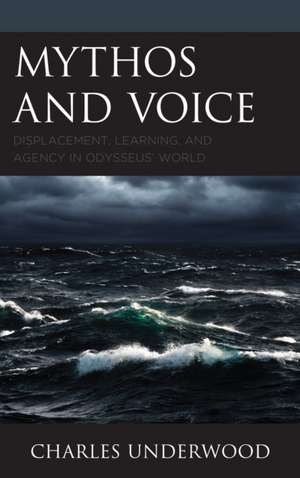
Mythos and Voice: Displacement, Learning, and Agency in Odysseus' World
Autor Charles Underwooden Limba Engleză Paperback – 14 sep 2020
The focus on mythos and voice enables readers to approach the study of learning and the acquisition of personal agency in the context of a hazardous world - the cultural world that Odysseus navigates in Homer's epic poem. With this focus, the author examines interactive processes of human learning in a specific cultural context - the epic universe of Homeric narrative. By ethnographically examining the learning contexts portrayed inHomer's epic, Mythos and Voice elucidates an Archaic Greek view of human learning through examples that show how the author(s) of the Odyssey envisioned and dramatized displacement, learning and agency in the epic work. The book focuses on aspects of Homeric cognition as they cumulatively develop among key characters within the Odyssey's inventive narrative structure. In this way, Mythos and Voice describes a culturally specific "theory" of learning and development - a perspective that proved compelling in the pre-classical and classical Greek world, even as it does to readers now.
Preț: 270.64 lei
Preț vechi: 369.35 lei
-27%
Puncte Express: 406
Carte tipărită la comandă
Livrare economică 16-30 noiembrie
Livrare prin curier în România Termenul estimat este afișat lângă disponibilitate.
Transport gratuit de la 400.00 lei Plată online sau ramburs, în funcție de opțiunile comenzii.
Retur gratuit în 14 zile Comandă securizată și suport în română.
Specificații
ISBN-13: 9781498534260
ISBN-10: 1498534260
Pagini: 228
Dimensiuni: 153 x 24917 x 17 mm
Greutate: 0.34 kg
Editura: Bloomsbury Publishing
Colecția Lexington Books
Locul publicării:New York, United States
ISBN-10: 1498534260
Pagini: 228
Dimensiuni: 153 x 24917 x 17 mm
Greutate: 0.34 kg
Editura: Bloomsbury Publishing
Colecția Lexington Books
Locul publicării:New York, United States
Cuprins
Chapter 1: Journey of the Heart: Navigating a World of Trouble
Chapter 2: Telemakhos in the Zone: Learning with Others in Mind
Chapter 3: Engendering the Male: Mentor and Mythos in Telemakhos' Journey
Chapter 4: Penelope's Wonder: Navigating the Mythos of Masculinity
Chapter 5: Odysseus on Edge: Learning to Survive in an Unreal World
Chapter 6: Iron Will and Heart's Desire: Body and Voice in the Heart's Journey
Chapter 2: Telemakhos in the Zone: Learning with Others in Mind
Chapter 3: Engendering the Male: Mentor and Mythos in Telemakhos' Journey
Chapter 4: Penelope's Wonder: Navigating the Mythos of Masculinity
Chapter 5: Odysseus on Edge: Learning to Survive in an Unreal World
Chapter 6: Iron Will and Heart's Desire: Body and Voice in the Heart's Journey
Recenzii
Mythos and Voice combines theoretical structure with close reading and exacting scholarship in near perfect balance. The concept of 'voice' in 'heroic discourse' (powerful speech) keeps the focus on the role of orality both in the making of the epic poem and in its very subject matter. The analysis of Achilles and Agamemnon conversing in Hades (Odyssey 24) is a tour de force of literary exegesis. The original adaptation of Vygotsky's 'zone of proximal development' and Bourdieu's 'habitus' emphasize interaction and relationalism, which place Mythos and Voice squarely amid current trends in social psychology or what the author calls 'cognitive ethnography.'
From his unique perspective as a working anthropologist, drawing especially on cultural psychology, Charles Underwood has re-envisioned the Odyssey as an extended meditation on human development and situated learning. A 'cognitive ethnography' of archaic Greece, as well as a meticulous, passage-by passage explication, the book offers compellingly fresh insights into the figures of Telemachus, Penelope, and Odysseus as they separately and collaboratively navigate a world of dangerous social displacement. Underwood's grasp of Homeric scholarship and range of theoretical perspectives, from Vygotsky and Bakhtin to Goffman and G.H. Mead, are impressive. The result is one of the deepest and most intriguing books about the Odyssey in years.
From his unique perspective as a working anthropologist, drawing especially on cultural psychology, Charles Underwood has re-envisioned the Odyssey as an extended meditation on human development and situated learning. A 'cognitive ethnography' of archaic Greece, as well as a meticulous, passage-by passage explication, the book offers compellingly fresh insights into the figures of Telemachus, Penelope, and Odysseus as they separately and collaboratively navigate a world of dangerous social displacement. Underwood's grasp of Homeric scholarship and range of theoretical perspectives, from Vygotsky and Bakhtin to Goffman and G.H. Mead, are impressive. The result is one of the deepest and most intriguing books about the Odyssey in years.