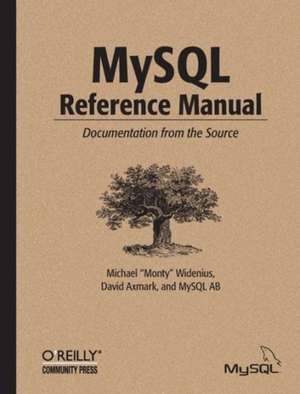
MySQL Reference Manual
Autor Michael Widenius, David Axmark, Kaj Arnoen Limba Engleză Paperback – 9 iul 2002
Abordarea practică a acestui volum derivă din însăși natura sa de documentație oficială: raportul dintre teorie și cod este net în favoarea aplicabilității imediate, oferind utilizatorului acces direct la mecanismele interne ale motorului de baze de date. Notăm cu interes faptul că MySQL Reference Manual, scris de Michael Widenius și echipa sa, elimină ambiguitățile interpretărilor secundare, oferind specificații brute pentru versiunea 4.0. Considerăm că structura sa, care pornește de la instalarea pe diverse sisteme de operare și ajunge la optimizări complexe de performanță, reflectă o progresie logică pentru orice administrator de sistem. Organizarea capitolelor permite o consultare rapidă; după o introducere tutorială în interogări SQL, manualul trece prompt la sarcini critice de administrare, precum configurarea privilegiilor și replicarea datelor. Complementar volumului Managing & Using MySQL, care pune accent pe teoria bazelor de date relaționale și utilizarea generală în medii Linux, acest manual de referință se concentrează pe detaliile tehnice de implementare și pe particularitățile motorului MySQL care îi asigură viteza și eficiența. Credem că diferențiatorul major față de alte titluri este rigoarea cu care sunt explicate formatele tabelelor și metodele de recuperare în caz de eroare. Volumul acoperă zone pe care ghidurile introductive le omit, cum ar fi adăugarea de funcții noi în MySQL sau investigarea diferențelor subtile între tipurile de date. Deși tehnologia a evoluat, principiile de optimizare și arhitectura prezentate aici de Michael Widenius rămân fundamentale pentru înțelegerea ecosistemului open source. Este, în esență, o resursă tehnică ce transformă documentația web într-un instrument de lucru fizic, indispensabil pentru depanare și tuning.
Preț: 276.59 lei
Preț vechi: 345.74 lei
-20%
Carte tipărită la comandă
Livrare economică 04-18 decembrie
Specificații
ISBN-10: 0596002653
Pagini: 816
Dimensiuni: 177 x 236 x 40 mm
Greutate: 1.15 kg
Editura: O'Reilly
Locul publicării:United States
V-ar putea interesa
-
 PHP and MySQL for Dynamic Web SitesLarry Ullman-20%Preț: 305.76 lei382.21 lei
 -
 Language of SQL, TheLarry Rockoff-20%Preț: 141.44 lei176.80 lei
 -
 SQL Queries for Mere MortalsJohn Viescas-20%Preț: 334.07 lei417.58 lei
 -
 -20%Preț: 211.63 lei264.55 lei
 -
 MySQL Crash CourseBen Forta-20%Preț: 209.68 lei262.10 lei
 -
 PHP and MySQL Web DevelopmentLaura Thomson-20%Preț: 316.71 lei395.88 lei
 -
 PHP & MySQL: Server-side Web DevelopmentJon Duckett-20%Preț: 275.79 lei344.74 lei
 -
 PHP & MySQLJon Duckett-20%Preț: 242.39 lei302.99 lei
 -
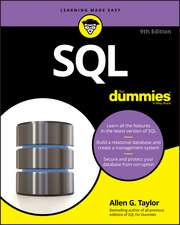 SQL For DummiesAllen G. Taylor-20%Preț: 174.83 lei218.53 lei
 -
 SQL All-in-One For DummiesAllen G. Taylor-20%Preț: 173.32 lei216.65 lei
 -
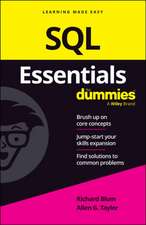 SQL Essentials for DummiesRichard Blum-20%Preț: 65.83 lei82.30 lei
 -
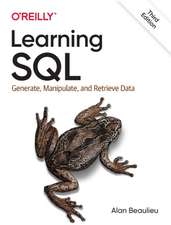 Learning SQL: Generate, Manipulate, and Retrieve DataAlan Beaulieu-20%Preț: 324.02 lei405.03 lei
 -
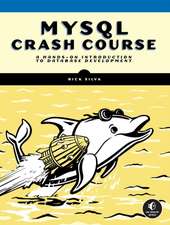 -35%Preț: 238.85 lei369.33 lei
 -
 PHP & MySQL in easy stepsMike Mcgrath-20%Preț: 73.86 lei92.32 lei
 -
 SQL in Easy StepsMike Mcgrath-20%Preț: 73.65 lei92.06 lei
 -
 Murachs MySQLJoel Murach-20%Preț: 353.49 lei441.87 lei
 -
 Murach's PHP and MySQLJoel Murach-20%Preț: 333.08 lei416.35 lei
 -
 Murach's MySQL (4th Edition)Joel Murach-20%Preț: 315.22 lei394.03 lei
 -
 Mastering MySQL AdministrationY V Ravi Kumar-20%Preț: 342.66 lei428.32 lei
De ce să citești această carte
Recomandăm această carte administratorilor de baze de date și dezvoltatorilor care au nevoie de o sursă autoritară pentru configurări avansate. Cititorul câștigă o înțelegere profundă a modului în care MySQL gestionează datele și securitatea. Este un instrument esențial pentru cei care lucrează cu sisteme legacy sau doresc să înțeleagă arhitectura internă a celui mai popular motor SQL open source.
Descriere scurtă
Many sophisticated topics appear in this comprehensive manual, ranging from the hitches you may run into when first installing MySQL to internals that will help you tune your queries. MySQL Reference Manual contains all the comprehensive reference material one would expect for building the product, running administrative utilities, and using various API as well as MySQL's rich version of SQL. In addition, you can turn a page and find such unexpected riches as:
- A thorough comparison of MySQL with SQL standards and other databases
- A discussion of privileges and suggested uses of privileges to enhance security
- Directions for replicating a database and for running several MySQL servers on a single system
- Directions for initializing a database from a flat file
- Guidelines for estimating the performance of different queries
- A far-reaching discussion of optimization, with reference to the implementation of MySQL
- Investigations of the differences between data types and the pros and cons of each type of number, string, or timestamp
- An extended inquiry into the effects of using delayed inserts
- A candid explanation of why various errors occur and how to recover from them
- Tips for weighted, full-text searches
- Detailed descriptions of the features, strengths, and weaknesses of available table formats
- A guide to adding new functions to MySQL