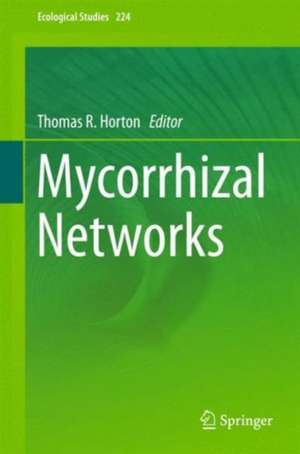
Mycorrhizal Networks
Editat de Thomas R. Hortonen Limba Engleză Hardback – 25 noi 2015
În cadrul programelor de studii avansate în ecologia botanică și micologie, înțelegerea interacțiunilor subterane a devenit fundamentală pentru explicarea dinamicii comunităților vegetale. Remarcăm în volumul Mycorrhizal Networks, coordonat de Thomas R. Horton, o sinteză riguroasă a ultimelor două decenii de descoperiri, marcând tranziția de la studiul simbiozei individuale la cel al rețelelor complexe care unesc indivizi și specii diferite. Observăm o organizare logică în trei piloni: arhitectura rețelelor, fluxul de carbon și azot și, cel mai important, poziționarea acestor relații pe spectrul dintre beneficiu reciproc și parazitism. Comparabil cu Mycorrhizal Ecology de Marcel G.A. van der Heijden în ceea ce privește rigoarea științifică, titlul de față aduce un plus de actualitate prin integrarea conceptului de „common mycelial networks” ca mecanism central de reținere a nutrienților și sechestrare a carbonului în ecosistemele forestiere. Găsim în cele nouă capitole nu doar o revizuire a termenilor și definițiilor, ci și o critică constructivă a metodologiilor experimentale actuale, autorii propunând noi prototipuri de testare pentru a izola mecanismele de transfer între plante. Deși Thomas R. Horton a explorat anterior teme diverse, această lucrare reprezintă o consolidare a expertizei sale în domeniul ecologiei fungice, oferind o perspectivă tehnică asupra modului în care genuri specifice, precum Alnus, pot forma rețele izolate, provocând teoriile generaliste despre conectivitatea pădurilor.
Preț: 1133.25 lei
Preț vechi: 1382.02 lei
-18%
Carte disponibilă
Livrare economică 30 octombrie-13 noiembrie
Specificații
ISBN-10: 9401773947
Pagini: 304
Ilustrații: XVIII, 286 p. 41 illus., 16 illus. in color.
Dimensiuni: 160 x 241 x 21 mm
Greutate: 0.68 kg
Ediția:1st ed. 2015
Editura: Springer
Locul publicării:Dordrecht, Netherlands
V-ar putea interesa
-
 -20%Preț: 357.46 lei446.14 lei
 -
 -28%Preț: 510.82 lei709.96 lei
 -
 Methods in Comparative Plant Population EcologyDavid Gibson-21%Preț: 483.35 lei612.26 lei
 -
 The Normalized Difference Vegetation IndexNathalie Pettorelli-31%Preț: 743.63 lei1078.10 lei
 -
 Ecology of Plant-Derived Smoke: Its Use in Seed GerminationLara Jefferson-32%Preț: 533.24 lei781.16 lei
 -
 Ecology of WisdomArne Næss-19%Preț: 63.70 lei78.26 lei
 -
 From Plant Traits to Vegetation StructureBill Shipley-11%Preț: 448.01 lei503.37 lei
 -
 Light and Photosynthesis in Aquatic EcosystemsJohn T O Kirk-11%Preț: 589.19 lei662.02 lei
 -
 Rainfed Farming SystemsPhilip Tow-18%Preț: 1290.25 lei1573.48 lei
Public țintă
GraduateDe ce să citești această carte
Această lucrare este esențială pentru cercetătorii și studenții de la nivel masteral sau doctoral care doresc să înțeleagă „internetul natural” al solului. Cititorul câștigă o perspectivă critică asupra modului în care ciupercile micorizice influențează competiția și supraviețuirea plantelor, trecând dincolo de descrierile simpliste ale simbiozei către o înțelegere sistemică a fluxurilor de resurse în ecosisteme complexe.
Cuprins
Recenzii
Textul de pe ultima copertă
Chapter 1 addresses the specificity of ectomycorrhizal symbionts and its role in plant communities, and provides an updated list of terms and definitions. Chapter 2 explores interactions between symbionts in mycorrhizal fungi networks, as well as interactions between fungal individuals. The second section of the book begins with the examination in Chapter 3 of extramatrical mycelium (mycelia beyond the root tips) in ectomycorrhizal fungi, focused on carbon and nitrogen. Chapter 4 reviews the influence of mycorrhizal networks on outcomes of plant competition in arbuscular mycorrhizal plant communities. Chapter 5 discusses nutrient movement between plants through networks with a focus on the magnitude, fate and importance of my
corrhiza-derived nutrients in ectomycorrhizal plants. Section 3 opens with a review of research on the role of ectomycorrhizal networks on seedling establishment in a primary successional habitat, in Chapter 6. The focus of Chapter 7 is on facilitation and antagonism in arbuscular mycorrhizal networks. Chapter 8 explores the unique networking dynamic of Alnus, which differs from most ectomycorrhizal plant hosts in forming isolated networks with little direct connections to networks of other host species in a forest. Chapter 9 argues that most experiments have not adequately tested the role of mycorrhizal networks on plant community dynamics, and suggests more tests to rule out alternative hypotheses to carbon movement between plants, especially those that include experimental manipulations of the mycorrhizal networks. Plant ecologists have accumulated a rich body of knowledge regarding nutrient acquisition by plants. The editor proposes that research indicating that mycorrhizal fungi compete for nutrients, which are then delivered to multiple hosts through mycorrhizal networks, represents an important new paradigm for plant ecologists.