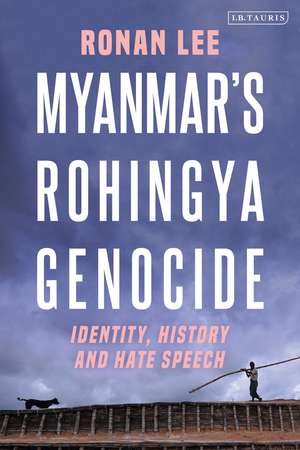
Myanmar’s Rohingya Genocide: Identity, History and Hate Speech
Autor Ronan Leeen Limba Engleză Paperback – 25 feb 2021
Casting new light on Rohingya identity, history and culture, this will be an essential contribution to the study of the Rohingya people and to the study of the early stages of genocide. This book adds convincingly to the body of evidence that the government of Myanmar has enabled a genocide in Rakhine State and the surrounding areas.
Preț: 172.57 lei
Preț vechi: 198.87 lei
-13%
Puncte Express: 259
Carte tipărită la comandă
Livrare economică 04-18 decembrie
Livrare express 30 octombrie-05 noiembrie pentru 58.77 lei
Livrare prin curier în România Termenul estimat este afișat lângă disponibilitate.
Transport gratuit de la 400.00 lei Plată online sau ramburs, în funcție de opțiunile comenzii.
Retur gratuit în 14 zile Comandă securizată și suport în română.
Specificații
ISBN-13: 9780755602476
ISBN-10: 0755602471
Pagini: 320
Ilustrații: 10 bw illus
Dimensiuni: 154 x 234 x 20 mm
Greutate: 0.48 kg
Editura: Bloomsbury Publishing
Colecția I.B.Tauris
Locul publicării:London, United Kingdom
ISBN-10: 0755602471
Pagini: 320
Ilustrații: 10 bw illus
Dimensiuni: 154 x 234 x 20 mm
Greutate: 0.48 kg
Editura: Bloomsbury Publishing
Colecția I.B.Tauris
Locul publicării:London, United Kingdom
Cuprins
List of Illustrations
Acronyms
Introduction: Bamboo, Tarpaulin and Mud
Chapter 1. Rohingya Roots in Ancient Arakan
Chapter 2. British Colonial Rule and Rohingya Identity
Chapter 3. Citizenship Laws: Making Rohingya Stateless
Chapter 4. Myanmar's Failed Political Transition
Chapter 5. Conflicting Historical Narratives
Chapter 6. People Would Like to Demolish Our History
Chapter 7. We are Rohingya
Chapter 8. Seeking Common Ground
Acknowledgements
Bibliographical Survey
Notes
Index
Acronyms
Introduction: Bamboo, Tarpaulin and Mud
Chapter 1. Rohingya Roots in Ancient Arakan
Chapter 2. British Colonial Rule and Rohingya Identity
Chapter 3. Citizenship Laws: Making Rohingya Stateless
Chapter 4. Myanmar's Failed Political Transition
Chapter 5. Conflicting Historical Narratives
Chapter 6. People Would Like to Demolish Our History
Chapter 7. We are Rohingya
Chapter 8. Seeking Common Ground
Acknowledgements
Bibliographical Survey
Notes
Index
Recenzii
25 years after the genocide against the Tutsi in Rwanda, will the international community really allow this to happen again? With Ronan Lee's profound new offering, we can no longer claim ignorance about the horrific plight of the Rohingya people.
Ronan Lee's book is one of the most important studies of the ongoing genocide against the Rohingya in Myanmar to date. It seeks to understand the Rohingya situation in its proper historical context and contemporary political situation, offering a fair, reliable, insightful analysis that identifies the many factors that will keep contributing to this crisis. The biggest contribution, however, is the examination of the genocide from the perspectives of different individuals involved in the crisis, which reveals just how complicated and difficult a resolution will be. This book is highly recommended to anyone seeking to understand the crisis, and importantly, those in governments and NGOs who can adapt practice on the basis of insights a careful reading of this volume offers.
In his new book, Myanmar's Rohingya Genocide, Lee in effect predicted the current seizure of power by the military ... Lee conducted fieldwork in Myanmar and its neighbouring countries, and his book is determined to tell the stories of the Rohingya themselves.
Ronan Lee's book is one of the most important studies of the ongoing genocide against the Rohingya in Myanmar to date. It seeks to understand the Rohingya situation in its proper historical context and contemporary political situation, offering a fair, reliable, insightful analysis that identifies the many factors that will keep contributing to this crisis. The biggest contribution, however, is the examination of the genocide from the perspectives of different individuals involved in the crisis, which reveals just how complicated and difficult a resolution will be. This book is highly recommended to anyone seeking to understand the crisis, and importantly, those in governments and NGOs who can adapt practice on the basis of insights a careful reading of this volume offers.
In his new book, Myanmar's Rohingya Genocide, Lee in effect predicted the current seizure of power by the military ... Lee conducted fieldwork in Myanmar and its neighbouring countries, and his book is determined to tell the stories of the Rohingya themselves.