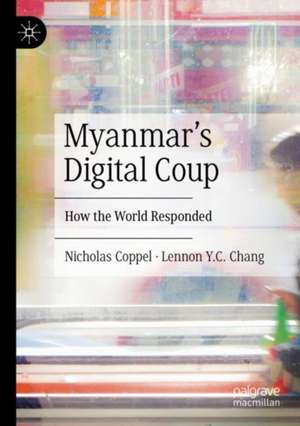
Myanmar's Digital Coup
Autor Nicholas Coppel, Lennon Y. C. Changen Limba Engleză Paperback – 24 iul 2025
Publicul țintă format din studenți în științe politice, cercetători ai spațiului sud-est asiatic și practicieni în diplomație va găsi în Myanmar's Digital Coup o analiză riguroasă a modului în care digitalizarea a transformat rezistența politică. Putem afirma că lucrarea semnată de Nicholas Coppel și Lennon Y. C. Chang umple un gol critic în literatura de specialitate, concentrându-se pe impactul tehnologiei asupra Mișcării de Nesupunere Civilă, un aspect mai puțin explorat în volumele anterioare care vizau doar tranziția democratică. Reținem că această a patra lovitură de stat din istoria modernă a Myanmarului este radical diferită tocmai prin conectivitatea cetățenilor și influența „Alianței Milk Tea”.
Cartea extinde cadrul propus de Myanmar’s Post-Coup Foreign Policy de Andrea Passeri cu date noi din primul an de după lovitura de stat, punând accent nu doar pe politica externă a juntei, ci și pe „arma digitală” folosită de ambele tabere. Subliniem organizarea logică a volumului: după o introducere în contextul istoric (Capitolele 1-2), autorii disecă în Capitolul 3 „weaponisation of the internet”, oferind detalii despre dezinformare și mobilizarea prin smartphone. Capitolele centrale (5-7) evaluează răspunsul instituțional al ONU și ASEAN, în timp ce ultimele secțiuni abordează dilemele economice ale corporațiilor internaționale (Capitoliul 9). Spre deosebire de Myanmar de Adam Simpson, care oferă o privire de ansamblu socio-economică, lucrarea de față este un studiu aplicat asupra eficacității sancțiunilor în raport cu diplomația digitală și implicarea societății civile globale.
Preț: 627.44 lei
Preț vechi: 682.00 lei
-8%
Carte disponibilă
Livrare economică 09-14 noiembrie
Livrare express 28 octombrie-03 noiembrie pentru 72.87 lei
Specificații
ISBN-10: 3031586476
Pagini: 244
Dimensiuni: 148 x 210 x 14 mm
Greutate: 0.32 kg
Editura: Springer
De ce să citești această carte
Această carte este esențială pentru a înțelege cum tehnologia digitală poate deveni atât un instrument de eliberare, cât și unul de represiune. Cititorul câștigă o perspectivă privilegiată, bazată pe experiența de diplomat a lui Nicholas Coppel, asupra limitelor intervenției internaționale. Este o recomandare certă pentru cei interesați de geopolitica actuală și de modul în care Generația Z redefinește protestul politic într-un stat paria.
Despre autor
Nicholas Coppel este un fost diplomat australian de rang înalt, având o experiență vastă în regiunea Asia-Pacific, inclusiv ca ambasador în Myanmar, ceea ce îi conferă o perspectivă rară asupra mecanismelor interne de putere. Lennon Y. C. Chang este un academic recunoscut, specializat în securitate cibernetică și criminalitate informatică, implicat activ în proiecte de consolidare a capacităților digitale în Myanmar. Colaborarea lor îmbină rigoarea academică cu pragmatismul diplomatic, oferind o analiză de autoritate asupra intersecției dintre tehnologie și politica de stat.
Descriere scurtă
Cuprins
Notă biografică
Lennon Y.C. Chang is Senior Lecturer in Criminology in the School of Social Sciences at Monash University, Australia. He is the Vice Chairman of the Asia Pacific Association of Technology and Society which he co-founded in 2012. He is also the founder of Cyberbaykin: Myanmar Cyber Security Awareness campaign. Before joining Monash University, he was an Assistant Professor of criminology in the Department of Applied Social Sciences at the City University of Hong Kong (2011-2015). He was awarded his PhD by the Australian National University in 2010. He has a Master in Criminology and Bachelor in Law degrees from National Taipei University. In 2007 he received an Endeavour Asia Award and in 2009 was identified by Peking University and Griffith Asia Institute as an Australia-China Emerging Leader. He was recently selected as a Global Emerging Voices Fellow and an Australia-China Youth Dialogue Fellow.
Textul de pe ultima copertă
— Dr. Morten B. Pedersen, University of New South Wales Canberra, Canberra, Australia.
This book analyses how technologies have been used by both the military junta and resistance movement in Myanmar’s digital coup to control information and the transfer of funds and to pursue accountability. They have been used to pressure and mobilise external actors and the book critically assesses international responses ranging from the United Nations, ASEAN, individual countries, activist groups, donors and international businesses. Contact with the military has been criticised as recognising and legitimising the regime and individual firms have come under pressure to exit. The authors argue that the National Unity Government overestimates the significance of foreign recognition and activists overestimate the influence of international responses on military behaviour. They suggest external actors change from judging and excoriating the responses of the international community and focus on how foreign governments,businesses or organisations can support and strengthen Myanmar society. If change in Myanmar is to come it will be those that have remained, not those that have left, that will bring it about.
Nicholas Coppel is President of the Australia Myanmar Institute and a former senior career diplomat. He was Australia's Ambassador to Myanmar for four years from 2015 to 2018.
Lennon Y.C. Chang is Associate Professor, Cyber Risk and Policy, in the Centre for Cyber Resilience and Trust and the School of Information Technology, at Deakin University. His research focuses on the intersection of law and technology, cybercrime and cyber security, disinformation campaigns and foreign interference. He co-founded Cyber Baykin: Myanmar Cyber Security Awareness Campaign. Dr Chang completed a PhD in Law at the Regulatory Institutions Network at the Australian National University.