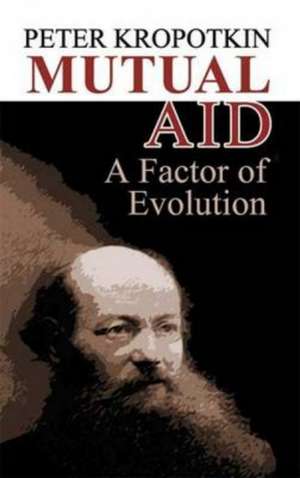
Mutual Aid: Dover Books on History, Political and Social Science
Autor Peter Kropotkinen Limba Engleză Paperback – 26 mai 2006
În această ediție publicată de Penguin Books, redescoperim Mutual Aid, o lucrare ce rămâne un pilon al gândirii sociopolitice moderne. Deși structura originală a fost păstrată, relevanța textului este amplificată de contextul academic actual, unde ecologia socială și biologia evoluționistă reevaluează constant mecanismele supraviețuirii. Peter Kropotkin propune o premisă care a sfidat dogmele epocii sale: succesul speciilor nu depinde de lupta individuală, ci de capacitatea de sprijin reciproc. Suntem de părere că rigoarea cu care autorul își bazează argumentele pe observații din lumea naturală și istoria civilizațiilor transformă acest volum într-un instrument critic împotriva darwinismului social. Comparabil cu The Origins of Virtue de Matt Ridley în analiza mecanismelor altruismului, Mutual Aid se diferențiază prin faptul că nu se limitează la biologie, ci extinde conceptul către o întreagă filozofie de organizare a societății. Descoperim aici o punte între observația științifică și viziunea politică, element care ancorează textul în continuarea lucrărilor sale fundamentale, precum The Conquest of Bread sau Modern Science & Anarchy. Dacă în eseurile sale politice Kropotkin analizează eșecurile revoluțiilor trecute, în acest volum el oferă fundamentul biologic și etic pentru o societate bazată pe cooperare voluntară. Tonul este cel al unui savant meticulos, oferind date care, așa cum observa Stephen Jay Gould, confirmă că lupta pentru existență ia adesea forma colaborării.

Preț: 101.10 lei
Preț vechi: 123.10 lei
-18%
Carte disponibilă
Livrare economică 13-20 noiembrie
Livrare express 30 octombrie-05 noiembrie pentru 50.70 lei
Specificații
ISBN-10: 0486449130
Pagini: 336
Dimensiuni: 165 x 210 x 20 mm
Greutate: 0.39 kg
Editura: Dover Publications Inc.
Seria Dover Books on History, Political and Social Science
V-ar putea interesa
-
 Big BangSimon SinghPreț: 123.02 lei
 -
 The Origins of VirtueMatt Ridley-19%Preț: 75.49 lei93.16 lei
 -
 The Blank SlateSteven Pinker-28%Preț: 78.74 lei109.00 lei
 -
 The Age of Spiritual MachinesRay Kurzweil-20%Preț: 106.23 lei132.78 lei
 -
 The Divided SelfR. D. Laing-31%Preț: 63.58 lei92.56 lei
 -
 The Case Against RealityDonald D. Hoffman-31%Preț: 63.92 lei92.82 lei
 -
 Anti-OedipusGilles DeleuzePreț: 130.27 lei
 -
 PsychiatryJohn Geddes-5%Preț: 271.35 lei285.64 lei
 -
 Burrhus F. Skinner: The Shaping of BehaviourFrederick Toates-23%Preț: 192.53 lei249.89 lei
 -
 Anarchist CommunismPeter Kropotkin-20%Preț: 45.58 lei56.65 lei
 -
 Preț: 71.12 lei
 -
 God and the StateMikhail BakuninPreț: 54.71 lei
 -
 The State and RevolutionVladimir Ilyich LeninPreț: 50.02 lei
 -
 The Cambridge Companion to AtheismMichael MartinPreț: 288.27 lei
 -
 The Greatest Show on EarthRichard Dawkins-22%Preț: 69.10 lei88.88 lei
 -
 Textbook of ImmunopsychiatryGolam Khandaker-5%Preț: 478.20 lei503.36 lei
 -
 The Conquest of BreadPetr Alekseevich KropotkinPreț: 51.85 lei
 -
 Inventing the FutureNick SrnicekPreț: 77.42 lei
 -
 Capitalist Realism (New Edition)Mark FisherPreț: 68.95 lei
 -
 Let the Right One InJohn Ajvide Lindqvist-25%Preț: 71.15 lei94.93 lei
 -
 Handling the UndeadJohn Ajvide Lindqvist-26%Preț: 58.91 lei79.58 lei
 -
 The Conquest of BreadPeter Kropotkin-27%Preț: 61.51 lei84.57 lei
De ce să citești această carte
Recomandăm această carte oricărui cititor interesat de antropologie, biologie sau filozofie politică. Mutual Aid oferă o perspectivă optimistă, dar riguros argumentată, asupra naturii umane, demonstrând că instinctul nostru primar este colaborarea, nu conflictul. Este o lectură esențială pentru a înțelege originile eticii sociale și pentru a vedea cum teoriile evoluționiste pot susține modele de organizare comunitară echitabile.
Despre autor
Peter Kropotkin (1842–1921) a fost un prinț rus care a abandonat privilegiile nobiliare pentru a deveni unul dintre cei mai influenți teoreticieni ai anarhismului comunist. Geograf și naturalist de renume, Kropotkin a integrat observațiile sale din expedițiile în Siberia în lucrări fundamentale care au influențat biologia umană și ecologia socială modernă. Opera sa, care include titluri precum Ethics; Origin and Development și The Conquest of Bread, explorează intersecția dintre științele naturii și organizarea socială, pledând constant pentru eliminarea structurilor de stat în favoarea cooperării voluntare.
Descriere scurtă
"Kropotkin's basic argument is correct," noted evolutionary biologist Stephen Jay Gould. "Struggle does occur in many modes, and some lead to cooperation among members of a species as the best pathway to advantage for individuals." Anthropologist Ashley Montagu declared that ""Mutual Aid" will never be any more out of date than will the Declaration of Independence. New facts may increasingly become available, but we can already see that they will serve largely to support Kropotkin's conclusion that 'in the ethical progress of man, mutual supportnot mutual strugglehas had the leading part.'" Physician and author Alex Comfort asserted that "Kropotkin profoundly influenced human biology by his theory of "Mutual Aid." . . . He was one of the first systematic students of animal communities, and may be regarded as the founder of modern social ecology.""
Descriere
One hundred years after his death, Peter Kropotkin is still one of the most inspirational figures of the anarchist movement. His message is clear: solidarity is strength! Every page of this new edition of Mutual Aid has been beautifully illustrated by one of anarchism's most celebrated current artists, N.O. Bonzo. The reader will also enjoy original artwork by GATS and insightful commentary by David Graeber, Ruth Kinna, Andrej Grubacic, and Allan Antliff.