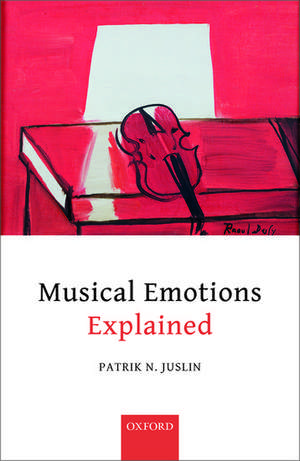
Musical Emotions Explained: Unlocking the Secrets of Musical Affect
Autor Patrik N. Juslinen Limba Engleză Hardback – 2 apr 2019
Preț: 369.10 lei
Preț vechi: 499.52 lei
-26%
Puncte Express: 554
Carte tipărită la comandă
Livrare economică 04-09 decembrie
Livrare prin curier în România Termenul estimat este afișat lângă disponibilitate.
Transport gratuit de la 400.00 lei Plată online sau ramburs, în funcție de opțiunile comenzii.
Retur gratuit în 14 zile Comandă securizată și suport în română.
Specificații
ISBN-13: 9780198753421
ISBN-10: 019875342X
Pagini: 624
Dimensiuni: 164 x 240 x 40 mm
Greutate: 1.11 kg
Editura: OUP OXFORD
Colecția OUP Oxford
Locul publicării:Oxford, United Kingdom
ISBN-10: 019875342X
Pagini: 624
Dimensiuni: 164 x 240 x 40 mm
Greutate: 1.11 kg
Editura: OUP OXFORD
Colecția OUP Oxford
Locul publicării:Oxford, United Kingdom
V-ar putea interesa
-
 Handbook of Music and Emotion: Theory, Research, ApplicationsPatrik N. Juslin-20%Preț: 533.93 lei668.85 lei
 -
 Vital SignsGregg LevoyPreț: 201.86 lei
 -
 -15%Preț: 444.27 lei522.67 lei
 -
 Emotions in Social Life: Critical Themes and Contemporary IssuesGillian BendelowPreț: 493.92 lei
 -
 Attitudes and PersuasionPhilip ErwinPreț: 297.84 lei
 -
 Emotions and Reasons: An Inquiry into Emotional JustificationPatricia S. GreenspanPreț: 407.88 lei
 -
 Feeling Power: Emotions and EducationMegan BolerPreț: 452.95 lei
 -
 Mastering Your MoodsMelvyn KinderPreț: 115.13 lei
 -
 -32%Preț: 532.09 lei779.09 lei
 -
 The Culture of ShameAndrew P. Morrison-19%Preț: 329.78 lei407.39 lei
 -
 Preț: 114.11 lei
 -
 The Regulation of EmotionPierre Philippot-18%Preț: 1130.16 lei1378.24 lei
 -
 The Psychological Significance of the BlushW. Ray CrozierPreț: 342.45 lei
 -
 Disgust: The Gatekeeper EmotionSusan MillerPreț: 444.19 lei
 -
 -18%Preț: 1190.66 lei1452.04 lei
 -
 Preț: 484.96 lei
 -
 The Development of Emotional CompetenceCarolyn Saarni-5%Preț: 376.55 lei396.36 lei
 -
 Expressing Emotion: Myths, Realities, and Therapeutic StrategiesEileen Kennedy-Moore-5%Preț: 324.03 lei341.08 lei
 -
 Lost CausesGeorge GrantPreț: 81.35 lei
 -
 Hatred: The Psychological Descent Into ViolenceWillard GaylinPreț: 175.80 lei
Recenzii
...Patrik Juslin's aim to explain listeners' musical emotions from a psychological perspective is fully achieved. Perhaps designed as a textbook for a course on music psychology, it also meets the needs of scholars from other disciplines; all terms are clearly explained regardless of their disciplinary origin, and little is assumed.
Juslin connects music and emotion to all manner of other human processes (e.g., learning, memory, perception) and, most strikingly, to aesthetics. The author's direct engagement with aesthetic judgment helps lift the book from something like an impressive compendium (a list of references runs 45 pages) to something much grander and more important. That the writing is consistently friendly and personal, never clinical, is somewhat surprising. Through some magic discussion remains accessible to almost any mature reader, even as the author marches through his argument with remarkable precision. The book could prove especially useful to musicians and might prompt them to think differently about what they do.
Handbook of Music and Emotion, by Patrik N. Juslin and John A. Sloboda, is an excellent book. It is comprehensive and up-to-date, well organized, well written, and stimulating.
Juslin connects music and emotion to all manner of other human processes (e.g., learning, memory, perception) and, most strikingly, to aesthetics. The author's direct engagement with aesthetic judgment helps lift the book from something like an impressive compendium (a list of references runs 45 pages) to something much grander and more important. That the writing is consistently friendly and personal, never clinical, is somewhat surprising. Through some magic discussion remains accessible to almost any mature reader, even as the author marches through his argument with remarkable precision. The book could prove especially useful to musicians and might prompt them to think differently about what they do.
Handbook of Music and Emotion, by Patrik N. Juslin and John A. Sloboda, is an excellent book. It is comprehensive and up-to-date, well organized, well written, and stimulating.
Notă biografică
Patrik N. Juslin is Professor of Psychology at Uppsala University in Sweden, where he directs their research and teaching in music psychology. His work focuses on the perception and experience of sound in music and speech, particularly in relation to emotion, also covering areas such as music education, health, music performance, and aesthetics. Juslin co-edited the Handbook of Music and Emotion (2010) together with John Sloboda, and has also previously worked semi-professionally as a guitar player.
Cuprins
- Part I: Introduction
- 1: Setting the Stage: Overture in C Major
- 2: The Book's Composition: Aim and Structure
- 3: The Value of a Psychological Approach
- 4: Music, Experience, and Affect
- Part II: Expression and Perception of Emotion
- 5: What Is Meant by Emotional Expression?
- 6: Empirical Studies: What Have We Learned?
- 7: Music as Expression: Objections and Obstacles
- 8: Breaking the Code: The Musical Features
- 9: How Are Music and Emotion Links Studied?
- 10: Viewing Music Through a Brunswikian Lens
- 11: The Voice of Angels? Iconic Expression
- 12: Further Layers: Intrinsic and Associative Expression
- 13: Deviation From the Exact: The Role of the Performer
- Part III: Arousal of Emotion
- 14: Beyond Perception: When Music Moves Us
- 15: Does Music Arouse Emotions? How Do We Know?
- 16: The Prevalence of Emotional Reactions
- 17: How Does Music Arouse Emotions?
- 18: Jumping at Shadows: Brain Stem Reflex
- 19: Get Into the Groove: Rhythmic Entrainment
- 20: Mirroring the Expression: Contagion
- 21: Ring My Bell: Evaluative Conditioning
- 22: Blast From the Past: Episodic Memory
- 23: Seeing in the Mind's Eye: Visual Imagery
- 24: What Comes Next? Musical Expectancy
- 25: Predictions, Implications, Complications
- Part IV: Aesthetic Judgment
- 26: Aesthetics: The Hard Problem?
- 27: Traditional Approaches to Aesthetics
- 28: What's Special? Adopting the Aesthetic Attitude
- 29: Aesthetic Criteria: Meet the Usual Suspects!
- 30: A Novel Approach Towards Aesthetic Judgment
- 31: Aesthetics and Affect in Broader Perspective
- 32: The Last Chorus: Putting It All Together
- 33: Coda: Final Outlook
- Appendix: The Lens Model Equation