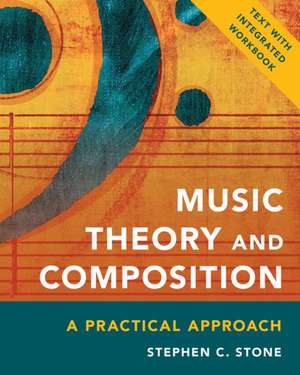
Music Theory and Composition: A Practical Approach
Autor Stephen C. Stoneen Limba Engleză Paperback – 26 ian 2018
With short, digestible chapters, Music Theory and Composition clearly presents otherwise complicated ideas not as strict rules, but as artistic ideals, encouraging the interactive creation of new compositions as a tool for learning.
The textbook is versatile and easily customizable, suiting
Different skill levels with species counterpoint providing a framework for the beginner while providing an interesting challenge for more experienced studentsDifferent curricular schedules with complete exercises in two, three, and four voices, allowing for an optional skip from two voices to fourDifferent pedagogical approaches with species exercises encouraging students to consider harmonic choices and figured bass ensuring functional progressions
Instructor Resources:
Instructor's Manual: The Instructor's Manual includes sample syllabi and student handoutsTest Bank: The test bank includes sample tests and answer keys in MS Word format.
Student Resources:
Additional Features:
complete curriculum for first-year theory courses
over 500 musical examples drawn from Common Practice Era compositions as well as more contemporary and popular pieces
focus on active composition throughout the text and workbook sections
large pop music section to expand student's application of theory
conversational tone to encourage student engagement
Designed for first-year college music theory courses, but accessible enough for the interested lay reader or high school student, the text offers a true balance of counterpoint and harmony.?
Preț: 523.03 lei
Preț vechi: 705.36 lei
-26%
Puncte Express: 785
Carte tipărită la comandă
Livrare economică 17 noiembrie-01 decembrie
Livrare prin curier în România Termenul estimat este afișat lângă disponibilitate.
Transport gratuit pentru acest produs Plată online sau ramburs, în funcție de opțiunile comenzii.
Retur gratuit în 14 zile Comandă securizată și suport în română.
Specificații
ISBN-13: 9781538101230
ISBN-10: 1538101238
Pagini: 520
Dimensiuni: 200 x 254 x 30 mm
Greutate: 1.07 kg
Editura: Bloomsbury Publishing
Colecția Rowman & Littlefield
Locul publicării:New York, United States
ISBN-10: 1538101238
Pagini: 520
Dimensiuni: 200 x 254 x 30 mm
Greutate: 1.07 kg
Editura: Bloomsbury Publishing
Colecția Rowman & Littlefield
Locul publicării:New York, United States
V-ar putea interesa
-
 The Music of Our LivesKathleen Marie Higgins-29%Preț: 345.00 lei483.69 lei
 -
 -34%Preț: 479.28 lei721.86 lei
 -
 Music in Puerto Rico: A Reader's AnthologyDonald Thompson-32%Preț: 390.72 lei577.72 lei
 -
 J.S. Bach: The Complete CantatasRichard Stokes-32%Preț: 525.97 lei773.93 lei
 -
 A History of Performing Pitch: The Story of 'A'Bruce Haynes-34%Preț: 801.33 lei1223.00 lei
 -
 Comprehensive Musical AnalysisJohn D. White-31%Preț: 411.70 lei597.17 lei
 -
 Silence and Slow Time: Studies in Musical NarrativeMartin Boykan-31%Preț: 532.46 lei769.77 lei
 -
 -35%Preț: 471.33 lei720.97 lei
 -
 -32%Preț: 920.92 lei1358.27 lei
 -
 -18%Preț: 1113.91 lei1358.42 lei
 -
 Preț: 165.85 lei
 -
 Decision Making and Controversies in State Supreme CourtsSalmon A. Shomade-28%Preț: 219.06 lei306.02 lei
 -
 Bass ChopsJon LiebmanPreț: 116.88 lei
 -
 Play Violin Today! Beginner's PackKaitlyn HahnPreț: 108.30 lei
 -
 Preț: 66.80 lei
 -
 Lively Guitar TunesWilliam A. BayPreț: 96.04 lei
 -
 Lively Clarinet TunesWilliam A. BayPreț: 80.22 lei
 -
 Lively Violin TunesWilliam A. BayPreț: 80.22 lei
 -
 Preț: 166.19 lei
 -
 MozartNorbert EliasPreț: 93.80 lei
 -
 Jazz HarmonyFrank SikoraPreț: 349.48 lei
 -
 UN BARROCO POSIBLESergio SiminovichPreț: 115.52 lei
Cuprins
Preface
A Note for Instructors
A Student's Introduction
Acknowledgments
Preludes - Rudiments
Prelude 1 - Notation of Sound
Prelude 2 - Meter
Prelude 3 - Scales and Key Signatures
Prelude 4 - Intervals
Prelude 5 - Triads
Prelude 6 - Seventh Chords
Part I - Melody
Chapter 1 - Melodic Construction
Chapter 2 - Major Key Functionality
Chapter 3 - Minor Key Functionality
Chapter 4 - Chromaticism in Melodies
Part II - Species Counterpoint to Chorale Style
Chapter 5 - Background for Species
Chapter 6 - First Species in Two Voices
Chapter 7 - Second and Third Species in Two Voices
Chapter 8 - Fourth Species in Two Voices
Chapter 9 - Fifth Species (Florid Counterpoint) in Two Voices
Chapter 10 - Two-Voice Counterpoint
Chapter 11 - Three Voices and Chords
Chapter 12 - First Species in Three Voices
Chapter 13 - Second and Third Species in Three Voices
Chapter 14 - Fourth Species in Three Voices
Chapter 15 - Fifth Species (Florid Counterpoint) in Three Voices
Chapter 12-15 Redux
Chapter 16 - Four Voice Counterpoint and Chorale Style
Chapter 17 - Figured Bass
Chapter 18 - Other Dissonances
Chapter 19 - The Purpose of Chorale Style
Part III - Diatonic Harmony to Form
Chapter 20 - Roman Numerals and Harmonic Progressions
Chapter 21 - Tonic and Dominant: The Fundamental Relationship
Chapter 22 - Predominants: The Basic Progression
Chapter 23 - Intensifying the Motion: Adding Dissonance
SeventhsCadential 6/4Chapter 24 - Submediant
Chapter 25 - Mediant
Chapter 26 - Harmonic Rhythm
Chapter 27 - Harmonizations
Chapter 28 - Linear Chords
Chapter 29 - Sequences
Chapter 30 - Tonicization
Chapter 31 - Modulation
Chapter 32 - Phrase-level Analysis
Chapter 33 - Small Forms
Part IV - Color Chords and Bold Chromaticism
Chapter 34 - Modal Mixture
Chapter 35 - Neapolitan
Chapter 36 - Augmented Sixth Chords
Chapter 37 - Altered Dominants
Chapter 38 - Enharmonic Reinterpretation
Chapter 39 - Third Relations
Part V - Popular Music
Chapter 40 - Introduction to Popular Music
Chapter 41 - General Stylistic Elements
Chapter 42 - Sonorities from Jazz: Stable Sevenths, Extended Tertian Chords, and Added
Note Harmonies
Chapter 43 - Lead Sheet Notation
Chapter 44 - Pop Progressions Following Classical Diatonic Functions
Chapter 45 - Blues and the Retrogression
Chapter 46 - Mediant and Ascending Thirds
Chapter 47 - Supertonic, Linear Harmonic Motion, and Diatonic Summary
Chapter 48 - Chromaticism from Classical Music
Chapter 49 - Chromaticism from Jazz - Tritone Substitution
Chapter 50 - Pop Chromaticism 1: L and ?VII
Chapter 51 - Pop Chromaticism 2: Quality Change
Chapter 52 - Three Analyses
Appendices
Appendix A - Melodies for Study
Appendix B - Cantus Firmi and Figured Basses for Exercises
Appendix C - Church Modes
Appendix D - Extended Tertian Harmony
Glossary
About the Author
A Note for Instructors
A Student's Introduction
Acknowledgments
Preludes - Rudiments
Prelude 1 - Notation of Sound
Prelude 2 - Meter
Prelude 3 - Scales and Key Signatures
Prelude 4 - Intervals
Prelude 5 - Triads
Prelude 6 - Seventh Chords
Part I - Melody
Chapter 1 - Melodic Construction
Chapter 2 - Major Key Functionality
Chapter 3 - Minor Key Functionality
Chapter 4 - Chromaticism in Melodies
Part II - Species Counterpoint to Chorale Style
Chapter 5 - Background for Species
Chapter 6 - First Species in Two Voices
Chapter 7 - Second and Third Species in Two Voices
Chapter 8 - Fourth Species in Two Voices
Chapter 9 - Fifth Species (Florid Counterpoint) in Two Voices
Chapter 10 - Two-Voice Counterpoint
Chapter 11 - Three Voices and Chords
Chapter 12 - First Species in Three Voices
Chapter 13 - Second and Third Species in Three Voices
Chapter 14 - Fourth Species in Three Voices
Chapter 15 - Fifth Species (Florid Counterpoint) in Three Voices
Chapter 12-15 Redux
Chapter 16 - Four Voice Counterpoint and Chorale Style
Chapter 17 - Figured Bass
Chapter 18 - Other Dissonances
Chapter 19 - The Purpose of Chorale Style
Part III - Diatonic Harmony to Form
Chapter 20 - Roman Numerals and Harmonic Progressions
Chapter 21 - Tonic and Dominant: The Fundamental Relationship
Chapter 22 - Predominants: The Basic Progression
Chapter 23 - Intensifying the Motion: Adding Dissonance
SeventhsCadential 6/4Chapter 24 - Submediant
Chapter 25 - Mediant
Chapter 26 - Harmonic Rhythm
Chapter 27 - Harmonizations
Chapter 28 - Linear Chords
Chapter 29 - Sequences
Chapter 30 - Tonicization
Chapter 31 - Modulation
Chapter 32 - Phrase-level Analysis
Chapter 33 - Small Forms
Part IV - Color Chords and Bold Chromaticism
Chapter 34 - Modal Mixture
Chapter 35 - Neapolitan
Chapter 36 - Augmented Sixth Chords
Chapter 37 - Altered Dominants
Chapter 38 - Enharmonic Reinterpretation
Chapter 39 - Third Relations
Part V - Popular Music
Chapter 40 - Introduction to Popular Music
Chapter 41 - General Stylistic Elements
Chapter 42 - Sonorities from Jazz: Stable Sevenths, Extended Tertian Chords, and Added
Note Harmonies
Chapter 43 - Lead Sheet Notation
Chapter 44 - Pop Progressions Following Classical Diatonic Functions
Chapter 45 - Blues and the Retrogression
Chapter 46 - Mediant and Ascending Thirds
Chapter 47 - Supertonic, Linear Harmonic Motion, and Diatonic Summary
Chapter 48 - Chromaticism from Classical Music
Chapter 49 - Chromaticism from Jazz - Tritone Substitution
Chapter 50 - Pop Chromaticism 1: L and ?VII
Chapter 51 - Pop Chromaticism 2: Quality Change
Chapter 52 - Three Analyses
Appendices
Appendix A - Melodies for Study
Appendix B - Cantus Firmi and Figured Basses for Exercises
Appendix C - Church Modes
Appendix D - Extended Tertian Harmony
Glossary
About the Author
Recenzii
The book is the result of over ten years; work; and it shows. Stone's writing style is "familiar" as if spoken, without being "chummy" or falsely fashionable. The book lacks gimmicks and silly asides to get the reader to "like" the author completely. It's authoritative without being "magisterial"; which really means that is covers its material as approachably as it does comprehensively. If you're looking for a single volume book that already seems to know why you have acquired it and how attached you are to music; yet not unable to admit that you can always learn more about the way good music works, then Music Theory and Composition can be heartily recommended.
Stephen Stone's Music Theory and Composition is indeed a practical approach, as the subtitle promises. Giving substantial, readable instruction in rudiments, counterpoint, harmony, and popular music, this flexible text will find immediate use in many different programs and courses.
Stephen Stone's Music Theory and Composition: A Practical Approach provides readers with an exceptionally clear and logical approach to studying music theory. An all-encompassing textbook, it lays out its contents in a fashion that reflects historical progression of music - from the study of single melody to species counterpoint, diatonic harmony, forms, and chromatic harmony to popular music. Embedded within this logical flow of the content is the author's ability to explain the 'why's' and 'how's' of music theory, which I think is the greatest strength of this book. Stone pinpoints and explains many of the most common struggles and stumbling blocks students encounter in learning music theory, which undoubtedly comes from his years of devoted teaching experience. Students are not just instructed on how to do things but are guided to understand why and how certain musical and theoretical phenomenon are preferred and emphasized in the common practice period. While reading, students will continue to find themselves exclaiming 'Aha! That's why!'
Stone's text encourages both knowledge and creativity. While instructors will welcome its adaptability to a variety of curricular plans, students will appreciate the clarity of writing and the breadth of repertoire. The chapters covering popular music are to be celebrated.
Stephen Stone's Music Theory and Composition is indeed a practical approach, as the subtitle promises. Giving substantial, readable instruction in rudiments, counterpoint, harmony, and popular music, this flexible text will find immediate use in many different programs and courses.
Stephen Stone's Music Theory and Composition: A Practical Approach provides readers with an exceptionally clear and logical approach to studying music theory. An all-encompassing textbook, it lays out its contents in a fashion that reflects historical progression of music - from the study of single melody to species counterpoint, diatonic harmony, forms, and chromatic harmony to popular music. Embedded within this logical flow of the content is the author's ability to explain the 'why's' and 'how's' of music theory, which I think is the greatest strength of this book. Stone pinpoints and explains many of the most common struggles and stumbling blocks students encounter in learning music theory, which undoubtedly comes from his years of devoted teaching experience. Students are not just instructed on how to do things but are guided to understand why and how certain musical and theoretical phenomenon are preferred and emphasized in the common practice period. While reading, students will continue to find themselves exclaiming 'Aha! That's why!'
Stone's text encourages both knowledge and creativity. While instructors will welcome its adaptability to a variety of curricular plans, students will appreciate the clarity of writing and the breadth of repertoire. The chapters covering popular music are to be celebrated.