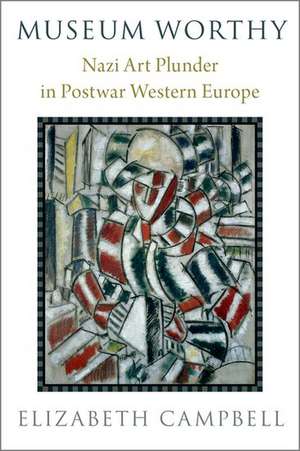
Museum Worthy: Nazi Art Plunder in Postwar Western Europe
Autor Elizabeth Campbellen Limba Engleză Hardback – 28 aug 2024
Preț: 185.56 lei
Preț vechi: 218.15 lei
-15%
Puncte Express: 278
Carte disponibilă
Livrare economică 22-28 octombrie
Livrare express 03-09 octombrie pentru 70.04 lei
Livrare prin curier în România Termenul estimat este afișat lângă disponibilitate.
Transport gratuit de la 400.00 lei Plată online sau ramburs, în funcție de opțiunile comenzii.
Retur gratuit în 14 zile Comandă securizată și suport în română.
Specificații
ISBN-13: 9780190051983
ISBN-10: 0190051981
Pagini: 360
Ilustrații: 32 b&w photographs
Dimensiuni: 165 x 229 x 43 mm
Greutate: 0.64 kg
Editura: Oxford University Press
Colecția OUP USA
Locul publicării:New York, United States
ISBN-10: 0190051981
Pagini: 360
Ilustrații: 32 b&w photographs
Dimensiuni: 165 x 229 x 43 mm
Greutate: 0.64 kg
Editura: Oxford University Press
Colecția OUP USA
Locul publicării:New York, United States
V-ar putea interesa
-
 -16%Preț: 184.10 lei217.95 lei
 -
 Stealing RembrandtsAnthony M. AmorePreț: 114.57 lei
 -
 -17%Preț: 78.83 lei94.78 lei
 -
 Witnessing the Robbing of the JewsSarah GensburgerPreț: 217.26 lei
 -
 Afterlives: Recovering the Lost Stories of Looted ArtDarsie AlexanderPreț: 305.54 lei
 -
 Goering's Man in Paris: The Story of a Nazi Art Plunderer and His WorldJonathan PetropoulosPreț: 116.15 lei
 -
 Saltzman, C: PlunderCynthia SaltzmanPreț: 226.22 lei
 -
 Napoleon's Plunder and the Theft of Veronese's FeastCynthia Saltzman-19%Preț: 75.18 lei92.59 lei
 -
 The Rape of EuropaLynn H. NicholasPreț: 122.40 lei
 -
 Preț: 206.46 lei
 -
 The Picasso HeistJames PattersonPreț: 142.22 lei
 -
 -17%Preț: 77.80 lei93.99 leiRecomandat
 -
 -34%Preț: 135.18 lei206.37 lei
 -
 Belonging and Betrayal: How Jews Made the Art World ModernCharles DellheimPreț: 277.56 lei
 -
 Perignon, P: The Vanished CollectionPauline Baer de PerignonPreț: 157.26 lei
 -
 Plunder?: How Museums Got Their TreasuresJustin M. JacobsPreț: 77.56 lei
 -
 RestitutionAlexander HermanPreț: 161.25 lei
 -
 Towards the Ethical Art MuseumGareth HarrisPreț: 161.52 lei
 -
 Preț: 392.44 lei
 -
 Preț: 214.86 lei
Recenzii
“Elizabeth Campbell examines the way in which American and European historians have explained the pillage of artworks by the Nazis and how this research has encouraged European museums and public institutions to look at their collections in a new ethical light. Her research examines the various ways in which public collections are seeking just and fair solutions by doing detailed provenance research. Campbell's far-ranging new book not only builds upon Lynn Nicholas's groundbreaking work, The Rape of Europa, but enlarges its scope.” - Emmanuelle Polack, art historian
“A thought-provoking monograph on the transnational history of looted art in the Holocaust. Elizabeth Campbell argues that the main West European museums left the work of restitution intentionally unfinished, in order to enrich their collections. In its comparative approach between France, Belgium and the Netherlands, this book explains why the restitution process of looted art is still ongoing today.” -Jean-Marc Dreyfus, author of The Goering Catalogue
“In Museum Worthy, Elizabeth Campbell offers a sweeping history of the unprecedented art restitution efforts emerging from the Nazi era: from the early Allied campaign of 'Monuments Men'
Museum Worthy is a worthwhile read. This book offers a useful and important perspective on restitution history. The mishandling of restitution in these three nations has had implications for the state of restitution today, which Campbell clearly hints at. A contemporary comparative study of the fallout of this lack of museum ethics in the modern-day realm of restitution would be most welcome. Art historians, historians, and legal experts should find this to be a useful read.
The book is richly illustrated, both in terms of images of looted items and through individual stories of loss and recovery. The reader is introduced to the voices of victims, restitution advocates, museum directors, and politicians through Campbell's extensive archival research in multiple countries as well as through memoirs and interviews. [Museum Worthy] contributes to a growing body of scholarship related to restitution and reparations that engages with the enormous, ongoing, and transnational impact of the Holocaust.
“A thought-provoking monograph on the transnational history of looted art in the Holocaust. Elizabeth Campbell argues that the main West European museums left the work of restitution intentionally unfinished, in order to enrich their collections. In its comparative approach between France, Belgium and the Netherlands, this book explains why the restitution process of looted art is still ongoing today.” -Jean-Marc Dreyfus, author of The Goering Catalogue
“In Museum Worthy, Elizabeth Campbell offers a sweeping history of the unprecedented art restitution efforts emerging from the Nazi era: from the early Allied campaign of 'Monuments Men'
Museum Worthy is a worthwhile read. This book offers a useful and important perspective on restitution history. The mishandling of restitution in these three nations has had implications for the state of restitution today, which Campbell clearly hints at. A contemporary comparative study of the fallout of this lack of museum ethics in the modern-day realm of restitution would be most welcome. Art historians, historians, and legal experts should find this to be a useful read.
The book is richly illustrated, both in terms of images of looted items and through individual stories of loss and recovery. The reader is introduced to the voices of victims, restitution advocates, museum directors, and politicians through Campbell's extensive archival research in multiple countries as well as through memoirs and interviews. [Museum Worthy] contributes to a growing body of scholarship related to restitution and reparations that engages with the enormous, ongoing, and transnational impact of the Holocaust.
Notă biografică
Elizabeth Campbell is Professor of History and Director of the Center for Art Collection Ethics at the University of Denver. She is the author of Defending National Treasures: French Art and Heritage under Vichy.
Cuprins
- Introduction: Nazi Plunder and National Patrimony
- 1. Nazi Art Plunder in Western Europe
- 2. Allied Victory and Art Recovery
- 3. Negotiating Cultural Restitution
- 4. Recovered Art as French Patrimony
- 5. National Heritage in the Netherlands
- 6. Restoring Belgian Artistic Heritage
- 7. Contested Patrimony since 1955
- Conclusion: A New Era of Museum Ethics
- Notes
- Bibliography
- Index