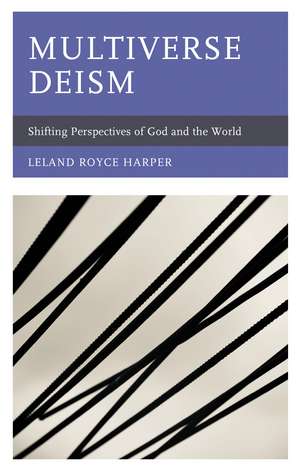
Multiverse Deism
Autor Leland Harperen Limba Engleză Hardback – 28 mai 2020
Preț: 464.90 lei
Preț vechi: 534.37 lei
-13%
Puncte Express: 697
Carte disponibilă
Livrare economică 04-18 noiembrie
Livrare express 20-24 octombrie pentru 30.95 lei
Livrare prin curier în România Termenul estimat este afișat lângă disponibilitate.
Transport gratuit pentru acest produs Plată online sau ramburs, în funcție de opțiunile comenzii.
Retur gratuit în 14 zile Comandă securizată și suport în română.
Specificații
ISBN-13: 9781793614759
ISBN-10: 179361475X
Pagini: 150
Dimensiuni: 157 x 235 x 13 mm
Greutate: 0.38 kg
Editura: Bloomsbury Publishing
Locul publicării:New York, United States
ISBN-10: 179361475X
Pagini: 150
Dimensiuni: 157 x 235 x 13 mm
Greutate: 0.38 kg
Editura: Bloomsbury Publishing
Locul publicării:New York, United States
Cuprins
Contents
Acknowledgments
Chapter 1Introduction
Chapter 2The Case for the Multiverse
Chapter 3The Theist and the Multiverse
Chapter 4Attributes of a Deistic God
Chapter 5Why Being a Deist May Not Be So Bad
Chapter 6Possible Alternative Version of Deism
Chapter 7Potential Difficulties and Further Lines of Inquiry for the Multiverse Deist
Chapter 8Practical Considerations and Concluding Thoughts
References
About the Author
Acknowledgments
Chapter 1Introduction
Chapter 2The Case for the Multiverse
Chapter 3The Theist and the Multiverse
Chapter 4Attributes of a Deistic God
Chapter 5Why Being a Deist May Not Be So Bad
Chapter 6Possible Alternative Version of Deism
Chapter 7Potential Difficulties and Further Lines of Inquiry for the Multiverse Deist
Chapter 8Practical Considerations and Concluding Thoughts
References
About the Author
Recenzii
In this trailblazing book, Leland Harper contributes to the growing body of literature on alternative concepts of God by engaging with cutting-edge research on the multiverse. Harper offers a thought-provoking survey of the various models of the multiverse that have been proposed and considers the most persuasive scientific and philosophical arguments in their favor. He also develops what is perhaps the definitive contemporary account of the deistic conception of God. Given the broad scope of this work, it will likely be of interest to a wide range of readers; most especially professional scholars and students working in the fields of philosophy of cosmology, philosophy of religion, and religious studies.. Harper's book makes a welcome and substantial contribution to the growing body of literature surrounding alternative concepts of God. Hopefully, it will inspire further research into the theistic implications of the multiverse and more treatments of deism in the future.
This book fits very well into the discussion of science and theology/religion and opens up interesting debates.
Deism is a fascinating, though neglected, alternative to traditional theism. In Multiverse Deism: Shifting Perspectives of God and the World, Leland Harper revives this view in a novel way by considering the metaphysical implications of cutting-edge research on the multiverse. I highly recommend this book to students and scholars in science, religion, and philosophy.
Wouldn't divine goodness create immensely many universes? Harper provides an impressively
wide-ranging discussion of this question and of how it might influence our concept of God.
In Multiverse Deism, Leland Royce Harper makes a significant contribution to the growing body of work on alternatives to classical theism. He develops and explores the implications of a deistic metaphysics of the divine, making a strong case for taking such an alternative seriously. Anyone working on the metaphysics of the divine-especially those interested in alternatives to classical theism-should read this book.
Harper explores and clarifies the various logical and conceptual connections that hold between deism and free will, the divine attributes, natural theology, the problem of evil, the problem of divine hiddenness, and divine action. This is an engaging and clearly written book, one that belongs on the bookshelf of anyone who is interested in the interface between contemporary cosmology, the philosophy of religion, and philosophical theology. I highly recommend it.
This book fits very well into the discussion of science and theology/religion and opens up interesting debates.
Deism is a fascinating, though neglected, alternative to traditional theism. In Multiverse Deism: Shifting Perspectives of God and the World, Leland Harper revives this view in a novel way by considering the metaphysical implications of cutting-edge research on the multiverse. I highly recommend this book to students and scholars in science, religion, and philosophy.
Wouldn't divine goodness create immensely many universes? Harper provides an impressively
wide-ranging discussion of this question and of how it might influence our concept of God.
In Multiverse Deism, Leland Royce Harper makes a significant contribution to the growing body of work on alternatives to classical theism. He develops and explores the implications of a deistic metaphysics of the divine, making a strong case for taking such an alternative seriously. Anyone working on the metaphysics of the divine-especially those interested in alternatives to classical theism-should read this book.
Harper explores and clarifies the various logical and conceptual connections that hold between deism and free will, the divine attributes, natural theology, the problem of evil, the problem of divine hiddenness, and divine action. This is an engaging and clearly written book, one that belongs on the bookshelf of anyone who is interested in the interface between contemporary cosmology, the philosophy of religion, and philosophical theology. I highly recommend it.