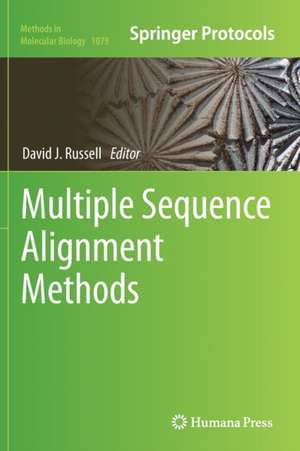
Multiple Sequence Alignment Methods
Editat de David J. Russellen Limba Engleză Paperback – 23 aug 2016
Authoritative and practical, Multiple Sequence Alignment Methods provides a readily available resource which will allow practitioners to experiment with different algorithms and find the particular algorithm that is of most use in their application.
Preț: 668.49 lei
Preț vechi: 786.46 lei
-15%
Puncte Express: 1003
Carte tipărită la comandă
Livrare economică 25 noiembrie-09 decembrie
Livrare prin curier în România Termenul estimat este afișat lângă disponibilitate.
Transport gratuit pentru acest produs Plată online sau ramburs, în funcție de opțiunile comenzii.
Retur gratuit în 14 zile Comandă securizată și suport în română.
Specificații
ISBN-13: 9781493960477
ISBN-10: 1493960474
Pagini: 300
Ilustrații: XII, 287 p. 63 illus., 47 illus. in color.
Dimensiuni: 178 x 254 x 17 mm
Greutate: 0.57 kg
Ediția:Softcover reprint of the original 1st edition 2014
Editura: Humana
Locul publicării:Totowa, NJ, United States
ISBN-10: 1493960474
Pagini: 300
Ilustrații: XII, 287 p. 63 illus., 47 illus. in color.
Dimensiuni: 178 x 254 x 17 mm
Greutate: 0.57 kg
Ediția:Softcover reprint of the original 1st edition 2014
Editura: Humana
Locul publicării:Totowa, NJ, United States
V-ar putea interesa
-
 Evolution: From Molecules to EcosystemsAndres Moya-33%Preț: 525.12 lei783.54 lei
 -
 Molecular Machines in BiologyJoachim Frank-14%Preț: 746.82 lei868.40 lei
 -
 Fluorescent Analogs of Biomolecular Building BlocksMarcus Wilhelmsson-9%Preț: 1103.81 lei1212.97 lei
 -
 The Manga Guide to Molecular BiologyMasaharu Takemura-19%Preț: 126.25 lei156.42 lei
Cuprins
Dynamic Programming.- Heuristic Alignment Methods.- Objective Functions.- An Appraisal of Benchmarks for Multiple Sequence Alignment.- BLAST and FASTA Similarity Searching for Multiple Sequence Alignment.- Clustal Omega, Accurate Alignment of Very Large Numbers of Sequences.- T-COFFEE: Tree-Based Consistency Objective Function for Alignment Evaluation.- MAFFT: Iterative Refinement and Additional Methods.- Multiple Sequence Alignment Using Probcons and Probalign.- Phylogeny-Aware Alignment with PRANK.- GramAlign: Fast Alignment Driven by Grammar-Based Phylogeny.- Multiple Sequence Alignment with DIALIGN.- PicXAA: A Probabilistic Scheme for Finding the Maximum Expected Accuracy Alignment of Multiple Biological Sequences.- Multiple Protein Sequence Alignment with MSAProbs.- Large-Scale Multiple Sequence Alignment and Tree Estimation Using SATé.- PRALINE: A Versatile Multiple Sequence Alignment Toolkit.- PROMALS3D: Multiple Protein Sequence Alignment Enhanced with Evolutionary and 3-Dimensional Structural Information.- MSACompro: Improving Multiple Protein Sequence Alignment by Predicted Structural Features.
Textul de pe ultima copertă
From basic performing of sequence alignment through a proficiency at understanding how most industry-standard alignment algorithms achieve their results, Multiple Sequence Alignment Methods describes numerous algorithms and their nuances in chapters written by the experts who developed these algorithms. The various multiple sequence alignment algorithms presented in this handbook give a flavor of the broad range of choices available for multiple sequence alignment generation, and their diversity is a clear reflection of the complexity of the multiple sequence alignment problem and the amount of information that can be obtained from multiple sequence alignments. Each of these chapters not only describes the algorithm it covers but also presents instructions and tips on using their implementation, as is fitting with its inclusion in the highly successful Methods in Molecular Biology series.
Authoritative and practical, Multiple Sequence Alignment Methods provides a readily available resource which will allow practitioners to experiment with different algorithms and find the particular algorithm that is of most use in their application.
Authoritative and practical, Multiple Sequence Alignment Methods provides a readily available resource which will allow practitioners to experiment with different algorithms and find the particular algorithm that is of most use in their application.
Caracteristici
Presents a broad range of choices available for multiple sequence alignment generation Focuses on practical aspects of algorithm usage Contains key notes and implementation advice from the experts