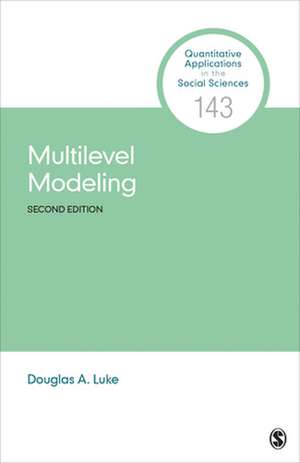
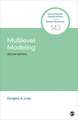
Multilevel Modeling: Quantitative Applications in the Social Sciences, cartea 143
Autor Douglas A. Lukeen Limba Engleză Electronic book text – 26 dec 2019
Din seria Quantitative Applications in the Social Sciences
-
 Preț: 372.54 lei
 -
 Preț: 372.29 lei
 -
 Preț: 366.50 lei
 -
 Preț: 371.20 lei
 -
 Preț: 367.72 lei
 -
 Preț: 371.46 lei
 -
 Preț: 371.49 lei
 -
 Preț: 367.51 lei
 -
 Preț: 319.49 lei
 -
 Preț: 371.16 lei
 -
 Preț: 371.23 lei
 -
 Preț: 309.69 lei
 -
 Preț: 372.47 lei
 -
 Preț: 337.87 lei
 -
 Preț: 339.66 lei
 -
 Preț: 341.40 lei
 -
 Preț: 371.04 lei
 -
 Preț: 371.34 lei
 -
 Preț: 341.19 lei
 -
 Preț: 365.98 lei
 -
 Preț: 341.82 lei
 -
 Preț: 372.23 lei
 -
 Preț: 341.51 lei
 -
 Preț: 343.11 lei
 -
 Preț: 371.04 lei
 -
 Preț: 371.28 lei
 -
 Preț: 370.45 lei
 -
 Preț: 370.45 lei
 -
 Preț: 366.87 lei
 -
 Preț: 341.16 lei
 -
 Preț: 335.55 lei
 -
 Preț: 371.64 lei
 -
 Preț: 341.36 lei
 -
 Preț: 371.69 lei
 -
 Preț: 370.98 lei
 -
 Preț: 341.36 lei
 -
 Preț: 341.46 lei
 -
 Preț: 341.36 lei
 -
 Preț: 175.73 lei
 -
 Preț: 366.67 lei
 - nou
 Preț: 114.20 lei
 - nou
 Preț: 114.20 lei
 - nou
 Preț: 114.20 lei
 - nou
 Preț: 114.20 lei
 - nou
 Preț: 114.20 lei
 -
 Preț: 114.20 lei
 -
 Preț: 175.73 lei
 - nou
 Preț: 114.20 lei
 - nou
 Preț: 114.20 lei
Preț: 175.73 lei
Puncte Express: 264
Preț estimativ în valută:
28.48€ • 32.74$ • 24.73£
28.48€ • 32.74$ • 24.73£
Indisponibil temporar
Doresc să fiu notificat când acest titlu va fi disponibil:
Se trimite...
Specificații
ISBN-13: 9781544310312
ISBN-10: 1544310315
Pagini: 128
Dimensiuni: 140 x 216 mm
Ediția:Second Edition
Editura: SAGE Publications
Colecția Sage Publications, Inc
Seria Quantitative Applications in the Social Sciences
Locul publicării:Thousand Oaks, United States
ISBN-10: 1544310315
Pagini: 128
Dimensiuni: 140 x 216 mm
Ediția:Second Edition
Editura: SAGE Publications
Colecția Sage Publications, Inc
Seria Quantitative Applications in the Social Sciences
Locul publicării:Thousand Oaks, United States
Recenzii
With
growing
statistical
software
package
costs,
more
researchers
are
using
R
than
ever
before.
This
book
allows
researchers
to
do
more
when
using
R.
The book offers insights and explanations from which both newcomers and seasoned experts can find benefit.
Because of the author’s pedagogically masterful presentation of multi-level modeling, the otherwise challenging journey to this topic now becomes not only smooth but also enjoyable.
This is a very well-written and organized book. The author uses practical examples to help the readers understand the reasoning and steps of a complex statistical approach. I have used the first edition of this book in my class, and definitely plan on using the second edition too. This is a book that I would highly recommend to clinical researchers who are interested in learning multilevel modeling.
Multilevel Modeling provides a thorough and accessible introduction to multilevel models. Through extensive examples, the author expertly guides the reader through the material addressing interpretation, graphical presentation, and diagnostics along the way.
The new second edition is even better than the first. The models presented are closely linked to an extended example that students can readily identify with.
The book offers insights and explanations from which both newcomers and seasoned experts can find benefit.
Because of the author’s pedagogically masterful presentation of multi-level modeling, the otherwise challenging journey to this topic now becomes not only smooth but also enjoyable.
This is a very well-written and organized book. The author uses practical examples to help the readers understand the reasoning and steps of a complex statistical approach. I have used the first edition of this book in my class, and definitely plan on using the second edition too. This is a book that I would highly recommend to clinical researchers who are interested in learning multilevel modeling.
Multilevel Modeling provides a thorough and accessible introduction to multilevel models. Through extensive examples, the author expertly guides the reader through the material addressing interpretation, graphical presentation, and diagnostics along the way.
The new second edition is even better than the first. The models presented are closely linked to an extended example that students can readily identify with.
Cuprins
Series
Editor's
Introduction
About the Author
Preface
1. The Need for Multilevel Modeling
Background and Rationale
Theoretical Reasons for Multilevel Models
Statistical Reasons for Multilevel Models
Scope of Book
Online Book Resources
2. Planning a Multilevel Model
The Basic Two-Level Multilevel Model
The Importance of Random Effects
Classifying Multilevel Models
3. Building a Multilevel Model
Introduction to Tobacco Voting Data Set
Assessing the Need for a Multilevel Model
Model-building Strategies
Estimation
Level-2 Predictors and Cross-Level Interactions
Hypothesis Testing
4. Assessing a Multilevel Model
Assessing Model Fit and Performance
Estimating Posterior Means
Centering
Power Analysis
5. Extending the Basic Model
The Flexibility of the Mixed-Effects Model
Generalized Models
Three-level Models
Cross-classified Models
6. Longitudinal Models
Longitudinal Data as Hierarchical: Time Nested Within Person
Intra-individual Change
Inter-individual Change
Alternative Covariance Structures
7.Guidance
Recommendations for Presenting Results
Useful Resources
References
About the Author
Preface
1. The Need for Multilevel Modeling
Background and Rationale
Theoretical Reasons for Multilevel Models
Statistical Reasons for Multilevel Models
Scope of Book
Online Book Resources
2. Planning a Multilevel Model
The Basic Two-Level Multilevel Model
The Importance of Random Effects
Classifying Multilevel Models
3. Building a Multilevel Model
Introduction to Tobacco Voting Data Set
Assessing the Need for a Multilevel Model
Model-building Strategies
Estimation
Level-2 Predictors and Cross-Level Interactions
Hypothesis Testing
4. Assessing a Multilevel Model
Assessing Model Fit and Performance
Estimating Posterior Means
Centering
Power Analysis
5. Extending the Basic Model
The Flexibility of the Mixed-Effects Model
Generalized Models
Three-level Models
Cross-classified Models
6. Longitudinal Models
Longitudinal Data as Hierarchical: Time Nested Within Person
Intra-individual Change
Inter-individual Change
Alternative Covariance Structures
7.Guidance
Recommendations for Presenting Results
Useful Resources
References
Descriere
Multilevel
Modelingis
a
concise,
practical
guide
to
building
models
for
multilevel
and
longitudinal
data.
Author
Douglas
A.
Luke
begins
by
providing
a
rationale
for
multilevel
models;
outlines
the
basic
approach
to
estimating
and
evaluating
a
two-level
model;
discusses
the
major
extensions
to
mixed-effects
models;
and
provides
advice
for
where
to
go
for
instruction
in
more
advanced
techniques.
Rich
with
examples,
theSecond
Editionexpands
coverage
of
longitudinal
methods,
diagnostic
procedures,
models
of
counts
(Poisson),
power
analysis,
cross-classified
models,
and
adds
a
new
section
added
on
presenting
modeling
results.
A
website
for
the
book
includes
the
data
and
the
statistical
code
(both
R
and
Stata)
used
for
all
of
the
presented
analyses.