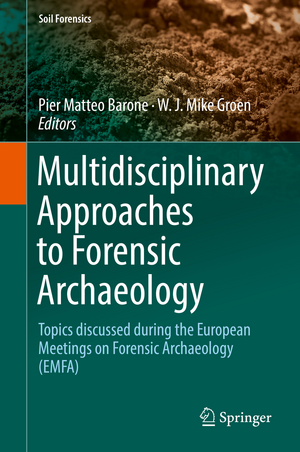
Multidisciplinary Approaches to Forensic Archaeology: Topics discussed during the European Meetings on Forensic Archaeology (EMFA): Soil Forensics
Editat de Pier Matteo Barone, W. J. Mike Groenen Limba Engleză Hardback – 3 noi 2018
Recomandăm acest volum ca referință profesională și resursă pentru nivelul de master sau doctorat, fiind o sinteză riguroasă a celor mai recente direcții de cercetare discutate în cadrul reuniunilor europene de arheologie judiciară (EMFA). Observăm că Multidisciplinary Approaches to Forensic Archaeology nu se limitează la prezentarea unor metode de excavare, ci analizează modul în care sistemele juridice diverse din Europa influențează practica investigativă de teren.
Structura volumului reflectă o progresie logică de la tehnologia de detectare la analiza post-recuperare. Prima parte este dedicată tehnicilor non-distructive, explorând utilizarea teledetecției, a analizei geospațiale și a geofizicii în locații complexe, precum mlaștinile de turbă sau mediile de apă dulce. A doua parte se concentrează pe intersecția dintre arheologie și antropologia judiciară, abordând teme precum tafonomia experimentală și scanarea 3D pentru validarea urmelor. Cititorii familiarizați cu Forensic Archaeology de Kimberlee Sue Moran vor aprecia aici accentul pus pe cooperarea transfrontalieră și pe integrarea specifică a forțelor de ordine în procesul științific.
Suntem de părere că editorii Pier Matteo Barone și W. J. Mike Groen reușesc să poziționeze lucrarea ca o continuare firească a cercetărilor anterioare. În timp ce Geoscientists at Crime Scenes se concentra pe specificul italian și pe „geo-crime”, acest nou titlu din seria Soil Forensics extinde perspectiva la nivel continental. Volumul demonstrează că arheologia judiciară a evoluat de la o ramură a arheologiei convenționale la o disciplină autonomă, esențială pentru rezolvarea cazurilor de persoane dispărute și investigarea scenelor de crimă complexe.

Preț: 1072.09 lei
Preț vechi: 1307.42 lei
-18%
Carte disponibilă
Livrare economică 14-28 mai
Specificații
ISBN-10: 3319943960
Pagini: 276
Ilustrații: XII, 279 p. 104 illus., 73 illus. in color.
Dimensiuni: 155 x 235 mm
Greutate: 0.64 kg
Ediția:1st ed. 2018
Editura: Springer International Publishing
Colecția Springer
Seria Soil Forensics
Locul publicării:Cham, Switzerland
V-ar putea interesa
-
 DNA Computing ModelsZoya Ignatova-18%Preț: 912.09 lei1112.30 lei
 -
 -15%Preț: 625.57 lei735.96 lei
 -
 -18%Preț: 914.52 lei1115.26 lei
 -
 Environmental Microbiology Research TrendsLaura B Ivanova-30%Preț: 1152.90 lei1648.56 lei
 -
 Geoscientists at Crime ScenesRosa Maria Di Maggio-18%Preț: 757.97 lei924.35 lei
 -
 Bioinformatics Research and ApplicationsIon MandoiuPreț: 398.42 lei
 -
 Systems Biology and Computational ProteomicsTrey IdekerPreț: 366.90 lei
 -
 Preț: 373.98 lei
 -
 Pattern Recognition in BioinformaticsMadhu ChettyPreț: 387.72 lei
 -
 Computational Methods in Systems BiologyMonika HeinerPreț: 383.38 lei
 -
 Transactions on Computational Systems Biology IXCorrado PriamiPreț: 368.12 lei
 -
 Mathematical Morphology and Its Application to Signal and Image ProcessingMichael H. F. WilkinsonPreț: 378.40 lei
 -
 Pattern Recognition in BioinformaticsVisakan KadirkamanathanPreț: 386.25 lei
 -
 Comparative GenomicsFrancesca D. CiccarelliPreț: 373.36 lei
 -
 Preț: 345.78 lei
 -
 Preț: 378.58 lei
 -
 Evolution in the Dark: Darwin's Loss Without SelectionHorst Wilkens-18%Preț: 911.49 lei1111.57 lei
 -
 Darwinisch denkenVolker SommerPreț: 160.83 lei
 -
 Introductory MicrobiologyD. Balachandar-8%Preț: 432.12 lei469.70 lei
 -
 Microbial BiotechnologyRatul Saikia-9%Preț: 710.49 lei780.75 lei
 -
 Illustrated Dictionary of MicrobiologySunil Patel-9%Preț: 906.86 lei996.55 lei
De ce să citești această carte
Această lucrare este esențială pentru experții criminaliști și arheologii care doresc să înțeleagă standardele europene de investigație. Cititorul câștigă acces la studii de caz recente și la metodologii avansate de scanare 3D și geofizică aplicată. Este un instrument indispensabil pentru cei care activează în intersecția dintre știință și justiție, oferind soluții practice pentru localizarea și recuperarea rămășițelor umane în contexte dificile.
Despre autor
Pier Matteo Barone este un expert recunoscut în geofizică și arheologie judiciară, fiind implicat activ în adaptarea tehnicilor de teledetecție pentru investigațiile criminalistice. W. J. Mike Groen colaborează frecvent cu instituții de medicină legală și forțe de ordine, având o experiență vastă în antropologie judiciară. Ambii editori au contribuit semnificativ la consolidarea comunității europene de profil prin organizarea întâlnirilor EMFA. Lucrările lor anterioare, axate pe dovezi antropologice ale crimelor din trecut și pe geofizica aplicată, subliniază angajamentul lor pentru o abordare multidisciplinară a științelor forensice.
Cuprins
Notă biografică
His research is centered on different remote sensing applications to better understand the archaeological landscape. He is also a recognized expert in forensic archaeology employed to testify in criminal and civil cases. He was a co-investigator in a three-year research project (FIRB 2012) with the geological institute of CNR (IGAG) investigating marble quarries of the Greco-Roman world in Turkey.
Finally, he has authored over a hundred of publications on these topics, he has presented several papers in national and international conferences, he has appeared on national public/private radio, TV, and magazines, and heis co-editor and reviewer of several international peer-reviewed journals.
WJ MIKE GROEN: Mike Groen is a forensic archaeologist employed by the Netherlands Forensic Institute (NFI) and a staff member at the Leiden University, Faculty of Archaeology. His past academic and professional experience relates to GIS modelling, field archaeology, human taphonomy and physical anthropology. He is responsible for the introduction of forensic archaeology in the Netherlands in 2005 and for the creation of the Forensic Archaeology group within the European Network of Forensic Science Institutes (ENFSI) in 2013. Since 2014 he chairs the Dutch Association of Physical Anthropologists (NVFA). His current research interest include forensic archaeology, GIS predictive modelling forensic taphonomy and scene of crime science.