
Multidimensional Item Response Theory: Statistics for Social and Behavioral Sciences
Autor M D Reckaseen Limba Engleză Hardback – 15 iul 2009
The text is appropriate for an advanced course in psychometric theory or as a reference work for those interested in applying MIRT methodology. A working knowledge of unidimensional item response theory and matrix algebra is assumed. Knowledge of factor analysis is also helpful.
Din seria Statistics for Social and Behavioral Sciences
- 18%
 Preț: 761.65 lei
 - 15%
 Preț: 563.78 lei
 - 18%
 Preț: 780.17 lei
 -
 Preț: 378.21 lei
 - 15%
 Preț: 623.22 lei
 - 18%
 Preț: 869.03 lei
 - 18%
 Preț: 861.90 lei
 - 15%
 Preț: 624.95 lei
 - 18%
 Preț: 856.45 lei
 - 18%
 Preț: 902.36 lei
 -
 Preț: 382.85 lei
 - 23%
 Preț: 853.18 lei
 -
 Preț: 375.65 lei
 - 18%
 Preț: 775.62 lei
 - 18%
 Preț: 915.29 lei
 - 18%
 Preț: 1082.72 lei
 - 18%
 Preț: 966.08 lei
 - 18%
 Preț: 1172.48 lei
 - 18%
 Preț: 862.81 lei
 - 15%
 Preț: 624.46 lei
 - 18%
 Preț: 702.67 lei
 - 15%
 Preț: 565.69 lei
 -
 Preț: 366.76 lei
 - 15%
 Preț: 619.45 lei
 - 15%
 Preț: 613.80 lei
 - 18%
 Preț: 1180.66 lei
 -
 Preț: 372.15 lei
 - 15%
 Preț: 615.05 lei
 -
 Preț: 366.56 lei
 - 18%
 Preț: 1333.07 lei
 -
 Preț: 370.62 lei
 - 15%
 Preț: 675.70 lei
 -
 Preț: 368.79 lei
 - 18%
 Preț: 1180.66 lei
 -
 Preț: 407.34 lei
Preț: 1178.07 lei
Preț vechi: 1436.66 lei
-18% Nou
Puncte Express: 1767
Preț estimativ în valută:
208.47€ • 244.45$ • 183.08£
208.47€ • 244.45$ • 183.08£
Carte tipărită la comandă
Livrare economică 13-27 februarie
Preluare comenzi: 021 569.72.76
Specificații
ISBN-13: 9780387899756
ISBN-10: 0387899758
Pagini: 354
Ilustrații: X, 354 p.
Dimensiuni: 167 x 241 x 30 mm
Greutate: 0.68 kg
Ediția:2009 edition
Editura: Springer
Seria Statistics for Social and Behavioral Sciences
Locul publicării:New York, NY, United States
ISBN-10: 0387899758
Pagini: 354
Ilustrații: X, 354 p.
Dimensiuni: 167 x 241 x 30 mm
Greutate: 0.68 kg
Ediția:2009 edition
Editura: Springer
Seria Statistics for Social and Behavioral Sciences
Locul publicării:New York, NY, United States
Public țintă
ResearchCuprins
Unidimensional Item Response Theory Models.- Historical Background for Multidimensional Item Response Theory (MIRT).- Multidimensional Item Response Theory Models.- Statistical Descriptions of Item and Test Functioning.- Estimation of Item and Person Parameters.- Analyzing the Structure of Test Data.- Transforming Parameter Estimates to a Specified Coordinate System.- Linking and Scaling.- Computerized Adaptive Testing Using MIRT.
Recenzii
From the reviews:
“This book is the result of the author’s many years of work in multidimensional item response theory (MIRT) work that builds on the foundations laid by item response theory (IRT) and factor analysis pioneers. … In summary this book seeks to present a complex topic in a readable fashion … . helpful to many IRT researchers especially to young researchers who will further develop theory and apply MIRT in their research–not only in psychology but in other areas of science.” (Fumiko Samfjima, Journal of the American Statistical Association, Vol. 106 (493), March, 2011)
“This book gives a comprehensive review of theories and applications in various aspects of Multidimensional Item Response Theory (MIRT). … Every chapter is self-contained and starts with well-explained background information. … In all, this book is an inspiring book in measurement and, more importantly, there is no other comparable text on the topic. … this book will remain a key resource (handbook and textbook) for many years to come, and we highly recommend the book to teachers, students and researchers who are interested in IRT.” (Hua-Hua Chang and Chun Wang, Psychometrika, Vol. 76 (3), July, 2011)
“This book is the result of the author’s many years of work in multidimensional item response theory (MIRT) work that builds on the foundations laid by item response theory (IRT) and factor analysis pioneers. … In summary this book seeks to present a complex topic in a readable fashion … . helpful to many IRT researchers especially to young researchers who will further develop theory and apply MIRT in their research–not only in psychology but in other areas of science.” (Fumiko Samfjima, Journal of the American Statistical Association, Vol. 106 (493), March, 2011)
“This book gives a comprehensive review of theories and applications in various aspects of Multidimensional Item Response Theory (MIRT). … Every chapter is self-contained and starts with well-explained background information. … In all, this book is an inspiring book in measurement and, more importantly, there is no other comparable text on the topic. … this book will remain a key resource (handbook and textbook) for many years to come, and we highly recommend the book to teachers, students and researchers who are interested in IRT.” (Hua-Hua Chang and Chun Wang, Psychometrika, Vol. 76 (3), July, 2011)
Textul de pe ultima copertă
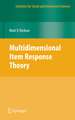
Multidimensional Item Response Theory is the first book to give thorough coverage to this emerging area of psychometrics. The book describes the commonly used multidimensional item response theory (MIRT) models and the important methods needed for their practical application. These methods include ways to determine the number of dimensions required to adequately model data, procedures for estimating model parameters, ways to define the space for a MIRT model, and procedures for transforming calibrations from different samples to put them in the same space. A full chapter is devoted to methods for multidimensional computerized adaptive testing.
The text is appropriate for an advanced course in psychometric theory or as a reference work for those interested in applying MIRT methodology. A working knowledge of unidimensional item response theory and matrix algebra is assumed. Knowledge of factor analysis is also helpful.
Mark D. Reckase is a professor of Measurement and Quantitative Methods in the College of Education at Michigan State University. He has been president of the National Council of Measurement in Education, Vice President of Division D of the American Educational Research Association, on the Board of Trustees of the Psychometric Society, and the editor of Applied Psychological Measurement and the Journal of Educational Measurement. He has been doing research in the area of MIRT since 1972.
The text is appropriate for an advanced course in psychometric theory or as a reference work for those interested in applying MIRT methodology. A working knowledge of unidimensional item response theory and matrix algebra is assumed. Knowledge of factor analysis is also helpful.
Mark D. Reckase is a professor of Measurement and Quantitative Methods in the College of Education at Michigan State University. He has been president of the National Council of Measurement in Education, Vice President of Division D of the American Educational Research Association, on the Board of Trustees of the Psychometric Society, and the editor of Applied Psychological Measurement and the Journal of Educational Measurement. He has been doing research in the area of MIRT since 1972.